Comparison

Aardwolf vs Spotted Hyena

Aardwolf (Proteles cristata) and Spotted Hyena (Crocuta crocuta) both belong to the family Hyaenidae (hyenas) and part ways below it. Both are recorded in 9 countries.
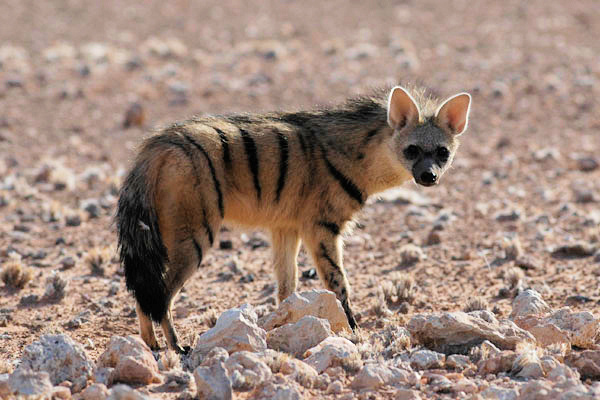
Aardwolf

Aardwolf

Proteles cristata

by Dkaeuferle = Dominik Käuferle, CC BY-SA 3.0, via Wikimedia Commons

Spotted Hyena

Spotted Hyena

Crocuta crocuta

Diego Delso, CC BY-SA 4.0, via Wikimedia Commons

Side by side

AardwolfSpotted Hyena
Scientific nameProteles cristata (Sparrman, 1783)Crocuta crocuta (Erxleben, 1777)
English nameAardwolfSpotted Hyena
GroupMammalsMammals
ClassMammalia MammalMammalia Mammal
OrderCarnivora CarnivoresCarnivora Carnivores
FamilyHyaenidae HyenasHyaenidae Hyenas
GenusProteles AardwolfCrocuta Spotted Hyena
Named in17831777
Red List categoryLeast ConcernLeast Concern
Countries on record9 countries32 countries
GBIF occurrence records1,004 records11,108 records

Rows where the two agree are shown in grey.

Where each is found

Both recorded in 9 countries

Only Spotted Hyena (23)

From Catalogue of Life checklists and GBIF occurrence records. A country missing from a list means no record is held, which is not proof of absence.

Checked facts

AardwolfSpotted Hyena
Appearance
  • The spotted hyaena has a sandy, yellowish or gray coat marked with black or dark brown spots. animaldiversity.org
  • The spots on the coat are darkest in young animals and may be nearly absent in very old individuals. animaldiversity.org
  • The spotted hyaena has coarse, woolly fur. animaldiversity.org
  • The species has a strongly built body, a massive neck, a large head and rounded ears. animaldiversity.org
  • Its front legs are longer than its hind legs, producing a downward slope along its back. animaldiversity.org
Size
Habitat
  • The species inhabits dry, open savannas and grasslands receiving less than 80 cm of average annual rainfall. animaldiversity.org
  • The species avoids deserts and heavily wooded areas. animaldiversity.org
  • Wet woodlands completely separate the northeastern and southern populations. animaldiversity.org
  • The species inhabits semi-deserts, savannahs, acacia bush and mountainous forests. animaldiversity.org
  • Spotted hyaenas become less common as forest habitats become denser. animaldiversity.org
  • The species does not inhabit the coastal tropical rainforests of western or central Africa. animaldiversity.org
  • In western Africa, the species prefers Guinea and Sudan savannah habitats. animaldiversity.org
  • Spotted hyaenas inhabit the arid, resource-limited environment of the south Namib Desert. pmc.ncbi.nlm.nih.gov
Diet
  • The species feeds exclusively on termites belonging to the Trinervitermes and Hodotermes groups. animaldiversity.org
  • Consumption of Trinervitermes and Hodotermes varies according to their seasonal abundance and activity. animaldiversity.org
  • Trinervitermes termites are active only during warmer months. animaldiversity.org
  • Hodotermes termites remain active into cooler months. animaldiversity.org
  • The species consumes termites by licking them from surfaces with a flat, sticky tongue. animaldiversity.org
  • An individual may consume up to 300,000 termites in one night. animaldiversity.org
  • The species requires very little drinking water because termites provide much of its fluid intake. animaldiversity.org
  • Spotted hyaenas are opportunistic predators whose diets can include prey ranging from ostrich eggs to large ungulates. pmc.ncbi.nlm.nih.gov
  • The species can hunt prey several times its own body weight. pmc.ncbi.nlm.nih.gov
  • Spotted hyaenas adjust their diets according to the prey most available in their environment. pmc.ncbi.nlm.nih.gov
  • In the south Namib Desert study, gemsbok, springbok, ostrich and greater kudu were recorded as local large herbivorous prey species. pmc.ncbi.nlm.nih.gov
  • The south Namib Desert study found no large herbivorous prey species that spotted hyaenas selected beyond its environmental availability. pmc.ncbi.nlm.nih.gov
Behaviour
  • Spotted hyaenas live in matrilineal clans in which females dominate males. animaldiversity.org
  • Juvenile males leave their natal clans after puberty and join other clans. animaldiversity.org
  • Female spotted hyaenas maintain stable linear dominance hierarchies. animaldiversity.org
  • An individual's position in the female dominance hierarchy is inherited from its mother. animaldiversity.org
  • Spotted hyaenas use communal dens, but communal care of young is generally absent. animaldiversity.org
Reproduction
DistributionNo checked fact yet
  • The species is native to sub-Saharan Africa. English Wikipedia
  • Confirmed records since 1970 include Tanzania, Kenya, Zambia, Zimbabwe, Mozambique, South Africa, Botswana, Namibia, Congo, Sudan, Central African Republic, Cameroon, Nigeria, Burkina Faso, Ivory Coast, Mali, Senegal and Sierra Leone. animaldiversity.org
  • Spotted hyaenas have been recorded at elevations of up to 4,000 metres in eastern Africa and Ethiopia. animaldiversity.org
  • The species was formerly distributed across Eurasia until the end of the Pleistocene. animaldiversity.org
  • High population densities occur in Tanzania's Serengeti and especially the Ngorongoro Crater. animaldiversity.org
Conservation
  • The spotted hyaena is classified as Least Concern by the IUCN. English Wikipedia
  • The estimated global population is between 27,000 and 47,000 individuals. English Wikipedia
  • Populations outside protected areas are declining due to habitat loss and poaching. English Wikipedia
Similar speciesNo checked fact yet
OtherNo checked fact yet
  • The spotted hyaena is the largest living member of the family Hyaenidae. English Wikipedia

In brief

Aardwolf

The Aardwolf feeds exclusively on termites belonging to the Trinervitermes and Hodotermes groups. Full profile

Spotted Hyena

Crocuta crocuta is native to sub-Saharan Africa and inhabits semi-deserts, savannahs, acacia bush and mountainous forests. It has a sandy, yellowish or gray coat with dark spots and is the largest living member of the family Hyaenidae. Full profile

Compare something else

Page built on 29 November 2026 from the data on the two species pages, where every source is listed.

Cite this page

ScientificNames.org. (2026). Aardwolf vs Spotted Hyena. Retrieved November 29, 2026, from https://scientificnames.org/compare/aardwolf-vs-spotted-hyena