Comparison
Baja California Bird’s-foot Trefoil vs Common Deerweed
Baja California Bird’s-foot Trefoil (Acmispon niveus) and Common Deerweed (Acmispon glaber) both belong to the genus Acmispon (deer-vetch) and part ways below it. Both are recorded in 2 countries.
Baja California Bird’s-foot Trefoil
Acmispon niveus
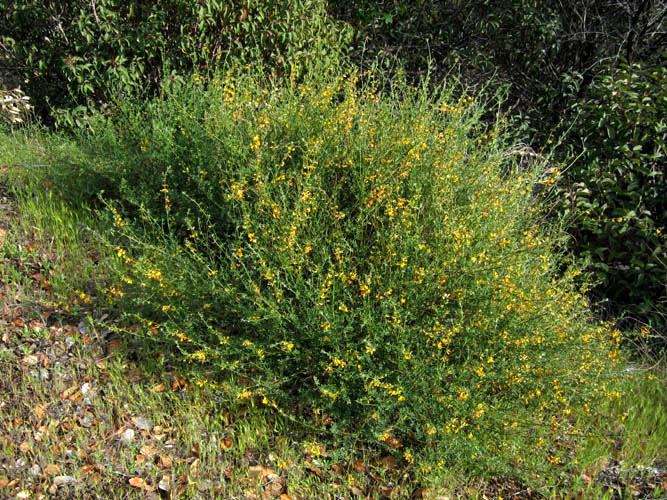

Side by side
| Baja California Bird’s-foot Trefoil | Common Deerweed | |
|---|---|---|
| Scientific name | Acmispon niveus (S.Watson) Brouillet | Acmispon glaber (Vogel) Brouillet |
| English name | Baja California Bird’s-foot Trefoil | Common Deerweed |
| Group | Flowering plants | Flowering plants |
| Class | Magnoliopsida | Magnoliopsida |
| Order | Fabales | Fabales |
| Family | Fabaceae Bean | Fabaceae Bean |
| Genus | Acmispon Deer-vetch | Acmispon Deer-vetch |
| Countries on record | 2 countries | 2 countries |
| GBIF occurrence records | 393 records | 22,756 records |
Rows where the two agree are shown in grey.
Where each is found
Both recorded in 2 countries
From Catalogue of Life checklists and GBIF occurrence records. A country missing from a list means no record is held, which is not proof of absence.
Checked facts
| Baja California Bird’s-foot Trefoil | Common Deerweed | |
|---|---|---|
| Appearance | No checked fact yet |
|
| Habitat | No checked fact yet |
|
| Diet | No checked fact yet |
|
| Behaviour | No checked fact yet |
|
| Reproduction | No checked fact yet |
|
| Uses | No checked fact yet |
|
In brief
Common Deerweed
Common deerweed is a perennial subshrub belonging to the Fabaceae family. It grows in dry environments, including chaparral, coastal sandy areas, and roadsides at elevations below 1,500 metres. It has yellow flowers that turn reddish as they age and curved fruits containing two seeds. Full profile
Compare something else
Page built on 26 November 2026 from the data on the two species pages, where every source is listed.
Cite this page
ScientificNames.org. (2026). Baja California Bird’s-foot Trefoil vs Common Deerweed. Retrieved November 26, 2026, from https://scientificnames.org/compare/baja-california-bird-s-foot-trefoil-vs-common-deerweed
“Baja California Bird’s-foot Trefoil vs Common Deerweed.” ScientificNames.org, 2026, scientificnames.org/compare/baja-california-bird-s-foot-trefoil-vs-common-deerweed. Accessed 26 Nov. 2026.
ScientificNames.org. “Baja California Bird’s-foot Trefoil vs Common Deerweed.” Accessed November 26, 2026. https://scientificnames.org/compare/baja-california-bird-s-foot-trefoil-vs-common-deerweed.
@misc{scientificnames_baja_california_birds_foot_trefoil_vs_common_deerweed,
  author = {{ScientificNames.org}},
  title = {Baja California Bird’s-foot Trefoil vs Common Deerweed},
  year = {2026},
  url = {https://scientificnames.org/compare/baja-california-bird-s-foot-trefoil-vs-common-deerweed},
  note = {Accessed 2026-11-26}
}