Comparison
New Mexico Bird's-foot Trefoil vs Common Deerweed
New Mexico Bird's-foot Trefoil (Acmispon oroboides) and Common Deerweed (Acmispon glaber) both belong to the genus Acmispon (deer-vetch) and part ways below it. Both are recorded in 2 countries.
New Mexico Bird's-foot Trefoil
Acmispon oroboides
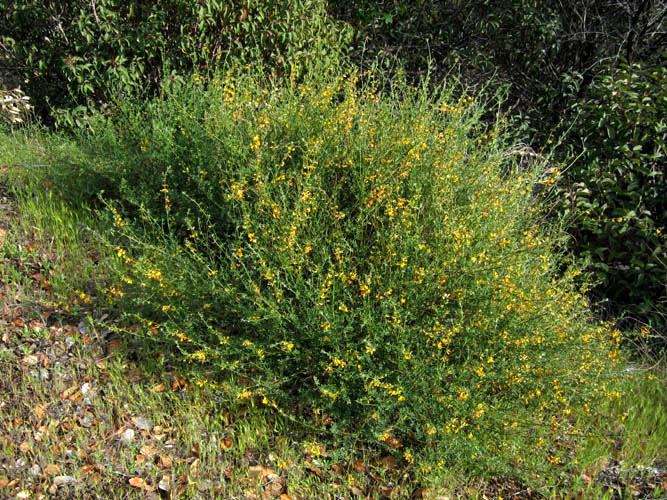

Side by side
| New Mexico Bird's-foot Trefoil | Common Deerweed | |
|---|---|---|
| Scientific name | Acmispon oroboides (Kunth) Brouillet | Acmispon glaber (Vogel) Brouillet |
| English name | New Mexico Bird's-foot Trefoil | Common Deerweed |
| Group | Flowering plants | Flowering plants |
| Class | Magnoliopsida | Magnoliopsida |
| Order | Fabales | Fabales |
| Family | Fabaceae Bean | Fabaceae Bean |
| Genus | Acmispon Deer-vetch | Acmispon Deer-vetch |
| Countries on record | 2 countries | 2 countries |
| GBIF occurrence records | 1,415 records | 22,756 records |
Rows where the two agree are shown in grey.
Where each is found
Both recorded in 2 countries
From Catalogue of Life checklists and GBIF occurrence records. A country missing from a list means no record is held, which is not proof of absence.
Checked facts
| New Mexico Bird's-foot Trefoil | Common Deerweed | |
|---|---|---|
| Appearance |
|
|
| Habitat |
|
|
| Diet | No checked fact yet |
|
| Behaviour | No checked fact yet |
|
| Reproduction |
|
|
| Distribution |
| No checked fact yet |
| Uses | No checked fact yet |
|
In brief
New Mexico Bird's-foot Trefoil
New Mexico bird's-foot trefoil is a small perennial legume with multiple stems that grow close to the ground. The species occurs in the southwestern United States and northern Mexico. Its flowers have yellow petals and red backsides. Full profile
Common Deerweed
Common deerweed is a perennial subshrub belonging to the Fabaceae family. It grows in dry environments, including chaparral, coastal sandy areas, and roadsides at elevations below 1,500 metres. It has yellow flowers that turn reddish as they age and curved fruits containing two seeds. Full profile
Compare something else
Page built on 27 November 2026 from the data on the two species pages, where every source is listed.
Cite this page
ScientificNames.org. (2026). New Mexico Bird's-foot Trefoil vs Common Deerweed. Retrieved November 27, 2026, from https://scientificnames.org/compare/new-mexico-birds-foot-trefoil-vs-common-deerweed
“New Mexico Bird's-foot Trefoil vs Common Deerweed.” ScientificNames.org, 2026, scientificnames.org/compare/new-mexico-birds-foot-trefoil-vs-common-deerweed. Accessed 27 Nov. 2026.
ScientificNames.org. “New Mexico Bird's-foot Trefoil vs Common Deerweed.” Accessed November 27, 2026. https://scientificnames.org/compare/new-mexico-birds-foot-trefoil-vs-common-deerweed.
@misc{scientificnames_new_mexico_birds_foot_trefoil_vs_common_deerweed,
  author = {{ScientificNames.org}},
  title = {New Mexico Bird's-foot Trefoil vs Common Deerweed},
  year = {2026},
  url = {https://scientificnames.org/compare/new-mexico-birds-foot-trefoil-vs-common-deerweed},
  note = {Accessed 2026-11-27}
}