Comparison
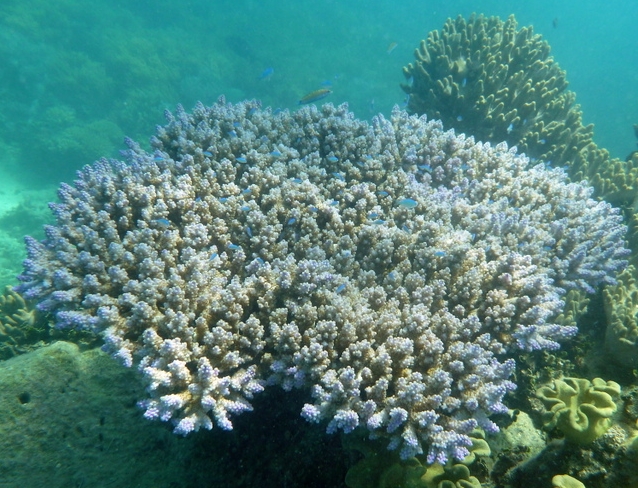
Bushy Staghorn Coral vs Staghorn Coral
Bushy Staghorn Coral (Acropora valida) and Staghorn Coral (Acropora cervicornis) both belong to the genus Acropora (horn corals) and part ways below it.


Staghorn Coral
Acropora cervicornis
Joeschmitty at English Wikipedia, CC BY 2.5, via Wikimedia Commons

Side by side
| Bushy Staghorn Coral | Staghorn Coral | |
|---|---|---|
| Scientific name | Acropora valida (Dana, 1846) | Acropora cervicornis (Lamarck, 1816) |
| English name | Bushy Staghorn Coral | Staghorn Coral |
| Group | Other invertebrates | Other invertebrates |
| Class | Anthozoa | Anthozoa |
| Order | Scleractinia | Scleractinia |
| Family | Acroporidae Stony Corals | Acroporidae Stony Corals |
| Genus | Acropora Horn Corals | Acropora Horn Corals |
| Named in | 1846 | 1816 |
| Red List category | Least Concern | Critically Endangered |
| Environment | marine | marine |
| Countries on record | 36 countries | 32 countries |
| GBIF occurrence records | 3,818 records | 3,937 records |
Rows where the two agree are shown in grey.
Where each is found
Only Bushy Staghorn Coral (36)
- American Samoa
- Australia
- British Indian Ocean Territory
- Brunei
- Cook Islands
- Fiji
- French Polynesia
- Guam
- India
- Indonesia
- Iran
- Japan
- Kiribati
- Malaysia
- Maldives
- Marshall Islands
- Micronesia
- New Caledonia
- Niue
- Northern Mariana Islands
- Oman
- Palau
- Papua New Guinea
- Philippines
- Pitcairn
- Samoa
- Saudi Arabia
- Singapore
- Solomon Islands
- Sri Lanka
- Taiwan
- Thailand
- Tonga
- United States Minor Outlying Islands
- Wallis and Futuna
- Yemen
Only Staghorn Coral (32)
- Anguilla
- Antigua and Barbuda
- Bahamas
- Barbados
- Belize
- Bonaire, Saint Eustatius and Saba
- British Virgin Islands
- Cayman Islands
- Colombia
- Costa Rica
- Cuba
- Curacao
- Dominican Republic
- Guadeloupe
- Haiti
- Honduras
- Jamaica
- Martinique
- Mexico
- Nicaragua
- Panama
- Puerto Rico
- Saint Barthelemy
- Saint Kitts and Nevis
- Saint Martin
- Saint Vincent and the Grenadines
- Sint Maarten
- Trinidad and Tobago
- Turks and Caicos Islands
- U.S. Virgin Islands
- United States
- Venezuela
From Catalogue of Life checklists and GBIF occurrence records. A country missing from a list means no record is held, which is not proof of absence.
Checked facts
| Bushy Staghorn Coral | Staghorn Coral | |
|---|---|---|
| Appearance |
|
|
| Size |
| No checked fact yet |
| Habitat |
|
|
| Behaviour | No checked fact yet |
|
| Reproduction | No checked fact yet |
|
| Distribution |
|
|
| Conservation |
|
|
| Uses | No checked fact yet |
|
| Similar species |
| No checked fact yet |
In brief
Bushy Staghorn Coral
Bushy staghorn coral (Acropora valida) is an invertebrate in the family Acroporidae, order Scleractinia, and class Anthozoa. It inhabits tropical shallow reefs at depths ranging from 1 to 15 metres. It has small axial corallites and appressed radial corallites of various sizes. Full profile
Staghorn Coral
Staghorn Coral (Acropora cervicornis) is an invertebrate that forms thick, upright branches resembling a stag's antlers. It occurs throughout the Western Atlantic, including the Florida Keys, the Bahamas, and Caribbean islands. Its colonies can form dense, interlocking groups called thickets. Full profile
Compare something else
Page built on 29 November 2026 from the data on the two species pages, where every source is listed.
Cite this page
ScientificNames.org. (2026). Bushy Staghorn Coral vs Staghorn Coral. Retrieved November 29, 2026, from https://scientificnames.org/compare/bushy-staghorn-coral-vs-staghorn-coral
“Bushy Staghorn Coral vs Staghorn Coral.” ScientificNames.org, 2026, scientificnames.org/compare/bushy-staghorn-coral-vs-staghorn-coral. Accessed 29 Nov. 2026.
ScientificNames.org. “Bushy Staghorn Coral vs Staghorn Coral.” Accessed November 29, 2026. https://scientificnames.org/compare/bushy-staghorn-coral-vs-staghorn-coral.
@misc{scientificnames_bushy_staghorn_coral_vs_staghorn_coral,
  author = {{ScientificNames.org}},
  title = {Bushy Staghorn Coral vs Staghorn Coral},
  year = {2026},
  url = {https://scientificnames.org/compare/bushy-staghorn-coral-vs-staghorn-coral},
  note = {Accessed 2026-11-29}
}