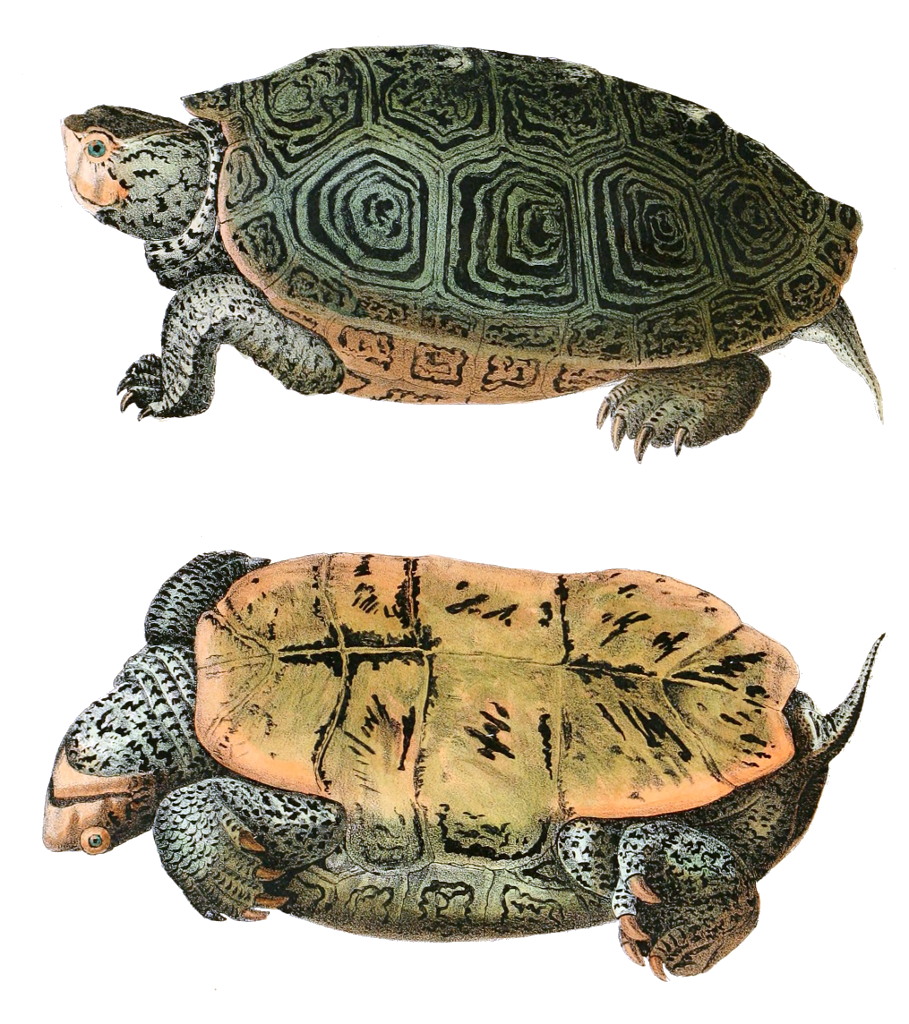
| Appearance | - The dorsal coloration is generally dark brown or dull olive, with darker reticulations or streaking sometimes present. English Wikipedia
- The plastron is yellowish and may have dark blotches in the centers of its scutes. English Wikipedia
- The carapace is low and broad, usually widest behind its midpoint. English Wikipedia
- Adult males have a light or pale yellow throat. English Wikipedia
- Adult carapaces are smooth and lack a keel or serrations. English Wikipedia
- Juveniles have lighter coloration and more prominent shell markings than adults. wdfw.wa.gov
- The turtle's coloration becomes darker with age. wdfw.wa.gov
| - The species has a diamond-shaped pattern on the upper surface of its shell, although its overall coloration and pattern vary considerably. English Wikipedia
- Its carapace is generally wider at the rear than at the front and has a longitudinal central ridge. English Wikipedia
- Its carapace ranges from brown to grey, while its plastron is lighter in coloration. English Wikipedia
- Its body coloration can be grey, brown, yellow, or white. English Wikipedia
- Almost all individuals have distinctive irregular black markings or spots on their heads and bodies. English Wikipedia
- The species has large webbed feet. English Wikipedia
|
|---|
| Size | - Straight carapace length ranges from 11 to 21 cm. English Wikipedia
- Adult carapace length ranges from 3.5 to 7.5 inches in Washington populations. wdfw.wa.gov
- Individuals can weigh 2.2 pounds or more. wdfw.wa.gov
| |
|---|
| Habitat | - Individuals also bask on top of aquatic vegetation. English Wikipedia
- In Washington, the species inhabits ponds and lakes rather than other types of water bodies. wdfw.wa.gov
- Washington populations use sunny upland habitats including Puget Sound prairies, Columbia Gorge oak-pine savanna, open forests, and pasture. wdfw.wa.gov
- The turtles nest in grasslands and open woodland surrounding ponds. wdfw.wa.gov
- Individuals can spend more than 200 days outside water. English Wikipedia
- Overwintering sites may be located 500 meters from the main water body. English Wikipedia
| - The species inhabits brackish coastal tidal marshes. English Wikipedia
- In most of its range, the species inhabits Spartina marshes that flood during high tides. English Wikipedia
- In Florida, the species also inhabits mangrove swamps. English Wikipedia
- South Florida diamondback terrapins use subtropical mangrove creek and island habitats in Everglades National Park. pubs.usgs.gov
- The species can tolerate freshwater and full-strength ocean water, although adults prefer intermediate salinities. English Wikipedia
- The species is exclusively estuarine. pubs.usgs.gov
|
|---|
| Diet | - The species is omnivorous and consumes insects, crayfish, and other aquatic invertebrates. English Wikipedia
- Its animal diet occasionally includes fish, tadpoles, and frogs. English Wikipedia
- The species consumes carrion when it is available. English Wikipedia
- Plant foods include filamentous algae, lily pads, tule, and cattail roots. English Wikipedia
- Juveniles primarily consume insects and carrion. English Wikipedia
- Individuals begin consuming plant matter at approximately three years of age. English Wikipedia
| - The species feeds on fish, crustaceans, marine worms, snails, clams, barnacles, mussels, other mollusks, insects, and carrion. English Wikipedia
- The species sometimes consumes small quantities of plant material, including algae. English Wikipedia
- Gastropods, crabs, and bivalves are the dominant food categories of diamondback terrapins in South Florida mangrove habitats. pubs.usgs.gov
- Food sources in South Florida terrapins differ more according to habitat than to body size class. pubs.usgs.gov
- Decapod crustacean remains occurred in all 13 fecal samples examined from the Florida East Coast subspecies. digitalcommons.fau.edu
- Decapod crustaceans accounted for 96.3% of the fecal mass in the examined Florida East Coast terrapins. digitalcommons.fau.edu
- The examined Florida East Coast terrapins also consumed small quantities of vegetation, bivalves, gastropods, and insects. digitalcommons.fau.edu
|
|---|
| Behaviour | - Individuals aggregate on emergent logs and boulders to bask. English Wikipedia
- The species leaves aquatic habitats to disperse, nest, overwinter, and aestivate during drought. wdfw.wa.gov
- Washington populations generally become active in late March or early April when water temperatures permit basking. wdfw.wa.gov
- Adult activity in Washington generally continues until late September or October. wdfw.wa.gov
| - The species is a strong swimmer. English Wikipedia
- The species can remain in full-strength salt water for extended periods. English Wikipedia
- Terrapins can obtain freshwater by drinking the surface layer that accumulates over salt water after rainfall. English Wikipedia
- Terrapins can raise their heads and open their mouths to catch falling raindrops. English Wikipedia
- Individuals tend to remain in the same areas for most or all of their lives rather than undertaking long-distance migrations. English Wikipedia
- The species generally hibernates during colder months in the mud of creeks and marshes. English Wikipedia
|
|---|
| Reproduction | | - Adults mate in early spring. English Wikipedia
- Females lay clutches containing 4–22 eggs in sand dunes during early summer. English Wikipedia
- Eggs generally hatch 60–85 days after being laid, depending on incubation temperature and nest depth. English Wikipedia
- Females can produce up to three egg clutches annually in the wild. English Wikipedia
- Females can produce up to five egg clutches annually in captivity. English Wikipedia
- Female terrapins can mate with multiple males and retain sperm for years. English Wikipedia
- The sex of hatchlings depends on incubation temperature. English Wikipedia
- Male terrapins generally reach sexual maturity at 2–3 years of age. English Wikipedia
- Female terrapins generally reach sexual maturity at 6–7 years, while northern populations may take 8–10 years. English Wikipedia
|
|---|
| Lifespan | | No checked fact yet |
|---|
| Distribution | No checked fact yet | - The species occurs along the Atlantic and Gulf coasts of the United States, from Cape Cod to Texas. English Wikipedia
- The species also has a naturally established population in Bermuda. English Wikipedia
|
|---|
| Conservation | - The western pond turtle is listed as vulnerable by the IUCN Red List and NatureServe according to document 1. English Wikipedia
- The northwestern pond turtle is classified as endangered in Washington. wdfw.wa.gov
- Historical population declines resulted partly from commercial exploitation for food, habitat alteration and loss, and introduced predators. wdfw.wa.gov
- Introduced red-eared sliders compete with western pond turtles. English Wikipedia
- Non-native bullfrog predation on hatchlings and mammalian predation on nests impede natural recruitment at many sites. wdfw.wa.gov
| - The IUCN classifies the species as Vulnerable because its population numbers are decreasing across most of its range. English Wikipedia
- The species is listed as endangered in Rhode Island. English Wikipedia
- The species is listed as threatened in Massachusetts. English Wikipedia
- Crab traps cause substantial mortality among diamondback terrapins along the New Jersey coast. English Wikipedia
- Coastal development has destroyed or altered more than 75% of the salt marshes historically inhabited by the species. English Wikipedia
- Rising ocean levels threaten the remaining salt marsh habitat. English Wikipedia
|
|---|
| Uses | - Indigenous peoples and American settlers historically used the species as food. English Wikipedia
| - Diamondback terrapins were historically consumed as a delicacy in the early twentieth century. English Wikipedia
|
|---|