Comparison

Two-spot Ladybird vs Seven-spot Ladybird

Two-spot Ladybird (Adalia bipunctata) and Seven-spot Ladybird (Coccinella septempunctata) both belong to the tribe Coccinellini and part ways below it. Both are recorded in 42 countries.
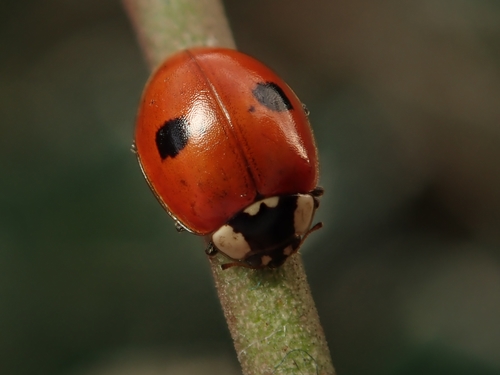
Two-spot Ladybird

Two-spot Ladybird

Adalia bipunctata

(c) Alexis Tinker-Tsavalas, some rights reserved (CC BY), uploaded by Alexis Tinker-Tsavalas, CC BY 4.0, via iNaturalist

Seven-spot Ladybird

Seven-spot Ladybird

Coccinella septempunctata

Unknown author, CC BY-SA 3.0, via Wikimedia Commons

Side by side

Two-spot LadybirdSeven-spot Ladybird
Scientific nameAdalia bipunctata (Linnaeus, 1758)Coccinella septempunctata Linnaeus, 1758
English nameTwo-spot LadybirdSeven-spot Ladybird
GroupInsectsInsects
ClassInsecta InsectInsecta Insect
OrderColeoptera BeetleColeoptera Beetle
FamilyCoccinellidae Ladybird BeetlesCoccinellidae Ladybird Beetles
GenusAdaliaCoccinella
Named in17581758
Environmentterrestrialterrestrial
Countries on record44 countries90 countries
GBIF occurrence records134,129 records744,260 records

Rows where the two agree are shown in grey.

Where each is found

Both recorded in 42 countries

Only Two-spot Ladybird (2)

Only Seven-spot Ladybird (48)

From Catalogue of Life checklists and GBIF occurrence records. A country missing from a list means no record is held, which is not proof of absence.

Checked facts

Two-spot LadybirdSeven-spot Ladybird
Appearance
  • Adults typically have orange or reddish wing covers with two black spots and a black-and-white pronotum. ipm.ucanr.edu
  • Adult beetles have an oblong shape when viewed from above and a convex, dome-shaped profile from the side. ipm.ucanr.edu
  • The species also occurs in forms with predominantly black wing covers bearing four or six red spots. English Wikipedia
  • Some North American individuals have spotless, four-banded, nine-to-twelve-spotted, or cross-hatched coloration patterns. English Wikipedia
  • The adult's head and thorax are black with yellow markings, while its undersides are black to reddish-brown. animaldiversity.org
  • The larvae have elongated, soft bodies that are black with yellow and white spots. animaldiversity.org
  • The eggs are orange to pale yellow and football-shaped. ipm.ucanr.edu
  • The pupae are initially cream-colored or pale and darken to blackish with gray or pale orange markings. ipm.ucanr.edu
  • The adult has an oval, convex body with orange-red wing covers bearing seven black spots. English Wikipedia
  • The underside of the abdomen, pronotum and legs are black. English Wikipedia
  • The adult has two white spots on the pronotum beside the inner edges of its eyes. English Wikipedia
  • Females are slightly broader and heavier than males. English Wikipedia
  • The species' eggs are orange or yellow, spindle-shaped and approximately 1 mm long. English Wikipedia
  • The larvae grow from 1–2 mm after hatching to approximately 8 mm after four instars. English Wikipedia
  • The pupae are approximately 6 mm long and usually range from grey to black. English Wikipedia
Size
  • Adults measure 6.5–7.8 mm in length and approximately 4 mm in width. English Wikipedia
Habitat
  • The species occurs in forests, grasslands, agricultural fields, marshes, suburban parks and gardens. English Wikipedia
  • The species inhabits environments with temperate climates, abundant vegetation and aphid concentrations. English Wikipedia
  • The species has been recorded from sea level to elevations of 1,500 m. English Wikipedia
  • Adults overwinter in sheltered locations including beneath tree bark and boulders, in hedgerows, grasses and leaf litter. English Wikipedia
  • The preferred overwintering habitat includes south-facing areas sheltered by boulders, small tussocks or dense grass hedgerows. animaldiversity.org
Diet
  • The species feeds primarily on aphids but also consumes adelgids and psyllids. ipm.ucanr.edu
  • Adults and larvae consume aphids and other small insects. English Wikipedia
  • The species also feeds on insect eggs and mites. animaldiversity.org
  • The species consumes soft-bodied pests including scale insects and mealybugs. fff.hort.purdue.edu
  • Adult beetles can obtain nourishment from flower nectar and pollen. ipm.ucanr.edu
  • Aphids are the principal food of both adult and larval stages. English Wikipedia
  • The species consumes at least 24 different aphid species. English Wikipedia
  • When aphids are scarce, adults can survive on nectar, pollen, whiteflies and thrips. English Wikipedia
  • Larvae may consume other ladybird larvae when aphids are scarce. English Wikipedia
  • The species feeds on pollen from flowering plants in the Compositae and Umbelliferae families before overwintering. English Wikipedia
  • Adults may consume fungal spores to build energy reserves before winter. English Wikipedia
  • Young larvae pierce and suck the contents of their prey, whereas older larvae and adults chew prey and may consume entire insects. ipm.ucanr.edu
  • The species also consumes soft-bodied insects including leaf beetle larvae, mealybugs, psyllids and whiteflies. ipm.ucanr.edu
Behaviour
  • Adults are active during daylight and dormant at night. English Wikipedia
  • Adults aggregate during hibernation for warmth, protection and potential mating opportunities. English Wikipedia
  • Adults can fly and migrate between plants and locations during the growing season. ipm.ucanr.edu
  • The species uses the chemical compound 2-isopropyl-3-methoxy-pyrazine to attract other individuals to overwintering sites. English Wikipedia
Reproduction
  • Females generally lay eggs in clusters. English Wikipedia
  • Females deposit eggs mostly on the undersides of leaves infested with aphids. ipm.ucanr.edu
  • Females deposit bright yellow eggs near potential food sources for their larvae. animaldiversity.org
  • The species develops through four life stages: egg, larva, pupa, and adult. ipm.ucanr.edu
  • Larvae pass through four instars before pupating. ipm.ucanr.edu
  • Pupation takes place within the skin of the final larval instar attached to plant material. ipm.ucanr.edu
  • Development from egg to reproductive adult takes approximately three weeks in warm temperatures. ipm.ucanr.edu
  • The species produces at least three generations annually. ipm.ucanr.edu
  • The species can produce up to five generations annually. English Wikipedia
  • Females lay approximately 250–500 eggs during their lifetimes. English Wikipedia
  • Females deposit fertilized eggs in clusters of approximately 10–30 on leaves, stems and other vegetation. English Wikipedia
  • Eggs generally hatch approximately four days after being laid, depending on ambient temperature. English Wikipedia
  • The pupal stage lasts approximately eight days. English Wikipedia
  • The complete development period from egg to adult is approximately six weeks. ipm.ucanr.edu
  • Females mate with multiple males, and multiple mating increases egg production and offspring viability. animaldiversity.org
  • The species does not provide parental care to its offspring. animaldiversity.org
DistributionNo checked fact yet
Conservation
  • Populations of this species have declined sharply in many North American states and provinces. English Wikipedia
  • Introduced non-native lady beetles have raised concerns about displacement of native two-spotted lady beetle populations. animaldiversity.org
  • The species' conservation status has not been evaluated and it is absent from the IUCN Red List and CITES databases. English Wikipedia
  • Some European populations are declining in association with the spread of the harlequin ladybird. English Wikipedia
Uses
  • The species is used as a biological control agent against aphids in greenhouses. English Wikipedia
  • The species has been introduced into Australia for biological control. English Wikipedia
  • The species helps reduce populations of aphids that damage agricultural and horticultural crops. animaldiversity.org
  • The species has been introduced to North America as a biological control agent against aphid infestations. English Wikipedia
  • Breeding programs rear the species for release on agricultural land to control aphid populations. English Wikipedia

In brief

Two-spot Ladybird

Adalia bipunctata is found throughout the Holarctic region. Adults typically have orange or reddish wing covers with two black spots and a black-and-white pronotum. Full profile

Seven-spot Ladybird

Coccinella septempunctata occurs in forests, grasslands, agricultural fields, marshes, suburban parks and gardens. Adults have orange-red wing covers bearing seven black spots. Full profile

Compare something else

Page built on 29 November 2026 from the data on the two species pages, where every source is listed.

Cite this page

ScientificNames.org. (2026). Two-spot Ladybird vs Seven-spot Ladybird. Retrieved November 29, 2026, from https://scientificnames.org/compare/two-spot-ladybird-vs-seven-spot-ladybird