Comparison
Afidenta misera vs Mealybug Destroyer
Afidenta misera (Afidenta misera) and Mealybug Destroyer (Cryptolaemus montrouzieri) both belong to the subfamily Coccinellinae and part ways below it.
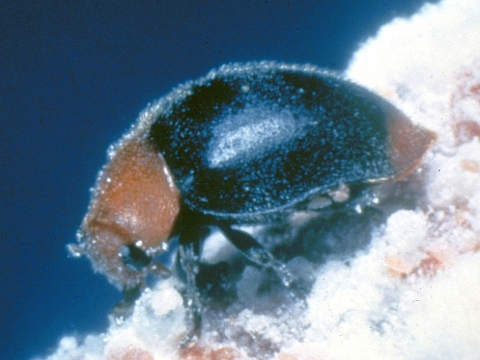
Mealybug Destroyer
Cryptolaemus montrouzieri
Quoted from source:"Image Citation: Jeffrey W. Lotz, Florida Department of Agriculture and Consumer Services, Bugwood.org" "Image Use: You must attribute the work in the manner specified (but not in a, CC BY 3.0 us, via Wikimedia Commons

Side by side
| Afidenta misera | Mealybug Destroyer | |
|---|---|---|
| Scientific name | Afidenta misera (Weise, 1901) | Cryptolaemus montrouzieri Mulsant, 1853 |
| English name | Not recorded | Mealybug Destroyer |
| Group | Insects | Insects |
| Class | Insecta Insect | Insecta Insect |
| Order | Coleoptera Beetle | Coleoptera Beetle |
| Family | Coccinellidae Ladybird Beetles | Coccinellidae Ladybird Beetles |
| Genus | Afidenta | Cryptolaemus |
| Named in | 1901 | 1853 |
| Environment | Not recorded | terrestrial |
| Countries on record | 3 countries | 42 countries |
| GBIF occurrence records | 16 records | 4,520 records |
Rows where the two agree are shown in grey.
Where each is found
Only Afidenta misera (3)
Only Mealybug Destroyer (42)
- Australia
- Austria
- Belgium
- Canada
- Cook Islands
- Costa Rica
- Croatia
- Cyprus
- Denmark
- Dominican Republic
- Finland
- France
- French Polynesia
- Germany
- Greece
- Guadeloupe
- Guam
- Guatemala
- Hungary
- Italy
- Jamaica
- Martinique
- Mexico
- Monaco
- Montenegro
- New Caledonia
- New Zealand
- Norway
- Poland
- Portugal
- Puerto Rico
- Russia
- Saint Barthelemy
- Saint Martin
- Spain
- Sweden
- Switzerland
- The Netherlands
- Trinidad and Tobago
- United Kingdom
- United States
- Wallis and Futuna
From Catalogue of Life checklists and GBIF occurrence records. A country missing from a list means no record is held, which is not proof of absence.
Checked facts
| Afidenta misera | Mealybug Destroyer | |
|---|---|---|
| Appearance |
|
|
| Size | No checked fact yet |
|
| Habitat | No checked fact yet |
|
| Diet |
|
|
| Behaviour |
|
|
| Reproduction |
|
|
| Distribution |
|
|
| Conservation | No checked fact yet |
|
| Uses | No checked fact yet |
|
In brief
Afidenta misera
Afidenta misera is widespread throughout the Oriental region. Full profile
Mealybug Destroyer
The species occurs in citrus groves in coastal California, greenhouses and interiorscapes, and has been introduced into several countries. Adults are dark beetles, while the larvae have long wax filaments that make them resemble mealybugs. Full profile
Compare something else
Page built on 28 November 2026 from the data on the two species pages, where every source is listed.
Cite this page
ScientificNames.org. (2026). Afidenta misera vs Mealybug Destroyer. Retrieved November 28, 2026, from https://scientificnames.org/compare/afidenta-misera-vs-mealybug-destroyer
“Afidenta misera vs Mealybug Destroyer.” ScientificNames.org, 2026, scientificnames.org/compare/afidenta-misera-vs-mealybug-destroyer. Accessed 28 Nov. 2026.
ScientificNames.org. “Afidenta misera vs Mealybug Destroyer.” Accessed November 28, 2026. https://scientificnames.org/compare/afidenta-misera-vs-mealybug-destroyer.
@misc{scientificnames_afidenta_misera_vs_mealybug_destroyer,
  author = {{ScientificNames.org}},
  title = {Afidenta misera vs Mealybug Destroyer},
  year = {2026},
  url = {https://scientificnames.org/compare/afidenta-misera-vs-mealybug-destroyer},
  note = {Accessed 2026-11-28}
}