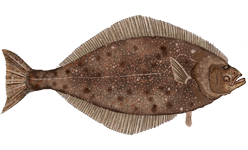
| Appearance | - Alaska plaice have brown coloration on their eyed side and typically pale to bright yellow coloration on their blind side. English Wikipedia
- The eyed side of the head bears five to seven small bony cones. English Wikipedia
- Alaska plaice are right-eye flounders. English Wikipedia
| - The Pacific halibut has a diamond-shaped body that is more elongated than that of most flatfishes. English Wikipedia
- Its body width is approximately one-third of its length. English Wikipedia
- The lateral line arches prominently above the pectoral fin. English Wikipedia
- Its tail is crescent-shaped. English Wikipedia
- Its small scales are embedded in the skin. English Wikipedia
- Both eyes are normally located on the dark upper side of its body. English Wikipedia
- Its upper coloration tends to match the ocean bottom, while its underside is lighter. English Wikipedia
- Its upper surface is generally gray to brown or nearly black, with mottling and numerous spots. adfg.alaska.gov
- Its underside is typically white. adfg.alaska.gov
- The dorsal fin extends continuously from near the eyes to the base of the tail. adfg.alaska.gov
- Its mouth reaches the middle of the lower eye or farther and is nearly symmetrical. adfg.alaska.gov
- Its tail is broad and symmetrical without a distinct fork. adfg.alaska.gov
|
|---|
| Size | No checked fact yet | - Females can exceed 2.4 metres in length and reach approximately 230 kilograms in weight. English Wikipedia
- The maximum reported size exceeds 8 feet in length and 500 pounds in weight. adfg.alaska.gov
- Male Pacific halibut rarely grow longer than three feet. adfg.alaska.gov
- A 20-inch Pacific halibut is predicted to weigh approximately 3 pounds. English Wikipedia
- A 58-inch Pacific halibut is predicted to weigh approximately 100 pounds. English Wikipedia
|
|---|
| Habitat | - Alaska plaice inhabit sandy bottoms of the continental shelf at depths of up to 600 metres. English Wikipedia
| - The species inhabits the continental shelf of the North Pacific Ocean and the Bering Sea. English Wikipedia
- Pacific halibut generally live on or near the seabed. English Wikipedia
- The species prefers water temperatures between 3 and 8 degrees Celsius. English Wikipedia
- Pacific halibut generally inhabit depths of 20 to 1,000 feet, although individuals have been recorded at 3,600 feet. adfg.alaska.gov
- The species occurs over various seabed types. adfg.alaska.gov
- Young halibut settle in shallow nearshore habitats at approximately six months of age. adfg.alaska.gov
|
|---|
| Diet | - Alaska plaice feed primarily on polychaetes, with amphipods and echiurans also included in their diet. English Wikipedia
| - Pacific halibut consume cod, turbot and pollock. English Wikipedia
- Their diet includes octopus, crabs and shrimp. English Wikipedia
- They sometimes leave the seabed to feed on pelagic fishes such as salmon, sand lance and herring. English Wikipedia
- Pacific halibut have also been found with seal remains in their stomachs. English Wikipedia
- During their first year, Pacific halibut larvae and juveniles feed on plankton. adfg.alaska.gov
- Halibut aged one to three years consume euphausiids and small fishes. adfg.alaska.gov
- Larger individuals consume herring, sand lance, capelin, smelt, pollock, sablefish, cod and rockfish. adfg.alaska.gov
- Their diet also includes octopuses, crabs and clams. adfg.alaska.gov
|
|---|
| Behaviour | - Alaska plaice commonly form large schools associated with schools of yellowfin sole. English Wikipedia
| - Pacific halibut are strong swimmers capable of migrating long distances. English Wikipedia
- Halibut of different ages and sizes generally migrate clockwise from northwest to southeast. English Wikipedia
- Mature individuals migrate from shallow summer feeding grounds to deeper winter spawning grounds. English Wikipedia
- Juvenile and some adult halibut generally migrate eastward and southward into the Gulf of Alaska coastal current. adfg.alaska.gov
|
|---|
| Reproduction | No checked fact yet | - Pacific halibut spawning generally occurs between November and March. adfg.alaska.gov
- Spawning takes place at depths of approximately 300 to 1,500 feet. adfg.alaska.gov
- Most male Pacific halibut reach sexual maturity at approximately eight years of age. adfg.alaska.gov
- Approximately half of female Pacific halibut are sexually mature by twelve years of age. adfg.alaska.gov
- Female Pacific halibut can release from a few thousand to several million eggs depending on their size. adfg.alaska.gov
- Egg fertilization occurs externally. adfg.alaska.gov
- Pacific halibut eggs hatch approximately fifteen days after fertilization. adfg.alaska.gov
- Pacific halibut larvae initially have one eye on each side of the head. adfg.alaska.gov
- The left eye migrates to the right side of the head when the larvae reach approximately one inch in length. adfg.alaska.gov
- Pacific halibut larvae drift with ocean currents after hatching and eventually reach shallower coastal waters. adfg.alaska.gov
|
|---|
| Distribution | - The species occurs in the North Pacific Ocean, ranging from the Gulf of Alaska eastward to the Chukchi Sea northward and the Sea of Japan westward. English Wikipedia
| No checked fact yet |
|---|
| Conservation | - FishBase reports a high to very high vulnerability score of 68 out of 100 for this species. fishbase.se
- FishBase characterizes the minimum population doubling time of this species as very low, exceeding 14 years. fishbase.se
| - The eastern Pacific population is managed as a single stock for assessment purposes because of extensive juvenile and adult movements. adfg.alaska.gov
- The United States and Canadian commercial Pacific halibut fishery has received Marine Stewardship Council sustainability certification. adfg.alaska.gov
|
|---|
| Uses | - Alaska plaice are generally harvested as bycatch rather than being directly targeted by commercial fisheries. English Wikipedia
- Commercial trawling bycatch rates of Alaska plaice can become relatively high when the species occurs alongside yellowfin sole. English Wikipedia
- The total allowable catch for Alaska plaice in the Bering Sea and Aleutian Islands management area was reached before the end of May 2005. English Wikipedia
- FishBase reports a protein content of 17.3% for Alaska plaice. fishbase.se
- FishBase reports an omega-3 content of 0.29 grams per 100 grams of Alaska plaice. fishbase.se
| - Pacific halibut are harvested by commercial, recreational and subsistence fisheries. English Wikipedia
- Pacific halibut provide food for several Indigenous groups along the Pacific Coast. English Wikipedia
- Some Pacific Coast Indigenous communities smoke and dry halibut for winter consumption. English Wikipedia
|
|---|
| Similar species | No checked fact yet | - Inexperienced anglers sometimes mistake Pacific halibut for arrowtooth flounder. adfg.alaska.gov
|
|---|