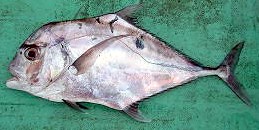
| Appearance | - The African pompano has a deep, laterally compressed body with the head and tail tapering toward their respective ends. English Wikipedia
- The first dorsal fin has four to seven visible spines, followed by one spine and 18 to 20 soft rays in the second dorsal fin. English Wikipedia
- The anal fin has two spines followed by 15 or 16 soft rays. English Wikipedia
- The pectoral fins are long and curved. English Wikipedia
- The body appears scaleless because its minute scales are embedded in the skin. English Wikipedia
- The lateral line has a pronounced dorsal arch and 12 to 30 scutes in its posterior section. English Wikipedia
- Juveniles have trailing dorsal and anal fin filaments that shorten as they mature. English Wikipedia
- The body is silvery-metallic blue to blue-green above and silvery underneath. English Wikipedia
- Juveniles have five chevron-shaped dark body bars and a black blotch near the base of the third to sixth soft dorsal-fin rays. English Wikipedia
- Juvenile fin filaments have dark blue to black bases, while the other fins are pale or translucent. English Wikipedia
- The body elongates as the fish matures. biogeodb.stri.si.edu
- The tail is strongly forked and its base is slender. biogeodb.stri.si.edu
- The species has a small, diffuse dark spot at the upper end of the gill opening. biogeodb.stri.si.edu
| - Juvenile specimens are yellow with black bands. English Wikipedia
- The juvenile colouration fades with age, and adult colouration is established at approximately 30 centimetres in length. English Wikipedia
|
|---|
| Size | - The species is documented to reach at least 130 cm in length. English Wikipedia
- The maximum published weight is 22.9 kg. English Wikipedia
- A maximum length of 150 cm has been reported, although those larger reports are considered unreliable in document 1. English Wikipedia
| - The maximum reported length of the species is approximately 180 centimetres. English Wikipedia
- Large specimens caught near Port Augusta in South Australia have weighed between 40 and 50 kilograms. English Wikipedia
|
|---|
| Habitat | - Adults commonly inhabit coastal waters at depths below 100 m. English Wikipedia
- Adults inhabit reefs and wrecks throughout the water column. English Wikipedia
- Juveniles are pelagic and occur in coastal areas and the open ocean. English Wikipedia
- Adults are described as solitary in coastal seas, while young fish are generally pelagic and drifting. biogeodb.stri.si.edu
- The species occurs in tropical waters with temperatures ranging from 18 to 27 °C. English Wikipedia
| - The species inhabits rocky reefs and nearby sandy areas in coastal waters and occasionally enters estuaries. English Wikipedia
- The species occurs at depths from shallow water to approximately 50 metres, although specimens have been caught below 300 metres. English Wikipedia
- Adults inhabit rocky reefs, rocky outcrops and drop-offs in coastal waters, as well as offshore pinnacles and islands. English Wikipedia
- The species prefers water temperatures between 17 and 24 °C. English Wikipedia
|
|---|
| Diet | - The species feeds predominantly on crustaceans, cephalopods and small fishes. English Wikipedia
- Its recorded prey categories include bony fishes, octopuses, squids, cuttlefishes and mobile benthic crustaceans. biogeodb.stri.si.edu
| - The species is an active predator that usually hunts in schools or pairs. English Wikipedia
- Its recorded diet includes yellowtail mackerel, squid, prawns, garfish, pilchards and kahawai. English Wikipedia
- The species has been recorded eating seabirds in New Zealand waters. English Wikipedia
|
|---|
| Behaviour | - The African pompano is a schooling predatory fish. English Wikipedia
- Juvenile fin filaments resemble jellyfish medusae and may provide protection against predators. English Wikipedia
- Larger fish, including mackerel, tunas and sharks, prey on the species. English Wikipedia
| - The species is highly mobile and pelagic. English Wikipedia
- The species forms schools of its own kind or associates with southern bluefin tuna and silver trevally. English Wikipedia
- Young fish weighing up to 7 kilograms can form shoals containing several hundred individuals. English Wikipedia
- Smaller individuals are generally found close to shore, whereas larger individuals are more common around deep reefs and offshore islands. English Wikipedia
- Juveniles are frequently associated with floating debris or weed far from land, which provides camouflage. English Wikipedia
- Yellowtail amberjacks commonly display curiosity around human vessels. English Wikipedia
- The species often accompanies stingrays in harbours and estuaries. English Wikipedia
|
|---|
| Reproduction | - The reproductive habits and maturation lengths of the species are poorly known. English Wikipedia
- A study in India recorded peak abundance of Alectis ciliaris larvae in April. English Wikipedia
- The eggs are spherical and pelagic, with a yolk and oil globule. English Wikipedia
- Spawning is thought to occur over sandy substrates in Mexico during spring. English Wikipedia
| No checked fact yet |
|---|
| Distribution | - The species occurs throughout tropical oceans and seas worldwide. English Wikipedia
- Its recorded distribution includes the eastern and western coasts of the United States, South America, Africa, the Indian Ocean, Asia, Australia and Pacific islands. English Wikipedia
| - Seriola lalandi occurs in tropical and temperate waters of the Southern Hemisphere and the northern Pacific. English Wikipedia
- In Australia, the species has been recorded from North Reef in Queensland to Trigg Island in Western Australia and south to Tasmania. English Wikipedia
|
|---|
| Conservation | - FishBase assigns the species a high to very high vulnerability score of 69 out of 100. fishbase.se
- FishBase reports a minimum population doubling time of 4.5 to 14 years. fishbase.se
| - FishBase reports a moderate to high vulnerability score of 50 out of 100 for the species. fishbase.se
- FishBase reports a minimum population doubling time of 4.5 to 14 years. fishbase.se
|
|---|
| Uses | - The species is commercially and recreationally fished because of its large size and food quality. English Wikipedia
- The species is marketed fresh, dried or salted. English Wikipedia
- Adults are commonly caught using hook-and-line methods, including trolling. English Wikipedia
- Juveniles are occasionally caught using beach seines. English Wikipedia
- Juveniles are considered potential aquarium fish because of their attractive appearance, although they do not survive well in captivity. English Wikipedia
- The species is highly regarded as a game fish and is considered one of the strongest jacks at larger sizes. English Wikipedia
- The species has been implicated in multiple ciguatera cases. English Wikipedia
| - The species is commercially fished and farmed through aquaculture. English Wikipedia
- The species is popular as sashimi under the name hiramasa. English Wikipedia
- Yellowtail amberjack is a traditional food of Māori in New Zealand, who call it haku. English Wikipedia
- Traditional Māori fishing methods include hooks incorporating iridescent pāua shell and large nets used to capture schools. English Wikipedia
- The species is considered a suitable candidate for marine aquaculture. English Wikipedia
- Juveniles for aquaculture are produced in hatcheries using captive-breeding stock. English Wikipedia
- Cultured specimens are predominantly sold to the Japanese restaurant market for sashimi consumption. English Wikipedia
- The species can be prepared by grilling or drying. English Wikipedia
|
|---|
| Similar species | No checked fact yet | - Seriola aureovittata from the northwest Pacific around Japan is treated as a separate species by some authorities. English Wikipedia
- Seriola dorsalis from the northeastern Pacific is treated as a separate species by some authorities. English Wikipedia
|
|---|
| Other | - The species belongs to the family Carangidae and order Carangiformes. English Wikipedia
| No checked fact yet |
|---|