Comparison

Allobates sumtuosus vs Colombian Niputidea Nurse Frog

Allobates sumtuosus (Allobates sumtuosus) and Colombian Niputidea Nurse Frog (Allobates niputidea) both belong to the genus Allobates (nurse frogs) and part ways below it.
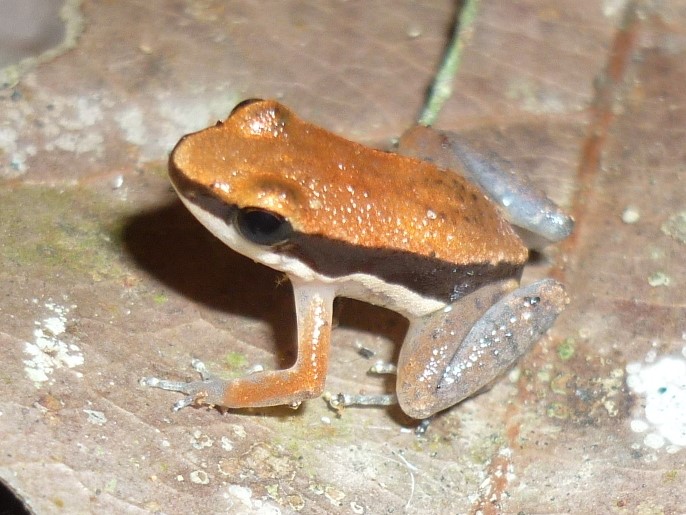
Allobates sumtuosus

Allobates sumtuosus

Pedro Ferreira Bisneto, CC BY 4.0, via Wikimedia Commons

Colombian Niputidea Nurse Frog

Allobates niputidea

Side by side

Allobates sumtuosusColombian Niputidea Nurse Frog
Scientific nameAllobates sumtuosus (Morales, 2002)Allobates niputidea Grant, Acosta-Galvis & Rada, 2007
English nameNot recordedColombian Niputidea Nurse Frog
GroupAmphibiansAmphibians
ClassAmphibia AmphibiansAmphibia Amphibians
OrderAnura FrogsAnura Frogs
FamilyAromobatidae Rocket FrogsAromobatidae Rocket Frogs
GenusAllobates Nurse FrogsAllobates Nurse Frogs
Named in20022007
Red List categoryData DeficientLeast Concern
Countries on record3 countries1 country
GBIF occurrence records362 records200 records

Rows where the two agree are shown in grey.

Where each is found

Only Allobates sumtuosus (3)

Only Colombian Niputidea Nurse Frog (1)

From Catalogue of Life checklists and GBIF occurrence records. A country missing from a list means no record is held, which is not proof of absence.

Checked facts

Allobates sumtuosusColombian Niputidea Nurse Frog
Appearance
  • Its dorsal coloration ranges from solid tan brown to copper. English Wikipedia
  • Some individuals have small, darker brown spots on their dorsal surface. English Wikipedia
  • The flanks are uniformly dark brown. English Wikipedia
  • Some individuals possess a short, pale linear marking extending from the inguinal region toward the body's midsection. English Wikipedia
  • A white iridescent stripe extends along the lower edge of the dark flanks from the snout to the groin, although it is often interrupted. English Wikipedia
  • Pale iridescent mottling occurs below the ventrolateral stripe against an unpigmented background. English Wikipedia
  • The throat, gular and pectoral regions, and abdomen are unpigmented and appear light gray to translucent. English Wikipedia
  • Males have a white to light gray vocal sac that becomes translucent when inflated. English Wikipedia
  • The iris is golden copper with tiny black flecks. English Wikipedia
  • The tympanum is distinct and round. English Wikipedia
  • The discs on all fingers and toes are weakly expanded. English Wikipedia
  • The toes have some basal webbing. English Wikipedia
No checked fact yet
SizeNo checked fact yet
Habitat
  • At the type locality, the species occurs in a mosaic of seasonally flooded igapó forest and unflooded terra-firme primary forest. English Wikipedia
  • In Guyana, the species has been encountered in both primary and secondary forests. English Wikipedia
  • In Guyana, its recorded habitats include well-drained mixed forest on white sand and mixed forest on gravelly clay laterite. English Wikipedia
  • The species inhabits forests in which tree heights do not exceed 20 meters. English Wikipedia
  • The species has been observed within 9 meters of permanent streams in its forest habitat. English Wikipedia
  • The species has been recorded at elevations between 50 and 970 meters above sea level. English Wikipedia
  • The species has been recorded in the Embalse Topocoro private reserve managed by ISAGEN. English Wikipedia
  • The species has been recorded in Pauxi Pauxi ProAves Reserve. English Wikipedia
  • The species has been recorded in Cabildo Verde Reserve. English Wikipedia
Behaviour
  • The species is active during the day. English Wikipedia
  • Males produce two types of advertisement calls. English Wikipedia
  • The first advertisement call consists of regular trills containing 23–35 short notes. English Wikipedia
  • The first advertisement call lasts approximately five seconds. English Wikipedia
  • The first call type is separated from subsequent calls by intervals of approximately 23 seconds. English Wikipedia
  • Notes in the first call type are separated by regular intervals of approximately 0.1 seconds. English Wikipedia
  • The first advertisement call type has an average peak frequency of approximately 6,325 Hz. English Wikipedia
  • The second advertisement call type consists of continuously emitted notes separated by silent intervals of variable duration. English Wikipedia
  • The second advertisement call type has an average peak frequency of approximately 6,200 Hz. English Wikipedia
Reproduction
  • Females lay clutches containing 5–11 eggs in leaf litter. English Wikipedia
  • After hatching, tadpoles are carried on the back of a male parent or, less commonly, a female parent. English Wikipedia
  • Parents deposit transported tadpoles in small temporary pools or moist leaf litter, where development continues. English Wikipedia
  • Tadpoles have occasionally been deposited in the foam nests of Physalaemus sp. and Leptodactylus rhodomystax. English Wikipedia
  • Deposition of tadpoles in other frogs' foam nests appears to help keep them sufficiently moist during dry periods. English Wikipedia
  • Adult males perch on leaf litter while calling to females. English Wikipedia
  • The species reproduces through larval development that includes a free-swimming tadpole stage. English Wikipedia
  • Young individuals have been observed near pools of water. English Wikipedia
Distribution
  • The species is recorded in the Brazilian states of Pará, Amazonas, and Roraima, as well as eastern Peru, central Guyana, and southern Suriname. English Wikipedia
  • The species may also occur in intervening areas and extend into Colombia. English Wikipedia
Conservation
  • The IUCN classifies the species as Least Concern as of 2023. English Wikipedia
  • Logging may threaten the species in some parts of its distribution. English Wikipedia
  • The species' known distribution includes the Rio Trombetas Biological Reserve in Brazil. English Wikipedia
  • The species' known distribution includes at least two protected areas in Peru. English Wikipedia
  • The species' known distribution includes Mabura Hill Forest Reserve in Guyana. English Wikipedia
  • The species' known distribution includes Sipaliwini Nature Reserve in Suriname. English Wikipedia
  • The species does not tolerate habitat disturbance well. English Wikipedia
  • The IUCN classifies the species as least concern. English Wikipedia
  • Habitat conversion for livestock cultivation and agriculture is identified as a threat to the species. English Wikipedia
  • Large cacao plantations are among the agricultural activities identified as habitat threats. English Wikipedia
  • Small subsistence farms growing cacao, avocados, and bananas are mentioned among the agricultural activities affecting the species' habitat. English Wikipedia
  • Traditional agroforestry practices on small farms that avoid agrochemicals are not considered a threat to the species by the cited scientists. English Wikipedia
OtherNo checked fact yet

In brief

Allobates sumtuosus

The species is recorded in Pará, Amazonas, and Roraima in Brazil, eastern Peru, central Guyana, and southern Suriname. It is distinguished by dorsal coloration ranging from tan brown to copper, dark brown flanks, and a white iridescent stripe that is often interrupted. Full profile

Colombian Niputidea Nurse Frog

The Colombian Niputidea Nurse Frog (Allobates niputidea Grant, Acosta-Galvis & Rada, 2007) is an amphibian in the family Aromobatidae, order Anura, and class Amphibia. It is endemic to Colombia and inhabits forests with tree heights not exceeding 20 meters, where it has been observed near permanent streams. It is diurnal and reproduces through a free-swimming tadpole stage. Full profile

Compare something else

Page built on 27 November 2026 from the data on the two species pages, where every source is listed.

Cite this page

ScientificNames.org. (2026). Allobates sumtuosus vs Colombian Niputidea Nurse Frog. Retrieved November 27, 2026, from https://scientificnames.org/compare/allobates-sumtuosus-vs-colombian-niputidea-nurse-frog