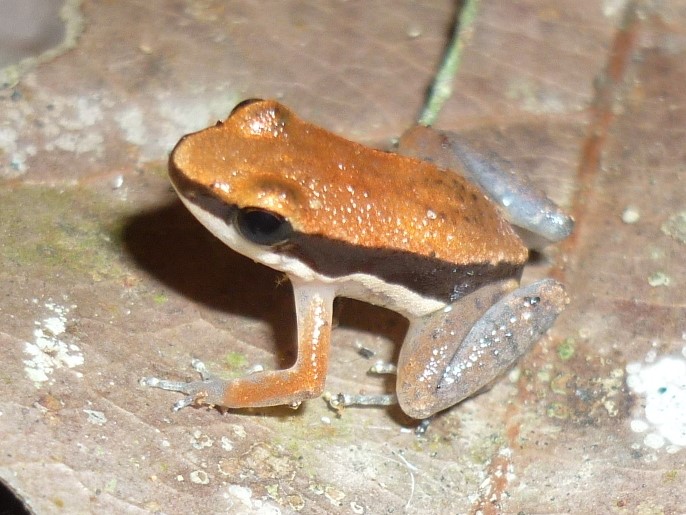
| Appearance | - Its dorsal coloration ranges from solid tan brown to copper. English Wikipedia
- Some individuals have small, darker brown spots on their dorsal surface. English Wikipedia
- The flanks are uniformly dark brown. English Wikipedia
- Some individuals possess a short, pale linear marking extending from the inguinal region toward the body's midsection. English Wikipedia
- A white iridescent stripe extends along the lower edge of the dark flanks from the snout to the groin, although it is often interrupted. English Wikipedia
- Pale iridescent mottling occurs below the ventrolateral stripe against an unpigmented background. English Wikipedia
- The throat, gular and pectoral regions, and abdomen are unpigmented and appear light gray to translucent. English Wikipedia
- Males have a white to light gray vocal sac that becomes translucent when inflated. English Wikipedia
- The iris is golden copper with tiny black flecks. English Wikipedia
- The tympanum is distinct and round. English Wikipedia
- The discs on all fingers and toes are weakly expanded. English Wikipedia
- The toes have some basal webbing. English Wikipedia
| - The dorsal skin is red or brick-colored and bears light brown or copper-colored lines originating on the snout. English Wikipedia
- The sides of the head and body are black, with a brown stripe above and a white stripe below. English Wikipedia
- The white lateral stripe can become blue toward the rear of the body. English Wikipedia
- A green-yellow marking occurs on the lip. English Wikipedia
- The upper surfaces of the forelegs are light brown with black or dark brown spots. English Wikipedia
- The axillary region has yellow or orange coloration. English Wikipedia
- The upper surfaces of the hind legs are black with blue-gray markings. English Wikipedia
- The undersides of the hind legs are blue with black markings. English Wikipedia
- The throat and chest are black and may contain some blue coloration. English Wikipedia
- The blue coloration forms an orange stripe near the junction of the front legs and body. English Wikipedia
- The belly is blue with black markings. English Wikipedia
- The iris is black with bronze or copper coloration near the pupil. English Wikipedia
|
|---|
| Size | | |
|---|
| Habitat | - At the type locality, the species occurs in a mosaic of seasonally flooded igapó forest and unflooded terra-firme primary forest. English Wikipedia
- In Guyana, the species has been encountered in both primary and secondary forests. English Wikipedia
- In Guyana, its recorded habitats include well-drained mixed forest on white sand and mixed forest on gravelly clay laterite. English Wikipedia
| - The species inhabits tropical rainforest. English Wikipedia
- It occurs in lowland forests and forests on rolling hills, primarily in primary forest but occasionally in secondary forest and riparian habitats near farmland. English Wikipedia
- The species spends time in leaf litter. English Wikipedia
- The species is terrestrial. amphibiaweb.org
- The species is usually found within leaf litter. amphibiaweb.org
- The species inhabits dense forests in the Napo and Pastaza drainage regions. amphibiansoftheworld.amnh.org
- The species has been recorded in Yasuní National Park, Sangay National Park, Yachana Reserve, and Jatun Sacha Biological Station. English Wikipedia
|
|---|
| Diet | No checked fact yet | |
|---|
| Behaviour | - The species is active during the day. English Wikipedia
- Males produce two types of advertisement calls. English Wikipedia
- The first advertisement call consists of regular trills containing 23–35 short notes. English Wikipedia
- The first advertisement call lasts approximately five seconds. English Wikipedia
- The first call type is separated from subsequent calls by intervals of approximately 23 seconds. English Wikipedia
- Notes in the first call type are separated by regular intervals of approximately 0.1 seconds. English Wikipedia
- The first advertisement call type has an average peak frequency of approximately 6,325 Hz. English Wikipedia
- The second advertisement call type consists of continuously emitted notes separated by silent intervals of variable duration. English Wikipedia
- The second advertisement call type has an average peak frequency of approximately 6,200 Hz. English Wikipedia
| |
|---|
| Reproduction | - Females lay clutches containing 5–11 eggs in leaf litter. English Wikipedia
- After hatching, tadpoles are carried on the back of a male parent or, less commonly, a female parent. English Wikipedia
- Parents deposit transported tadpoles in small temporary pools or moist leaf litter, where development continues. English Wikipedia
- Tadpoles have occasionally been deposited in the foam nests of Physalaemus sp. and Leptodactylus rhodomystax. English Wikipedia
- Deposition of tadpoles in other frogs' foam nests appears to help keep them sufficiently moist during dry periods. English Wikipedia
| |
|---|
| Distribution | - The species is recorded in the Brazilian states of Pará, Amazonas, and Roraima, as well as eastern Peru, central Guyana, and southern Suriname. English Wikipedia
- The species may also occur in intervening areas and extend into Colombia. English Wikipedia
| |
|---|
| Conservation | - The IUCN classifies the species as Least Concern as of 2023. English Wikipedia
- Logging may threaten the species in some parts of its distribution. English Wikipedia
- The species' known distribution includes the Rio Trombetas Biological Reserve in Brazil. English Wikipedia
- The species' known distribution includes at least two protected areas in Peru. English Wikipedia
- The species' known distribution includes Mabura Hill Forest Reserve in Guyana. English Wikipedia
- The species' known distribution includes Sipaliwini Nature Reserve in Suriname. English Wikipedia
| - The species is classified as Least Concern by the IUCN. English Wikipedia
- Habitat loss and deforestation associated with agriculture, livestock cultivation, and road construction for oil extraction threaten the species in some locations. English Wikipedia
- Pollution originating from farms, livestock, and mining can affect the species. English Wikipedia
|
|---|
| Similar species | No checked fact yet | - Allobates zaparo most closely resembles Allobates bilinguis. English Wikipedia
- Its resemblance to Allobates bilinguis is associated with Batesian mimicry of toxic frogs. English Wikipedia
|
|---|
| Other | | - The species does not have poisonous chemicals in its skin despite its resemblance to chemically defended frogs. English Wikipedia
- Allobates zaparo was formerly classified in the genus Epipedobates before being transferred to Allobates. English Wikipedia
|
|---|