Comparison

Alpheus arenicolus vs Tiger Pistol Shrimp

Alpheus arenicolus (Alpheus arenicolus) and Tiger Pistol Shrimp (Alpheus bellulus) both belong to the genus Alpheus (pistol shrimps) and part ways below it.
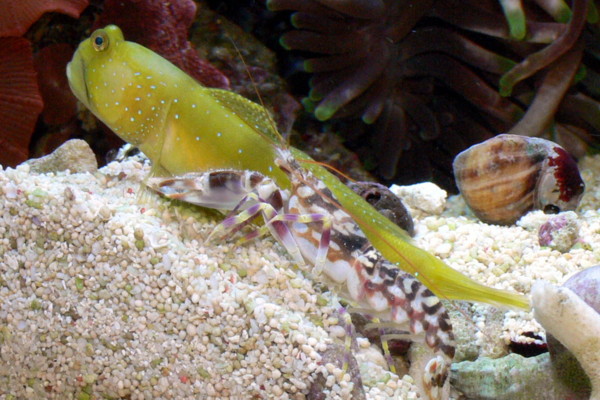
Tiger Pistol Shrimp

Tiger Pistol Shrimp

Alpheus bellulus

User:Haplochromis, CC BY-SA 3.0, via Wikimedia Commons

Side by side

Alpheus arenicolusTiger Pistol Shrimp
Scientific nameAlpheus arenicolus A. H. Banner & D. M. Banner, 1983Alpheus bellulus Miya & Miyake, 1969
English nameNot recordedTiger Pistol Shrimp
GroupCrustaceansCrustaceans
ClassMalacostracaMalacostraca
OrderDecapodaDecapoda
FamilyAlpheidae Snapping ShrimpsAlpheidae Snapping Shrimps
GenusAlpheus Pistol ShrimpsAlpheus Pistol Shrimps
Named in19831969
Environmentmarinemarine
Countries on recordNot recorded4 countries
GBIF occurrence recordsNot recorded208 records

Rows where the two agree are shown in grey.

Where each is found

Only Tiger Pistol Shrimp (4)

From Catalogue of Life checklists and GBIF occurrence records. A country missing from a list means no record is held, which is not proof of absence.

Checked facts

Alpheus arenicolusTiger Pistol Shrimp
AppearanceNo checked fact yet
SizeNo checked fact yet
  • The species reaches a body length of up to 4–5 cm, excluding its antennae. English Wikipedia
HabitatNo checked fact yet
  • The species inhabits sandy, muddy and detrital substrates in shallow water. English Wikipedia
  • The species occurs at depths of up to 20 m. English Wikipedia
  • The species constructs burrows that provide shelter and protection. English Wikipedia
  • It reinforces the sides of its burrows with small pieces of shell and coral. English Wikipedia
  • It regularly removes sediment from its burrows to prevent deposits from accumulating inside. English Wikipedia
DietNo checked fact yet
  • The species primarily feeds on small invertebrates. English Wikipedia
  • Its diet can also include detritus, macroalgae and animal carcasses found near its burrow. English Wikipedia
  • In symbiotic pairs, the species has been observed receiving food from gobies. English Wikipedia
  • When kept with gobies without another available food source, the species can survive by eating goby feces. English Wikipedia
  • In captivity, the species accepts flakes, pellets, frozen mysis shrimp, brine shrimp and finely chopped seafood. English Wikipedia
BehaviourNo checked fact yet
  • The species uses its enlarged claw to produce powerful bubbles that stun prey. English Wikipedia
  • The shrimp's claw produces an air bubble travelling at more than 100 kilometres per hour when it closes. English Wikipedia
  • The collapse of its produced bubble can generate sound reaching 218 decibels. English Wikipedia
  • The bubble produced by the species can reach a temperature of 4,800 degrees Celsius. English Wikipedia
  • The species lives in burrows in symbiosis with gobies, including Cryptocentrus cinctus, Amblyeleotris guttata and Stonogobiops yasha. English Wikipedia
  • The shrimp digs and maintains shared burrows while its goby partner watches for danger. English Wikipedia
  • The shrimp has poor eyesight and depends on its goby partner to warn it of danger. English Wikipedia
  • The species maintains antenna contact with its goby partner. English Wikipedia
  • The shrimp retreats into its burrow after detecting noticeable movement from its goby partner. English Wikipedia
  • The species usually does not leave its burrow unless its partner fish is near the entrance. English Wikipedia
  • The species has been observed sharing burrows with the porcelain crab Enosteoides lobatus. English Wikipedia
  • During the initial construction stage of a burrow, the species prioritizes burrow formation over feeding and resting. English Wikipedia
  • The species is particularly vulnerable to predation when it lacks a burrow during the initial stages of burrow development. English Wikipedia
ReproductionNo checked fact yet
  • The goby-shrimp symbiotic relationship begins early in development and often persists into adulthood. English Wikipedia
UsesNo checked fact yet
  • The species is popular in the marine aquarium hobby because of its relatively subdued temperament, low cost and basic care requirements. English Wikipedia
Similar speciesNo checked fact yet
  • Phylogenetic evidence suggests that Alpheus randalli and Alpheus bellulus belong to the same taxon within a monophyletic group. English Wikipedia
  • The cytochrome b protein amino acid composition of this species is similar to that of Alpheus randali and Alpheus lobidens. English Wikipedia
OtherNo checked fact yet
  • The species shares a translocation and inversion event involving trnE in its mitochondrial genome with several other Alpheus species. English Wikipedia
  • Burrow construction by the species contributes to sediment cycling in marine ecosystems. English Wikipedia

In brief

Tiger Pistol Shrimp

Alpheus bellulus inhabits sandy, muddy and detrital substrates in shallow water at depths of up to 20 m. It is distinguished by its enlarged right claw, which produces powerful bubbles that stun prey. Full profile

Compare something else

Page built on 26 November 2026 from the data on the two species pages, where every source is listed.

Cite this page

ScientificNames.org. (2026). Alpheus arenicolus vs Tiger Pistol Shrimp. Retrieved November 26, 2026, from https://scientificnames.org/compare/alpheus-arenicolus-vs-tiger-pistol-shrimp