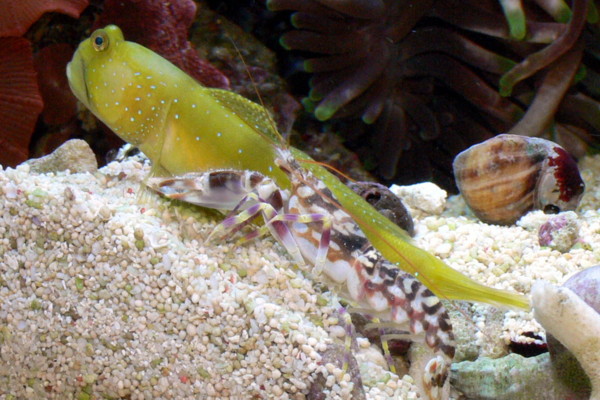
| Appearance | | - The species has a small rostrum and lacks spines along the edge of its carapace. English Wikipedia
- Its enlarged snapping claw can occur on either the right or left side and measures approximately half the body length. English Wikipedia
- The enlarged claw has a deep notch on both sides beneath its finger joint. English Wikipedia
- The species' smaller claw is unmodified and normally sized. English Wikipedia
- Its coloration is translucent dark green, with orange and blue tips on the uropods. English Wikipedia
- Its coloration ranges from dark blue-green to gray. animaldiversity.org
- Its body is translucent and speckled with darker gray-brown spots. animaldiversity.org
- Most individuals have orange coloration behind the eyes, on the tail tip, and on the enlarged claw. animaldiversity.org
- The species has three pairs of legs, two pairs of antennae, and two claws. animaldiversity.org
- Both claws are covered with setae. animaldiversity.org
- The modified snapping claw occurs on either side of the body rather than consistently on one particular side. animaldiversity.org
|
|---|
| Size | - The species reaches a body length of up to 4–5 cm, excluding its antennae. English Wikipedia
| - The species can reach a maximum body length of 5.5 cm, although most adults are smaller. English Wikipedia
- Adult individuals typically measure between 3.0 and 5.5 cm from the rostrum to the tail end, although some reach only 10 mm. animaldiversity.org
- Males and females reach approximately the same overall body size. animaldiversity.org
- The male's snapping claw is slightly larger than the female's. animaldiversity.org
|
|---|
| Habitat | - The species inhabits sandy, muddy and detrital substrates in shallow water. English Wikipedia
- The species occurs at depths of up to 20 m. English Wikipedia
- The species constructs burrows that provide shelter and protection. English Wikipedia
- It reinforces the sides of its burrows with small pieces of shell and coral. English Wikipedia
- It regularly removes sediment from its burrows to prevent deposits from accumulating inside. English Wikipedia
| - The species inhabits shallow tropical and semitropical waters near the seabed. English Wikipedia
- Its preferred habitats include reefs, seagrass meadows, salt marshes, and muddy areas. English Wikipedia
- Most populations inhabit subtidal seabeds at depths of 30 metres or more. animaldiversity.org
- The species commonly inhabits oyster reefs. animaldiversity.org
- It occupies waters with salinities ranging from mesohaline concentrations of 5–18 ppt to hyperhaline concentrations above 40 ppt. animaldiversity.org
- The species commonly uses rocks, shells, seaweed, and other available cover in shallow water. animaldiversity.org
|
|---|
| Diet | - The species primarily feeds on small invertebrates. English Wikipedia
- Its diet can also include detritus, macroalgae and animal carcasses found near its burrow. English Wikipedia
- In symbiotic pairs, the species has been observed receiving food from gobies. English Wikipedia
- When kept with gobies without another available food source, the species can survive by eating goby feces. English Wikipedia
- In captivity, the species accepts flakes, pellets, frozen mysis shrimp, brine shrimp and finely chopped seafood. English Wikipedia
| - The species feeds on worms, small crustaceans, gobies, and pearlfish. English Wikipedia
- Its larvae depend entirely on egg yolk and oil reserves until functional mouthparts develop. animaldiversity.org
|
|---|
| Behaviour | - The species uses its enlarged claw to produce powerful bubbles that stun prey. English Wikipedia
- The shrimp's claw produces an air bubble travelling at more than 100 kilometres per hour when it closes. English Wikipedia
- The collapse of its produced bubble can generate sound reaching 218 decibels. English Wikipedia
- The bubble produced by the species can reach a temperature of 4,800 degrees Celsius. English Wikipedia
- The species lives in burrows in symbiosis with gobies, including Cryptocentrus cinctus, Amblyeleotris guttata and Stonogobiops yasha. English Wikipedia
- The shrimp digs and maintains shared burrows while its goby partner watches for danger. English Wikipedia
- The shrimp has poor eyesight and depends on its goby partner to warn it of danger. English Wikipedia
- The species maintains antenna contact with its goby partner. English Wikipedia
- The shrimp retreats into its burrow after detecting noticeable movement from its goby partner. English Wikipedia
- The species usually does not leave its burrow unless its partner fish is near the entrance. English Wikipedia
- The species has been observed sharing burrows with the porcelain crab Enosteoides lobatus. English Wikipedia
- During the initial construction stage of a burrow, the species prioritizes burrow formation over feeding and resting. English Wikipedia
- The species is particularly vulnerable to predation when it lacks a burrow during the initial stages of burrow development. English Wikipedia
| - Individuals conceal themselves in natural openings during daylight hours. English Wikipedia
- Individuals hide or burrow beneath rocks and shells for daytime protection. animaldiversity.org
- The species produces a loud, staccato concussive sound using its snapping claw. English Wikipedia
- The snapping sound results from the collapse of a short-lived cavitation bubble created by a high-speed water jet. English Wikipedia
- The modified snapping pincer is present only in adult individuals. animaldiversity.org
- The species is highly territorial and frequently experiences territorial intrusions between adjacent territories. animaldiversity.org
- Territorial confrontations commonly begin with antenna contact and snapping by both individuals. animaldiversity.org
- The species commonly forms monogamous male-female pairs. English Wikipedia
- Approximately 65% of shrimp captured in one study were found in male-female pairs. animaldiversity.org
|
|---|
| Reproduction | - The goby-shrimp symbiotic relationship begins early in development and often persists into adulthood. English Wikipedia
| |
|---|
| Distribution | No checked fact yet | - The species occurs in the western Atlantic Ocean and the Gulf of Mexico. English Wikipedia
- Its distribution includes the West Indies and Bermuda. English Wikipedia
- Its western Atlantic distribution extends from Cape Hatteras south to Florida and Brazil. English Wikipedia
- The species is frequently found along the United States Atlantic coast between the Outer Banks of North Carolina and southern Florida. animaldiversity.org
- Populations occur along the coasts of Caribbean islands and extend south to Brazil. animaldiversity.org
|
|---|
| Uses | - The species is popular in the marine aquarium hobby because of its relatively subdued temperament, low cost and basic care requirements. English Wikipedia
| No checked fact yet |
|---|
| Similar species | - Phylogenetic evidence suggests that Alpheus randalli and Alpheus bellulus belong to the same taxon within a monophyletic group. English Wikipedia
- The cytochrome b protein amino acid composition of this species is similar to that of Alpheus randali and Alpheus lobidens. English Wikipedia
| No checked fact yet |
|---|
| Other | - The species shares a translocation and inversion event involving trnE in its mitochondrial genome with several other Alpheus species. English Wikipedia
- Burrow construction by the species contributes to sediment cycling in marine ecosystems. English Wikipedia
| |
|---|