Comparison
Brazilian Teal vs Mute Swan
Brazilian Teal (Amazonetta brasiliensis) and Mute Swan (Cygnus olor) both belong to the family Anatidae (ducks) and part ways below it.
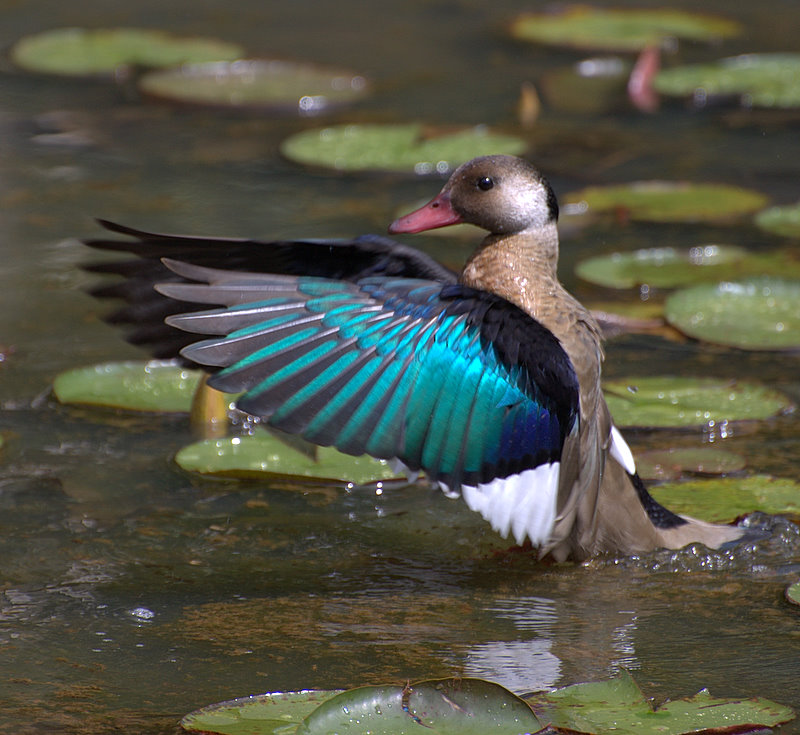
Brazilian Teal
Amazonetta brasiliensis
Dario Sanches from SÃO PAULO, BRASIL, CC BY-SA 2.0, via Wikimedia Commons


Side by side
| Brazilian Teal | Mute Swan | |
|---|---|---|
| Scientific name | Amazonetta brasiliensis (J. F. Gmelin, 1789) | Cygnus olor (J. F. Gmelin, 1789) |
| English name | Brazilian Teal | Mute Swan |
| Group | Birds | Birds |
| Class | Aves Bird | Aves Bird |
| Order | Anseriformes Ducks | Anseriformes Ducks |
| Family | Anatidae Ducks | Anatidae Ducks |
| Genus | Amazonetta Brazilian Teals | Cygnus Swan |
| Named in | 1789 | 1789 |
| Red List category | Least Concern | Least Concern |
| Environment | freshwater, terrestrial | freshwater, terrestrial |
| Countries on record | 10 countries | 79 countries |
| GBIF occurrence records | 123,335 records | 6,944,307 records |
Rows where the two agree are shown in grey.
Where each is found
Only Brazilian Teal (10)
Only Mute Swan (79)
- Aland Islands
- Albania
- Armenia
- Australia
- Austria
- Azerbaijan
- Belarus
- Belgium
- Bermuda
- Bosnia and Herzegovina
- Bulgaria
- Canada
- China
- Croatia
- Cyprus
- Czechia
- Denmark
- Estonia
- Finland
- France
- Georgia
- Germany
- Greece
- Guernsey
- Hungary
- Iceland
- India
- Iran
- Ireland
- Isle of Man
- Israel
- Italy
- Japan
- Jersey
- Kazakhstan
- Kosovo
- Kyrgyzstan
- Latvia
- Liechtenstein
- Lithuania
- Luxembourg
- Malta
- Mexico
- Moldova
- Monaco
- Mongolia
- Montenegro
- Myanmar
- New Zealand
- North Korea
- North Macedonia
- Norway
- Oman
- Pakistan
- Poland
- Portugal
- Romania
- Russia
- Serbia
- Singapore
- Slovakia
- Slovenia
- South Africa
- South Korea
- Spain
- Svalbard and Jan Mayen
- Sweden
- Switzerland
- Taiwan
- Thailand
- The Netherlands
- Turkey
- Turkmenistan
- Ukraine
- United Arab Emirates
- United Kingdom
- United States
- Uzbekistan
- Vietnam
From Catalogue of Life checklists and GBIF occurrence records. A country missing from a list means no record is held, which is not proof of absence.
Checked facts
| Brazilian Teal | Mute Swan | |
|---|---|---|
| Appearance |
|
|
| Size | No checked fact yet |
|
| Habitat |
|
|
| Diet |
|
|
| Behaviour |
|
|
| Reproduction |
|
|
| Distribution |
| No checked fact yet |
| Conservation |
|
|
| Uses | No checked fact yet |
|
| Similar species | No checked fact yet |
|
| Name origin | No checked fact yet |
|
In brief
Brazilian Teal
The Brazilian Teal is widely distributed across eastern South America. It has light brown plumage, with males distinguished by red beaks and legs and a pale grey area on the side of the head and neck. Full profile
Mute Swan
Cygnus olor inhabits freshwater lagoons, lakes and slow-flowing rivers. Adults have entirely white plumage, dark grey legs and a bright orange bill with black markings. Full profile
Compare something else
Page built on 27 November 2026 from the data on the two species pages, where every source is listed.
Cite this page
ScientificNames.org. (2026). Brazilian Teal vs Mute Swan. Retrieved November 27, 2026, from https://scientificnames.org/compare/brazilian-teal-vs-mute-swan
“Brazilian Teal vs Mute Swan.” ScientificNames.org, 2026, scientificnames.org/compare/brazilian-teal-vs-mute-swan. Accessed 27 Nov. 2026.
ScientificNames.org. “Brazilian Teal vs Mute Swan.” Accessed November 27, 2026. https://scientificnames.org/compare/brazilian-teal-vs-mute-swan.
@misc{scientificnames_brazilian_teal_vs_mute_swan,
  author = {{ScientificNames.org}},
  title = {Brazilian Teal vs Mute Swan},
  year = {2026},
  url = {https://scientificnames.org/compare/brazilian-teal-vs-mute-swan},
  note = {Accessed 2026-11-27}
}