Comparison
Amur Corktree vs Lemon
Amur Corktree (Phellodendron amurense) and Lemon (Citrus × limon) both belong to the family Rutaceae (rue family) and part ways below it. Both are recorded in 10 countries.


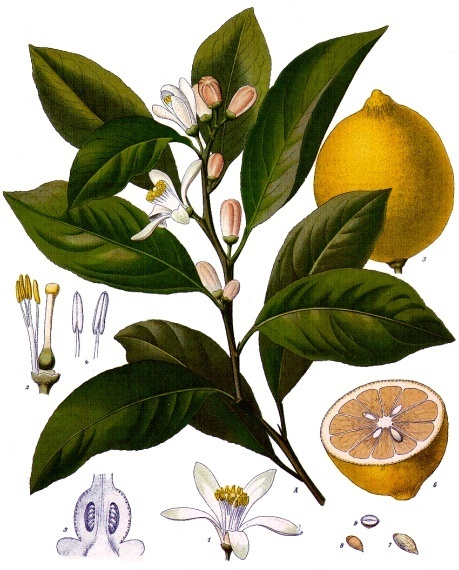
Lemon
Citrus × limon
Franz Eugen Köhler, Köhler's Medizinal-Pflanzen, Public domain, via Wikimedia Commons

Side by side
| Amur Corktree | Lemon | |
|---|---|---|
| Scientific name | Phellodendron amurense Rupr. | Citrus × limon (L.) Osbeck |
| English name | Amur Corktree | Lemon |
| Group | Flowering plants | Flowering plants |
| Class | Magnoliopsida | Magnoliopsida |
| Order | Sapindales | Sapindales |
| Family | Rutaceae Rue Family | Rutaceae Rue Family |
| Genus | Phellodendron Corktree | Citrus Kumquat |
| Countries on record | 15 countries | 110 countries |
| GBIF occurrence records | 8,692 records | 4,748 records |
Rows where the two agree are shown in grey.
Where each is found
Both recorded in 10 countries
Only Amur Corktree (5)
Only Lemon (100)
- Afghanistan
- Albania
- Algeria
- Argentina
- Australia
- Bahamas
- Bangladesh
- Belize
- Benin
- Bermuda
- Bolivia
- Brazil
- Burkina Faso
- Cabo Verde
- Cambodia
- Cameroon
- Central African Republic
- Chad
- Chile
- Colombia
- Costa Rica
- Croatia
- Cuba
- Curacao
- Cyprus
- Democratic Republic of the Congo
- Dominican Republic
- Ecuador
- Egypt
- El Salvador
- Equatorial Guinea
- Ethiopia
- Fiji
- Finland
- France
- French Guiana
- French Polynesia
- Georgia
- Germany
- Greece
- Guadeloupe
- Guam
- Guatemala
- Guinea
- Haiti
- Honduras
- Hong Kong
- India
- Indonesia
- Iran
- Iraq
- Israel
- Italy
- Ivory Coast
- Jamaica
- Kenya
- Lebanon
- Madagascar
- Malaysia
- Maldives
- Malta
- Martinique
- Mayotte
- Mexico
- Micronesia
- Morocco
- Mozambique
- Myanmar
- Nepal
- New Caledonia
- New Zealand
- Nicaragua
- Nigeria
- Niue
- Pakistan
- Palau
- Panama
- Papua New Guinea
- Paraguay
- Peru
- Philippines
- Portugal
- Puerto Rico
- Reunion
- Seychelles
- Sierra Leone
- South Africa
- Spain
- Sri Lanka
- Sweden
- Tanzania
- Thailand
- The Netherlands
- Tokelau
- Trinidad and Tobago
- Tunisia
- Turkey
- United Kingdom
- Venezuela
- Zimbabwe
From Catalogue of Life checklists and GBIF occurrence records. A country missing from a list means no record is held, which is not proof of absence.
Checked facts
| Amur Corktree | Lemon | |
|---|---|---|
| Appearance |
|
|
| Size |
|
|
| Habitat |
|
|
| Diet | No checked fact yet |
|
| Behaviour |
| No checked fact yet |
| Reproduction |
|
|
| Distribution |
| No checked fact yet |
| Conservation |
| No checked fact yet |
| Uses |
|
|
| Other | No checked fact yet |
|
In brief
Amur Corktree
Amur Corktree (Phellodendron amurense Rupr.) is a medium-sized flowering tree in the family Rutaceae, order Sapindales, and class Magnoliopsida. The species is native to China, Korea, and Japan. It is distinguished by its corky grayish-brown bark, neon-yellow inner bark, and black fruits. Full profile
Lemon
Species of the genus Citrus naturally occur in regions with warm or mild climates, particularly the Mediterranean region. The lemon tree is a small evergreen tree that produces pointed, oval-shaped yellow fruits botanically classified as hesperidia. Full profile
Compare something else
Page built on 28 November 2026 from the data on the two species pages, where every source is listed.
Cite this page
ScientificNames.org. (2026). Amur Corktree vs Lemon. Retrieved November 28, 2026, from https://scientificnames.org/compare/amur-corktree-vs-lemon
“Amur Corktree vs Lemon.” ScientificNames.org, 2026, scientificnames.org/compare/amur-corktree-vs-lemon. Accessed 28 Nov. 2026.
ScientificNames.org. “Amur Corktree vs Lemon.” Accessed November 28, 2026. https://scientificnames.org/compare/amur-corktree-vs-lemon.
@misc{scientificnames_amur_corktree_vs_lemon,
  author = {{ScientificNames.org}},
  title = {Amur Corktree vs Lemon},
  year = {2026},
  url = {https://scientificnames.org/compare/amur-corktree-vs-lemon},
  note = {Accessed 2026-11-28}
}