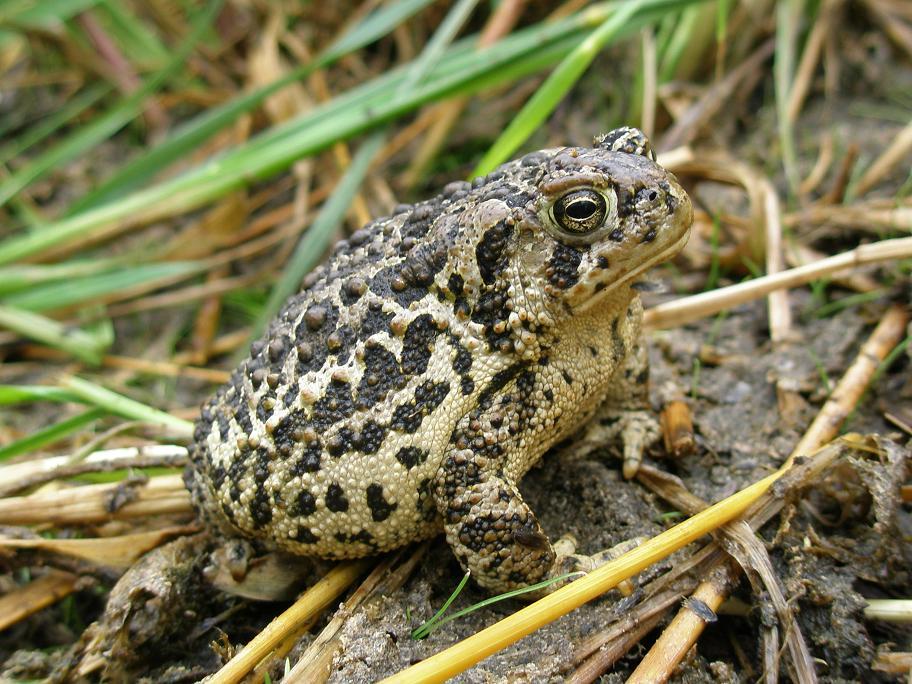
| Appearance | - Its skin glands are reddish or orange. English Wikipedia
- Its underside is whitish or buff and may have faint dark spots. English Wikipedia
- Juveniles have more prominent underside spotting than adults and yellow undersides of their feet. English Wikipedia
- Males have a dusky throat. English Wikipedia
- Males develop nuptial pads during the breeding season. English Wikipedia
- Small red dots cover the species' tan or grey body. nps.gov
- Its tadpoles are black or dark brown with metallic bronze flecks. nps.gov
| - The Wyoming toad has dark brown, gray, or green skin with small dark markings on its underside. English Wikipedia
- The dorsal surface of the Wyoming toad bears small, rounded, blotchy warts and blurry light lines. English Wikipedia
- Male Wyoming toads have dark throats. English Wikipedia
- Individual Wyoming toads can be distinguished by differences in their skin colors and wart patterns. English Wikipedia
|
|---|
| Size | | |
|---|
| Habitat | - The species occurs primarily along rocky streams and riverbeds. English Wikipedia
- It inhabits arid and semi-arid regions. English Wikipedia
- In dry regions, it uses seasonal pools and temporary rain puddles for breeding. English Wikipedia
- During dry periods, it shelters in burrows, beneath rocks, or under moist plant matter. English Wikipedia
- In the Grand Canyon, it occurs near permanent streams in side canyons and along the Colorado River. nps.gov
- It prefers rocky areas and uses rock crevices for shelter. nps.gov
| - Wyoming toads inhabit floodplains and the short-grass margins of ponds, creeks, and lakes. English Wikipedia
- Wyoming toads use abandoned pocket gopher and ground squirrel burrows as hibernation sites. English Wikipedia
- Adult Wyoming toads are attracted to habitats with greater vegetation cover than those preferred by younger individuals. English Wikipedia
- Adult Wyoming toads generally occupy locations farther inland than younger individuals. English Wikipedia
- Adult Wyoming toads occupy substrates with cooler surface temperatures than younger individuals. English Wikipedia
- Historically, Wyoming toads occupied floodplains, ponds, shallow lakes, and seepage pools in the Laramie Basin. English Wikipedia
|
|---|
| Diet | - Adults are carnivorous and feed primarily on insects. nps.gov
- Its recorded insect prey includes ants, bees, and beetles. nps.gov
- It occasionally eats smaller amphibians. nps.gov
| No checked fact yet |
|---|
| Behaviour | - The species is docile and can be handled easily, with little or no secretion from its skin glands. English Wikipedia
- It often spends daylight hours in rock crevices. nps.gov
- It becomes active at dusk to feed and mate. nps.gov
- The species becomes suddenly active during rainfall, when many individuals emerge. English Wikipedia
- Males make a high-pitched trill lasting 4–10 seconds as their most common call. nps.gov
- During breeding season, males engage in wrestling matches to establish territories. nps.gov
| - Wyoming toads are mainly active at night. English Wikipedia
- Wyoming toads emerge from hibernation in early May and migrate to the north shore for mating. English Wikipedia
- Wyoming toads return to the south shore by late September or early October to hibernate. English Wikipedia
- Younger Wyoming toads remain active for approximately one month longer than older individuals. English Wikipedia
- The mating call of the Wyoming toad has a low frequency, a slow pulse rate, and a longer duration than calls of other toads. English Wikipedia
|
|---|
| Reproduction | - The breeding season occurs from March through June. nps.gov
- Females lay individual eggs rather than depositing them in clumps. nps.gov
- Eggs hatch approximately three days after being laid. English Wikipedia
- Tadpoles metamorphose into adults within 6–8 weeks after hatching. nps.gov
| - Male Wyoming toads reach sexual maturity at approximately two years of age. English Wikipedia
- Female Wyoming toads reach sexual maturity at approximately three years of age. English Wikipedia
- Captive breeding programs for Wyoming toads have experienced low reproductive output because of low ovulation and fertilization rates. English Wikipedia
- Extended hormonal priming of Wyoming toads has increased fecundity and the number of eggs produced per individual. English Wikipedia
- Higher water temperatures reduce the time required for Wyoming toad metamorphosis. English Wikipedia
- Captive-bred Wyoming toads have been released into Mortenson Lake, Lake George, and a private release site. English Wikipedia
- Some wild breeding activity was reported at Crescent Lake, Wyoming, in 2011. English Wikipedia
|
|---|
| Distribution | - The species is native to the southwestern United States and northwestern Mexico. English Wikipedia
- Baja California is a particularly important part of its Mexican distribution. English Wikipedia
- Within Arizona, it occurs in almost all areas except high mountains and the Yuma Desert. nps.gov
| - The Wyoming toad is endemic to Wyoming and occurs exclusively in the Laramie Plains. wgfd.wyo.gov
- The historical distribution of the Wyoming toad was restricted to the Laramie Basin in Albany County, Wyoming. pmc.ncbi.nlm.nih.gov
- Mortenson Lake in Albany County, Wyoming, was the location where a small population of Wyoming toads was rediscovered after their presumed extinction. pmc.ncbi.nlm.nih.gov
|
|---|
| Conservation | - The species can survive losing 40% of its body water. nps.gov
| - The Wyoming toad was federally listed as endangered in January 1984. English Wikipedia
- The Wyoming toad has been considered extinct in the wild since 1991. English Wikipedia
- Chytrid fungus is considered a major threat to the survival of the Wyoming toad. English Wikipedia
- Chytrid infection affected approximately 41% of the Wyoming toad population surveyed at Porter Lake in 2010. English Wikipedia
- The chytrid infection rate among Wyoming toads at Porter Lake reached 100% in 2011. English Wikipedia
- A captive-breeding program for Wyoming toads began in 1989. pmc.ncbi.nlm.nih.gov
- The captive Wyoming toad population was estimated at approximately 500 individuals in the study reporting on its genetic diversity. pmc.ncbi.nlm.nih.gov
- Wyoming toads exhibit reduced diversity at major histocompatibility complex genes compared with bufonid species that experienced similar population bottlenecks. pmc.ncbi.nlm.nih.gov
- Population decline may have reduced the immunogenetic diversity of Wyoming toads and increased their vulnerability to infectious diseases. pmc.ncbi.nlm.nih.gov
- Rearing Wyoming toads for release rather than releasing tadpoles has reduced release mortality and shortened the time needed to reach breeding size. pmc.ncbi.nlm.nih.gov
|
|---|
| Similar species | - The species may hybridize with the western toad (Anaxyrus boreas) in some locations. English Wikipedia
| No checked fact yet |
|---|