Comparison

Angonoka Tortoise vs Radiated Tortoise

Angonoka Tortoise (Astrochelys yniphora) and Radiated Tortoise (Astrochelys radiata) both belong to the genus Astrochelys and part ways below it. Both are recorded in 1 country.

Angonoka Tortoise

Angonoka Tortoise

Astrochelys yniphora

Hans Hillewaert, CC BY-SA 4.0, via Wikimedia Commons

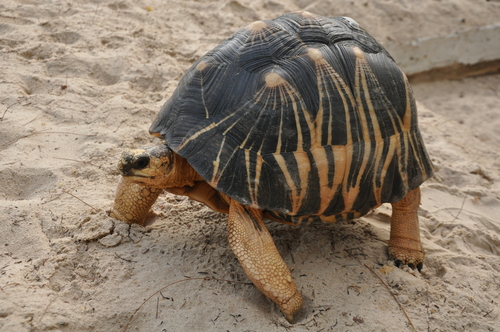
Radiated Tortoise

Radiated Tortoise

Astrochelys radiata

(c) Josip Skejo, some rights reserved (CC BY), uploaded by Josip Skejo, CC BY 4.0, via iNaturalist

Side by side

Angonoka TortoiseRadiated Tortoise
Scientific nameAstrochelys yniphora (Vaillant, 1885)Astrochelys radiata (Shaw, 1802)
English nameAngonoka TortoiseRadiated Tortoise
GroupReptilesReptiles
ClassReptilia ReptileReptilia Reptile
OrderTestudines TurtleTestudines Turtle
FamilyTestudinidae TortoisesTestudinidae Tortoises
GenusAstrochelysAstrochelys
Named in18851802
Red List categoryCritically EndangeredCritically Endangered
Countries on record1 country3 countries
GBIF occurrence records122 records395 records

Rows where the two agree are shown in grey.

Where each is found

Both recorded in 1 country

Only Radiated Tortoise (2)

From Catalogue of Life checklists and GBIF occurrence records. A country missing from a list means no record is held, which is not proof of absence.

Checked facts

Angonoka TortoiseRadiated Tortoise
Appearance
  • The carapace is highly domed and light brown, with prominent growth rings on each scute. English Wikipedia
  • The outer portions of the vertebral scutes are darker brown than the rest of the carapace. English Wikipedia
  • The gular scute projects forward between the front legs and curves upward toward the neck. English Wikipedia
  • The head and snout range from black to shades of brown and have yellow spots near the ears. animaldiversity.org
  • The neck, limbs, and tail are generally brown with tan or yellow markings. animaldiversity.org
  • The tortoise has flattened legs with armored, scaly skin and clawed toes. animaldiversity.org
  • The oval carapace is highly domed and generally has eleven marginal scutes on each side plus a larger posterior scute. animaldiversity.org
  • The plastron is yellow with a brownish tint. animaldiversity.org
  • The carapace becomes darker and more uniformly colored as the tortoise ages. animaldiversity.org
  • Adult males have longer gular scutes and longer, thicker tails than females. animaldiversity.org
  • Female tortoises have flat plastrons, whereas males have concave plastrons. animaldiversity.org
  • Adults have a high-domed carapace, a blunt head, and elephantine feet. English Wikipedia
  • The legs, feet, and head are yellow, apart from a variably sized black patch on the top of the head. English Wikipedia
  • The carapace has yellow lines radiating from the center of each dark shell plate. English Wikipedia
  • Its shell has smooth scutes rather than raised, pyramidal ones. English Wikipedia
  • Males generally have longer tails and more noticeable notches beneath their tails than females. English Wikipedia
  • Hatchlings are white to off-white rather than having the yellow coloration of adults. English Wikipedia
SizeNo checked fact yet
Habitat
  • The species inhabits dry forests in the Baly Bay area of northwestern Madagascar. English Wikipedia
  • The species uses bamboo-scrub habitat containing shrubs, savanna grasses, bamboo, and unvegetated open areas. English Wikipedia
  • Its habitat includes shrub species of Bauhinia and Terminalia, generally less than two metres tall. English Wikipedia
  • Its natural habitat occurs below 50 metres above sea level. English Wikipedia
  • The species lives in bamboo-scrub savannahs containing palms and shrub thickets in a hot-tropical, semi-humid zone. animaldiversity.org
  • The tortoises shelter in dense thickets but prefer open grassy areas for foraging. animaldiversity.org
  • The species inhabits dry brush regions in southern Madagascar. English Wikipedia
  • Subtropical or tropical dry shrubland is a recorded habitat type for the species. iucnredlist.org
  • Coastal sand dunes are also recorded as a habitat type for the species. iucnredlist.org
Diet
  • The species feeds on grasses growing in open rocky areas of bamboo scrub. English Wikipedia
  • Its recorded plant foods include shrubs, forbs, and herbs. English Wikipedia
  • The tortoise has been observed eating dead bamboo leaves but not living bamboo. English Wikipedia
  • The species has also been observed consuming dried feces from bushpigs and carnivores. English Wikipedia
Behaviour
  • Individuals regularly graze in the same areas, keeping the vegetation closely trimmed. English Wikipedia
Reproduction
Distribution
  • The species is endemic to Madagascar. English Wikipedia
  • Its natural distribution is restricted to an area of approximately 25 to 60 square kilometres around Baly Bay. English Wikipedia
  • Five isolated populations occur within 30 kilometres of Baly Bay. animaldiversity.org
  • The species is naturally restricted to the extreme southern and southwestern parts of Madagascar. English Wikipedia
  • Introduced populations occur on the islands of Réunion and Mauritius. English Wikipedia
Conservation
  • Fires associated with clearing land for cattle grazing are among the principal threats to the species. English Wikipedia
  • Introduced bushpigs prey on the eggs and young of the species. English Wikipedia
  • The species is protected under Madagascar's national law and listed in CITES Appendix I. English Wikipedia
  • Baie de Baly National Park was established in 1997 to conserve the species. English Wikipedia
  • The first five captive-bred individuals were released into the wild in Baie de Baly National Park in 1998. English Wikipedia
  • A captive-breeding centre was established at Ampijoroa in Madagascar in 1986. English Wikipedia
  • The captive-breeding project produced 224 juveniles from 17 adults by December 2004. English Wikipedia
  • Conservation activities have included involving local communities in constructing firebreaks. English Wikipedia
  • The species' annual adult survival rate is approximately 97%. animaldiversity.org
  • The species is classified as Critically Endangered by the IUCN. English Wikipedia
  • Habitat destruction and poaching are major reasons for the species' threatened status. English Wikipedia
  • The species is threatened by habitat loss, hunting for food, and exploitation in the pet trade. English Wikipedia
  • Commercial trade in wild-caught individuals is illegal except under exceptional licensed circumstances. English Wikipedia
  • The species occurs in at least one protected area. iucnredlist.org
  • Conservation sites have been identified throughout the species' range. iucnredlist.org
  • The estimated area of occupancy is between 5,000 and 20,000 square kilometres. iucnredlist.org
  • The estimated extent of occurrence is between 500 and 2,000 square kilometres. iucnredlist.org
Similar species
  • Astrochelys yniphora and the radiated tortoise are the only two species in the genus Astrochelys. English Wikipedia
No checked fact yet

In brief

Angonoka Tortoise

Astrochelys yniphora inhabits dry forests and bamboo-scrub habitats in the Baly Bay area of northwestern Madagascar. It is distinguished by a highly domed carapace and a forward-projecting gular scute that curves upward toward the neck. Full profile

Radiated Tortoise

The species is naturally restricted to the extreme southern and southwestern parts of Madagascar. It is distinguished by yellow lines radiating from the centers of its dark shell plates. Full profile

Compare something else

Page built on 28 November 2026 from the data on the two species pages, where every source is listed.

Cite this page

ScientificNames.org. (2026). Angonoka Tortoise vs Radiated Tortoise. Retrieved November 28, 2026, from https://scientificnames.org/compare/angonoka-tortoise-vs-radiated-tortoise