Comparison
Gray-bellied Night Monkey vs Panamanian Night Monkey
Gray-bellied Night Monkey (Aotus lemurinus) and Panamanian Night Monkey (Aotus zonalis) both belong to the genus Aotus (night monkeys) and part ways below it. Both are recorded in 2 countries.

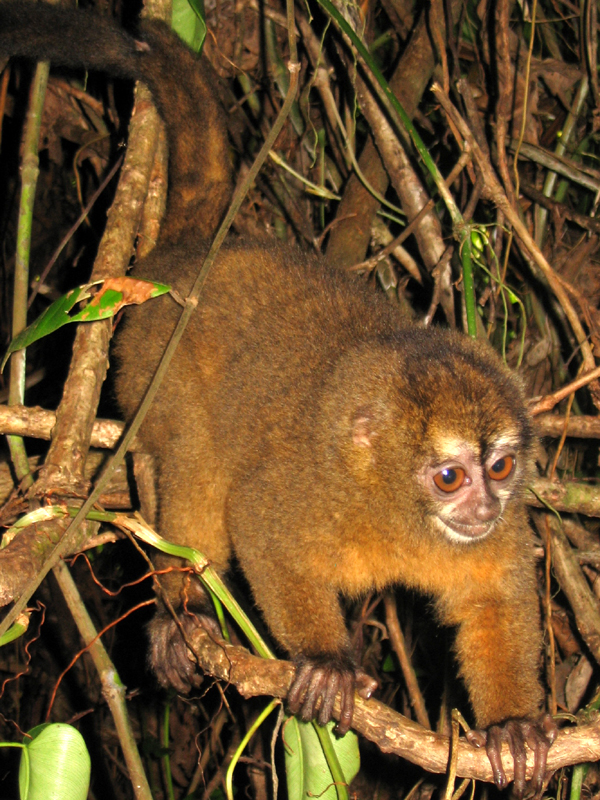
Gray-bellied Night Monkey
Aotus lemurinus
Esteban Villa Restrepo, CC BY-SA 4.0, via Wikimedia Commons


Side by side
| Gray-bellied Night Monkey | Panamanian Night Monkey | |
|---|---|---|
| Scientific name | Aotus lemurinus I. Geoffroy Saint-Hilaire, 1843 | Aotus zonalis Goldman, 1914 |
| English name | Gray-bellied Night Monkey | Panamanian Night Monkey |
| Group | Mammals | Mammals |
| Class | Mammalia Mammal | Mammalia Mammal |
| Order | Primates Primate | Primates Primate |
| Family | Aotidae Owl Monkeys | Aotidae Owl Monkeys |
| Genus | Aotus Night Monkeys | Aotus Night Monkeys |
| Named in | 1843 | 1914 |
| Red List category | Vulnerable | Near Threatened |
| Countries on record | 3 countries | 2 countries |
| GBIF occurrence records | 603 records | 292 records |
Rows where the two agree are shown in grey.
Where each is found
Both recorded in 2 countries
Only Gray-bellied Night Monkey (1)
From Catalogue of Life checklists and GBIF occurrence records. A country missing from a list means no record is held, which is not proof of absence.
Checked facts
| Gray-bellied Night Monkey | Panamanian Night Monkey | |
|---|---|---|
| Appearance |
|
|
| Size | No checked fact yet |
|
| Habitat |
|
|
| Diet |
| No checked fact yet |
| Behaviour |
|
|
| Reproduction |
|
|
| Distribution |
|
|
| Conservation |
|
|
| Uses |
|
|
| Similar species | No checked fact yet |
|
| Other |
| No checked fact yet |
In brief
Gray-bellied Night Monkey
The Gray-bellied Night Monkey is a mammal in the family Aotidae, order Primates, class Mammalia, and genus Aotus. It occurs in Panama, Colombia, Ecuador, Peru, Brazil, Paraguay, Argentina, and Bolivia. It is nocturnal, forms monogamous pairs, and lives in family groups containing between two and five individuals. Full profile
Panamanian Night Monkey
The Panamanian Night Monkey is an arboreal species that lives in groups of two to six individuals. It occurs in Panama and the Chocó region of Colombia, with confirmed records from the Atlantic lowlands of Panama near the Costa Rican border. Full profile
Compare something else
Page built on 27 November 2026 from the data on the two species pages, where every source is listed.
Cite this page
ScientificNames.org. (2026). Gray-bellied Night Monkey vs Panamanian Night Monkey. Retrieved November 27, 2026, from https://scientificnames.org/compare/gray-bellied-night-monkey-vs-panamanian-night-monkey
“Gray-bellied Night Monkey vs Panamanian Night Monkey.” ScientificNames.org, 2026, scientificnames.org/compare/gray-bellied-night-monkey-vs-panamanian-night-monkey. Accessed 27 Nov. 2026.
ScientificNames.org. “Gray-bellied Night Monkey vs Panamanian Night Monkey.” Accessed November 27, 2026. https://scientificnames.org/compare/gray-bellied-night-monkey-vs-panamanian-night-monkey.
@misc{scientificnames_gray_bellied_night_monkey_vs_panamanian_night_monkey,
  author = {{ScientificNames.org}},
  title = {Gray-bellied Night Monkey vs Panamanian Night Monkey},
  year = {2026},
  url = {https://scientificnames.org/compare/gray-bellied-night-monkey-vs-panamanian-night-monkey},
  note = {Accessed 2026-11-27}
}