Comparison

Black-headed Night Monkey vs Panamanian Night Monkey

Black-headed Night Monkey (Aotus nigriceps) and Panamanian Night Monkey (Aotus zonalis) both belong to the genus Aotus (night monkeys) and part ways below it.

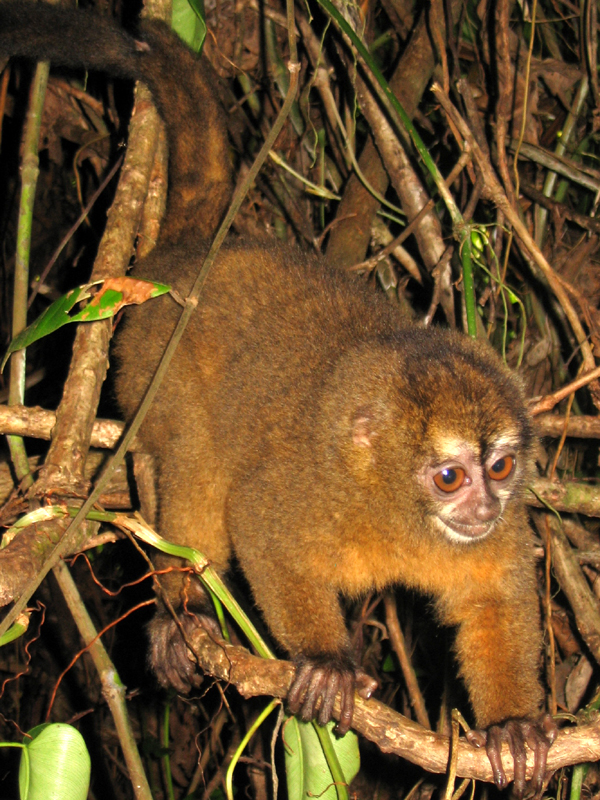
Black-headed Night Monkey

Black-headed Night Monkey

Aotus nigriceps

Miguelrangeljr, CC BY-SA 3.0, via Wikimedia Commons

Panamanian Night Monkey

Panamanian Night Monkey

Aotus zonalis

dsasso, CC BY-SA 2.0, via Wikimedia Commons

Side by side

Black-headed Night MonkeyPanamanian Night Monkey
Scientific nameAotus nigriceps Dollman, 1909Aotus zonalis Goldman, 1914
English nameBlack-headed Night MonkeyPanamanian Night Monkey
GroupMammalsMammals
ClassMammalia MammalMammalia Mammal
OrderPrimates PrimatePrimates Primate
FamilyAotidae Owl MonkeysAotidae Owl Monkeys
GenusAotus Night MonkeysAotus Night Monkeys
Named in19091914
Red List categoryLeast ConcernNear Threatened
Countries on record3 countries2 countries
GBIF occurrence records252 records292 records

Rows where the two agree are shown in grey.

Where each is found

Only Black-headed Night Monkey (3)

Only Panamanian Night Monkey (2)

From Catalogue of Life checklists and GBIF occurrence records. A country missing from a list means no record is held, which is not proof of absence.

Checked facts

Black-headed Night MonkeyPanamanian Night Monkey
Appearance
  • Adults have dark grey-black agouti fur on their upper backs and forelimbs. animaldiversity.org
  • The lower back, outer hind legs, and tail have orange-tan fur. animaldiversity.org
  • The forehead bears three prominent black stripes that nearly converge. animaldiversity.org
  • Two forehead stripes extend along the sides of the face toward the maxilla, while the central stripe reaches the bridge of the nose. animaldiversity.org
  • The species has white patches above the eyes, on the cheeks, and beneath the mouth. animaldiversity.org
  • Bright orange fur covers the sides of the neck and extends across the chest, stomach, limbs, and underside of the tail. animaldiversity.org
  • The species has short, thick coats. animaldiversity.org
  • The species has disproportionately large brown eyes. animaldiversity.org
  • Its small external ears are concealed by fur. animaldiversity.org
  • Its digits are long and slender, with straight nails and broad fingertip pads. animaldiversity.org
  • The second digit of each foot has a curved nail that may serve a grooming function. animaldiversity.org
Size
Habitat
  • The species inhabits lowland and hillside tropical forests. animaldiversity.org
  • The species is generally found in the upper canopy levels of forests. animaldiversity.org
  • Individuals select sleeping sites in branch forks, particularly in trees belonging to the genus Miconia. animaldiversity.org
  • The species in Peru has been recorded in areas degraded by human activities or natural ecosystem disturbances. English Wikipedia
Diet
  • The species is primarily frugivorous and prefers ripe Ficus fruits. animaldiversity.org
  • Its documented foods include leaves, flowers, moths, beetles, and spiders. English Wikipedia
  • The species also opportunistically consumes leaves, flowers, moths, beetles, and spiders. animaldiversity.org
No checked fact yet
Behaviour
  • The species is primarily nocturnal but has occasionally been observed during daylight. animaldiversity.org
  • Individuals move using arboreal quadrupedal locomotion. animaldiversity.org
  • Individuals defend their territories through vocalizations and aggression directed primarily at members of the same sex. animaldiversity.org
  • Territorial confrontations typically last between 5 and 30 minutes. animaldiversity.org
  • The species has average home ranges of approximately 9.2 hectares. animaldiversity.org
  • Nightly travel distances range from 340 to 1,025 metres, averaging 708 metres. animaldiversity.org
  • Resonant whoops and low-pitched hoots are the most common vocal communication forms in the genus. animaldiversity.org
  • Individuals use urine and skin secretions for scent marking. animaldiversity.org
  • The species is arboreal. English Wikipedia
  • The species lives in groups containing between two and six individuals. English Wikipedia
  • Social groups consist of an adult pair and their infant and juvenile or subadult offspring. English Wikipedia
  • Social groups are territorial and occupy home ranges that overlap only slightly. English Wikipedia
  • The species communicates through vocal, olfactory and behavioural signals. English Wikipedia
  • At least nine types of vocal calls have been documented. English Wikipedia
  • Its vocal repertoire includes grunts, screams, squeals, moans and trills. English Wikipedia
  • Males develop a scent gland near the tail at approximately one year of age. English Wikipedia
  • The species uses scent marking as a communication method. English Wikipedia
  • The species also communicates through urine washing, rubbing urine onto its hands and feet. English Wikipedia
  • Observed behavioural displays include arched-back postures and stiff-legged jumping. English Wikipedia
  • The species generally moves by walking on all four legs. English Wikipedia
  • The species can leap or run when necessary. English Wikipedia
Reproduction
Distribution
  • The species occurs in Bolivia, Brazil, and Peru. English Wikipedia
  • Its distribution includes the Amazonian and Madeiran forests of Peru, Brazil, and Colombia. animaldiversity.org
  • The species occurs in forest areas associated with the Huallaga, Ucayali, Yavari, Purus, and Madre de Dios river basins. animaldiversity.org
  • The species occurs in Panama and the Chocó region of Colombia. English Wikipedia
  • The species has been reported, without confirmation, from Costa Rica, particularly its Caribbean coast. English Wikipedia
  • The species is confirmed to occur in the Atlantic lowlands of Panama near the Costa Rican border. English Wikipedia
Conservation
UsesNo checked fact yet
  • The species can be observed by tourists visiting Panama with the assistance of a skilled guide. English Wikipedia
Similar species
  • The black-headed night monkey is classified as a red-necked or southern night monkey. animaldiversity.org
  • The species was formerly classified as a subspecies of the gray-bellied night monkey. English Wikipedia
  • Its classification as a separate species is supported by a study by Thomas Defler published in 2001. English Wikipedia
Other
  • The basal metabolic rate is 18–24% below the predicted rate for other mammals weighing one kilogram. animaldiversity.org
No checked fact yet

In brief

Black-headed Night Monkey

The species occurs in Bolivia, Brazil, and Peru, inhabiting lowland and hillside tropical forests. It is distinguished by three prominent black forehead stripes, large brown eyes, and bright orange fur on its underside. Full profile

Panamanian Night Monkey

The Panamanian Night Monkey is an arboreal species that lives in groups of two to six individuals. It occurs in Panama and the Chocó region of Colombia, with confirmed records from the Atlantic lowlands of Panama near the Costa Rican border. Full profile

Compare something else

Page built on 27 November 2026 from the data on the two species pages, where every source is listed.

Cite this page

ScientificNames.org. (2026). Black-headed Night Monkey vs Panamanian Night Monkey. Retrieved November 27, 2026, from https://scientificnames.org/compare/black-headed-night-monkey-vs-panamanian-night-monkey