Comparison

Panamanian Night Monkey vs Azara's Night Monkey

Panamanian Night Monkey (Aotus zonalis) and Azara's Night Monkey (Aotus azarae) both belong to the genus Aotus (night monkeys) and part ways below it.
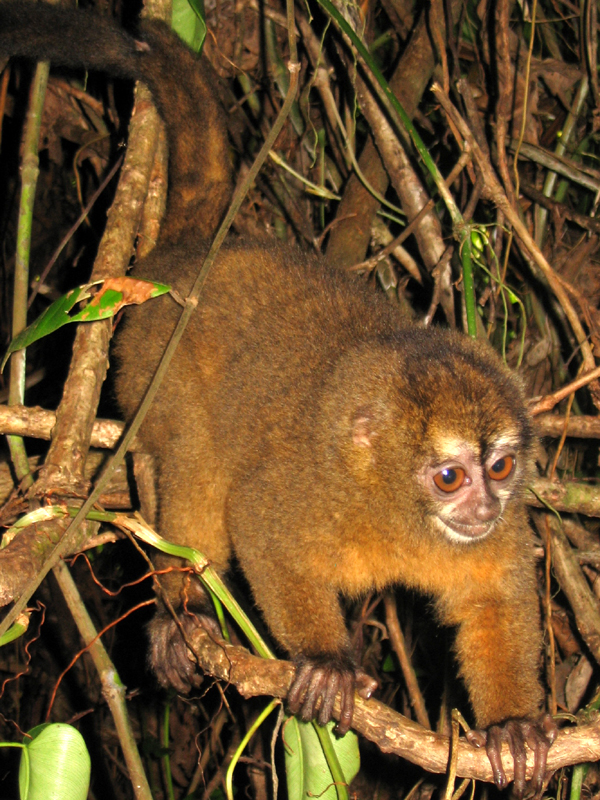
Panamanian Night Monkey

Panamanian Night Monkey

Aotus zonalis

dsasso, CC BY-SA 2.0, via Wikimedia Commons

Azara's Night Monkey

Azara's Night Monkey

Aotus azarae

Rich Hoyer, CC BY 2.0, via Wikimedia Commons

Side by side

Panamanian Night MonkeyAzara's Night Monkey
Scientific nameAotus zonalis Goldman, 1914Aotus azarae (Humboldt, 1812)
English namePanamanian Night MonkeyAzara's Night Monkey
GroupMammalsMammals
ClassMammalia MammalMammalia Mammal
OrderPrimates PrimatePrimates Primate
FamilyAotidae Owl MonkeysAotidae Owl Monkeys
GenusAotus Night MonkeysAotus Night Monkeys
Named in19141812
Red List categoryNear ThreatenedLeast Concern
Countries on record2 countries5 countries
GBIF occurrence records292 records468 records

Rows where the two agree are shown in grey.

Where each is found

Only Panamanian Night Monkey (2)

Only Azara's Night Monkey (5)

From Catalogue of Life checklists and GBIF occurrence records. A country missing from a list means no record is held, which is not proof of absence.

Checked facts

Panamanian Night MonkeyAzara's Night Monkey
Appearance
SizeNo checked fact yet
Habitat
  • The species inhabits gallery forests and semi-deciduous forests in the range of A. a. azarae. English Wikipedia
  • The subspecies A. a. infulatus occurs in humid lowland forests and gallery forests. English Wikipedia
  • The species occupies forest habitats extending into the more open landscapes of the Gran Chaco. English Wikipedia
  • Individuals inhabit trees in Bolivia, Paraguay, and northern Argentina. animaldiversity.org
  • Individuals sleep in hollow trees or dense foliage during the day. animaldiversity.org
DietNo checked fact yet
  • The species primarily eats fruit but also consumes leaves, flowers, insects, invertebrates, and small vertebrates. English Wikipedia
  • Fruits consumed include those belonging to the fig, guava, and nettle families. English Wikipedia
  • The species consumes grasshoppers, moths, millipedes, and occasionally bird eggs. English Wikipedia
  • The species also eats seeds, bark, and gums. animaldiversity.org
Behaviour
  • The species is arboreal. English Wikipedia
  • The species lives in groups containing between two and six individuals. English Wikipedia
  • Social groups consist of an adult pair and their infant and juvenile or subadult offspring. English Wikipedia
  • Social groups are territorial and occupy home ranges that overlap only slightly. English Wikipedia
  • The species communicates through vocal, olfactory and behavioural signals. English Wikipedia
  • At least nine types of vocal calls have been documented. English Wikipedia
  • Its vocal repertoire includes grunts, screams, squeals, moans and trills. English Wikipedia
  • Males develop a scent gland near the tail at approximately one year of age. English Wikipedia
  • The species uses scent marking as a communication method. English Wikipedia
  • The species also communicates through urine washing, rubbing urine onto its hands and feet. English Wikipedia
  • Observed behavioural displays include arched-back postures and stiff-legged jumping. English Wikipedia
  • The species generally moves by walking on all four legs. English Wikipedia
  • The species can leap or run when necessary. English Wikipedia
  • Individuals sleep in groups containing between two and five monkeys. English Wikipedia
  • The average social group consists of approximately three individuals. English Wikipedia
  • The species moves through forests by leaping between trees and traveling quadrupedally. English Wikipedia
  • Individuals use lianas to travel between trees. animaldiversity.org
  • The species forms small family groups consisting of parents and usually two to four offspring. animaldiversity.org
  • The species is genetically monogamous and forms stable reproductive pairs. English Wikipedia
  • The median duration of a pair bond is nine years. English Wikipedia
  • Individuals typically have one or two partners during their lifetimes. English Wikipedia
  • Males begin carrying infants when the infants reach approximately two weeks of age. English Wikipedia
  • Males carry infants more frequently than females. English Wikipedia
  • The species communicates through auditory and olfactory signals. English Wikipedia
  • Hoots are used for long-distance communication. English Wikipedia
  • Individuals use scent marking through urine and glands located at the base of the tail. English Wikipedia
Reproduction
Distribution
  • The species occurs in Panama and the Chocó region of Colombia. English Wikipedia
  • The species has been reported, without confirmation, from Costa Rica, particularly its Caribbean coast. English Wikipedia
  • The species is confirmed to occur in the Atlantic lowlands of Panama near the Costa Rican border. English Wikipedia
  • Azara's night monkey occurs in Argentina, Bolivia, Brazil, Peru, and Paraguay. English Wikipedia
Conservation
Uses
  • The species can be observed by tourists visiting Panama with the assistance of a skilled guide. English Wikipedia
  • The species has been used in biomedical research involving malaria and other natural infections. animaldiversity.org
  • The species has been used in research on ophthalmology and memory-related functions. animaldiversity.org
Similar species
  • The species was formerly classified as a subspecies of the gray-bellied night monkey. English Wikipedia
  • Its classification as a separate species is supported by a study by Thomas Defler published in 2001. English Wikipedia
No checked fact yet

In brief

Panamanian Night Monkey

The Panamanian Night Monkey is an arboreal species that lives in groups of two to six individuals. It occurs in Panama and the Chocó region of Colombia, with confirmed records from the Atlantic lowlands of Panama near the Costa Rican border. Full profile

Azara's Night Monkey

Aotus azarae occurs in Argentina, Bolivia, Brazil, Peru, and Paraguay. It has very large eyes, a relatively round head, and a non-prehensile tail with a black posterior third. Full profile

Compare something else

Page built on 27 November 2026 from the data on the two species pages, where every source is listed.

Cite this page

ScientificNames.org. (2026). Panamanian Night Monkey vs Azara's Night Monkey. Retrieved November 27, 2026, from https://scientificnames.org/compare/panamanian-night-monkey-vs-azaras-night-monkey