Comparison
California Ebony Tarantula vs Texas Brown Tarantula
California Ebony Tarantula (Aphonopelma eutylenum) and Texas Brown Tarantula (Aphonopelma hentzi) both belong to the genus Aphonopelma and part ways below it. Both are recorded in 2 countries.

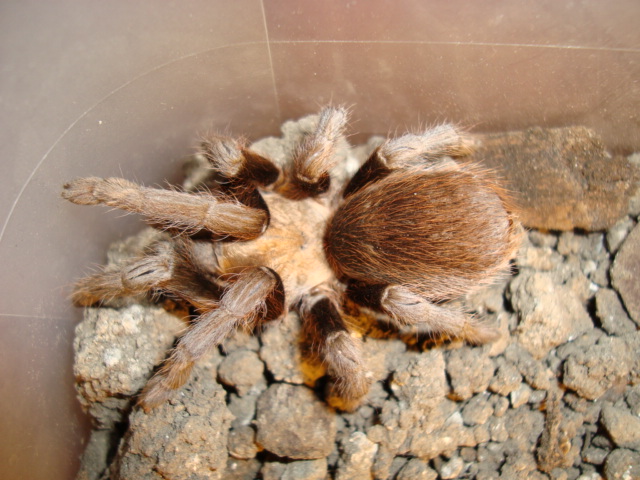
California Ebony Tarantula
Aphonopelma eutylenum
Chris A. Hamilton, Brent E. Hendrixson, Jason E. Bond, CC BY 4.0, via Wikimedia Commons


Side by side
| California Ebony Tarantula | Texas Brown Tarantula | |
|---|---|---|
| Scientific name | Aphonopelma eutylenum Chamberlin, 1940 | Aphonopelma hentzi (Girard, 1852) |
| English name | California Ebony Tarantula | Texas Brown Tarantula |
| Group | Spiders and other arachnids | Spiders and other arachnids |
| Class | Arachnida Arachnid | Arachnida Arachnid |
| Order | Araneae Spider | Araneae Spider |
| Family | Theraphosidae Tarantulas | Theraphosidae Tarantulas |
| Genus | Aphonopelma | Aphonopelma |
| Named in | 1940 | 1852 |
| Countries on record | 2 countries | 2 countries |
| GBIF occurrence records | 1,004 records | 6,597 records |
Rows where the two agree are shown in grey.
Where each is found
Both recorded in 2 countries
From Catalogue of Life checklists and GBIF occurrence records. A country missing from a list means no record is held, which is not proof of absence.
Checked facts
| California Ebony Tarantula | Texas Brown Tarantula | |
|---|---|---|
| Appearance |
|
|
| Size |
|
|
| Habitat | No checked fact yet |
|
| Behaviour | No checked fact yet |
|
| Reproduction |
|
|
| Distribution |
|
|
| Other | No checked fact yet |
|
In brief
California Ebony Tarantula
The species occurs in California, United States. Its body coloration ranges from light beige through dark brown to ebony. Full profile
Texas Brown Tarantula
Aphonopelma hentzi occurs in Colorado, Kansas, Missouri, New Mexico, Arizona, Oklahoma, Arkansas, Texas, and Louisiana, and has also been documented in northern Mexico along the New Mexico and Texas borders. Adults can attain leg spans exceeding 10 cm (4 in) and weights greater than 85 g (3 oz). Full profile
Compare something else
Page built on 29 November 2026 from the data on the two species pages, where every source is listed.
Cite this page
ScientificNames.org. (2026). California Ebony Tarantula vs Texas Brown Tarantula. Retrieved November 29, 2026, from https://scientificnames.org/compare/california-ebony-tarantula-vs-texas-brown-tarantula
“California Ebony Tarantula vs Texas Brown Tarantula.” ScientificNames.org, 2026, scientificnames.org/compare/california-ebony-tarantula-vs-texas-brown-tarantula. Accessed 29 Nov. 2026.
ScientificNames.org. “California Ebony Tarantula vs Texas Brown Tarantula.” Accessed November 29, 2026. https://scientificnames.org/compare/california-ebony-tarantula-vs-texas-brown-tarantula.
@misc{scientificnames_california_ebony_tarantula_vs_texas_brown_tarantula,
  author = {{ScientificNames.org}},
  title = {California Ebony Tarantula vs Texas Brown Tarantula},
  year = {2026},
  url = {https://scientificnames.org/compare/california-ebony-tarantula-vs-texas-brown-tarantula},
  note = {Accessed 2026-11-29}
}