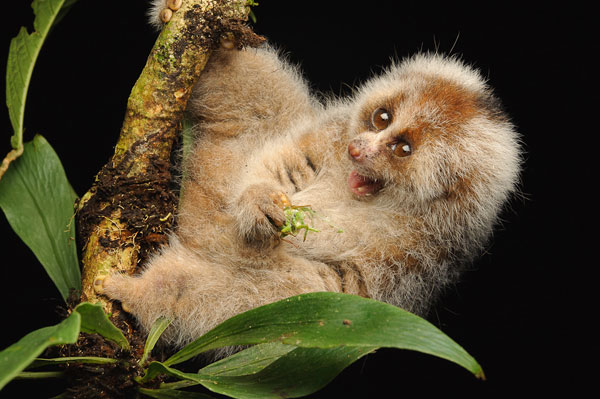
| Appearance | - The golden angwantibo has lustrous orange fur with a woolly texture. English Wikipedia
- Its fur is generally more vibrant orange than that of the Calabar angwantibo. English Wikipedia
- A white line runs along the golden angwantibo's nose. English Wikipedia
- Juvenile golden angwantibos have darker fur that becomes lighter as they mature. English Wikipedia
- Dark fur surrounding the eyes forms eyebrow-like patterns. English Wikipedia
- The front of the golden angwantibo's face is almost hairless. English Wikipedia
- The species has slender limbs, a cylindrical torso and blunt hindquarters. English Wikipedia
- Its head is globular, with a narrow snout and large eyes. English Wikipedia
- The golden angwantibo has a reduced index finger consisting of a tubercle with two very small phalanges. English Wikipedia
- Its tail is approximately 18 millimetres long and has a tuft of stiff, dark hairs. English Wikipedia
- The golden angwantibo has broad ribs that overlap in a shingle-like arrangement along its back. English Wikipedia
| |
|---|
| Size | - The golden angwantibo has a head-body length of approximately 22 centimetres. English Wikipedia
- The average body weight of golden angwantibos across both sexes is approximately 210 grams. English Wikipedia
- The species has a skull measuring approximately 54 millimetres. English Wikipedia
| - The average body length of the Bangka slow loris is 258.05 mm (10.159 inches). English Wikipedia
|
|---|
| Habitat | - The golden angwantibo primarily inhabits the understorey of rainforests, generally within five metres of the ground. English Wikipedia
- The species is also found on farmland. English Wikipedia
- Golden angwantibos are usually found alongside river banks. English Wikipedia
- The species occurs at forest edges and in treefall gaps created by tornados. English Wikipedia
- Golden angwantibos sleep during daylight hours in dense vegetation or tree forks. English Wikipedia
| |
|---|
| Diet | - Approximately 87 percent of the golden angwantibo's diet consists of animal prey, while fruit accounts for approximately 13 percent. English Wikipedia
- The species also consumes small quantities of wood fibres. English Wikipedia
- When available, golden angwantibos prefer easily consumed prey such as moths and orthopterans. English Wikipedia
- Golden angwantibos remove irritating caterpillar hairs by holding the caterpillar in their mouths and brushing its hairs away with their hands. English Wikipedia
| |
|---|
| Behaviour | - The golden angwantibo is nocturnal and generally solitary, although it exhibits social interactions. English Wikipedia
- Golden angwantibos primarily communicate indirectly through urine marking. English Wikipedia
- Adult golden angwantibos without infants generally sleep alone. English Wikipedia
- Mothers leave their infants alone while they forage. English Wikipedia
- The species moves slowly through trees using cautious climbing movements. English Wikipedia
- Golden angwantibos cannot jump and depend on continuous arboreal routes when travelling through trees. English Wikipedia
| - The Bangka slow loris is nocturnal. English Wikipedia
- The species uses its curved second hind-toe claw for scratching and grooming. English Wikipedia
- The species uses its toothcomb for grooming. English Wikipedia
- The Bangka slow loris uses secretions from its brachial gland defensively by wiping them onto its toothcomb. English Wikipedia
- The species has a toxic bite, a distinctive characteristic among primates. English Wikipedia
- The species activates its brachial gland toxin by mixing the secretion with saliva. English Wikipedia
- The species applies toxin to its fur during grooming to protect its infants. English Wikipedia
|
|---|
| Reproduction | - Female golden angwantibos can produce multiple single-offspring births within one year. English Wikipedia
- The gestation period of the golden angwantibo lasts approximately 131–136 days. English Wikipedia
- Newborn golden angwantibos weigh between 24 and 30 grams. English Wikipedia
- Golden angwantibo infants are born with their eyes fully open and a developed coat of dense fur. English Wikipedia
- Infants are weaned at approximately 100–130 days of age. English Wikipedia
- Golden angwantibos reach sexual maturity at approximately nine to ten months of age. English Wikipedia
| No checked fact yet |
|---|
| Distribution | - The golden angwantibo occurs in localised populations across Cameroon, the Central African Republic, the Republic of the Congo, Equatorial Guinea and Gabon. English Wikipedia
- The Sanaga River separates the golden angwantibo's range in Cameroon from that of the Calabar angwantibo. English Wikipedia
| - The Bangka slow loris occurs in southwestern Borneo and on Bangka Island. English Wikipedia
|
|---|
| Conservation | - The golden angwantibo is classified as a species of least concern on the IUCN Red List. English Wikipedia
- Hunting for bushmeat and extraction of body parts for traditional medicine are identified threats to the species. English Wikipedia
- The species is poorly studied, limiting reliable estimates of its abundance. English Wikipedia
| - The Bangka slow loris was assessed by the IUCN in 2015 as Critically Endangered. iucnredlist.org
- Habitat loss is one of the greatest threats to the survival of the Bangka slow loris. English Wikipedia
- Illegal wildlife trade is a major threat to the species. English Wikipedia
- The species is protected from commercial trade under Appendix I of CITES. English Wikipedia
- Tin mining and oil palm plantations have caused extensive habitat destruction on Bangka Island. English Wikipedia
|
|---|
| Similar species | - The Calabar angwantibo is the other species in the genus Arctocebus. English Wikipedia
| - The Bangka slow loris was formerly classified as a subspecies or synonym of the Bornean slow loris, Nycticebus menagensis. English Wikipedia
- Nycticebus bancanus was elevated to full species status in 2013 following examination of museum specimens and photographs. English Wikipedia
|
|---|
| Name origin | No checked fact yet | |
|---|
| Other | No checked fact yet | |
|---|