Comparison

Humblot's Heron vs Great Blue Heron

Humblot's Heron (Ardea humbloti) and Great Blue Heron (Ardea herodias) both belong to the genus Ardea (great herons) and part ways below it.
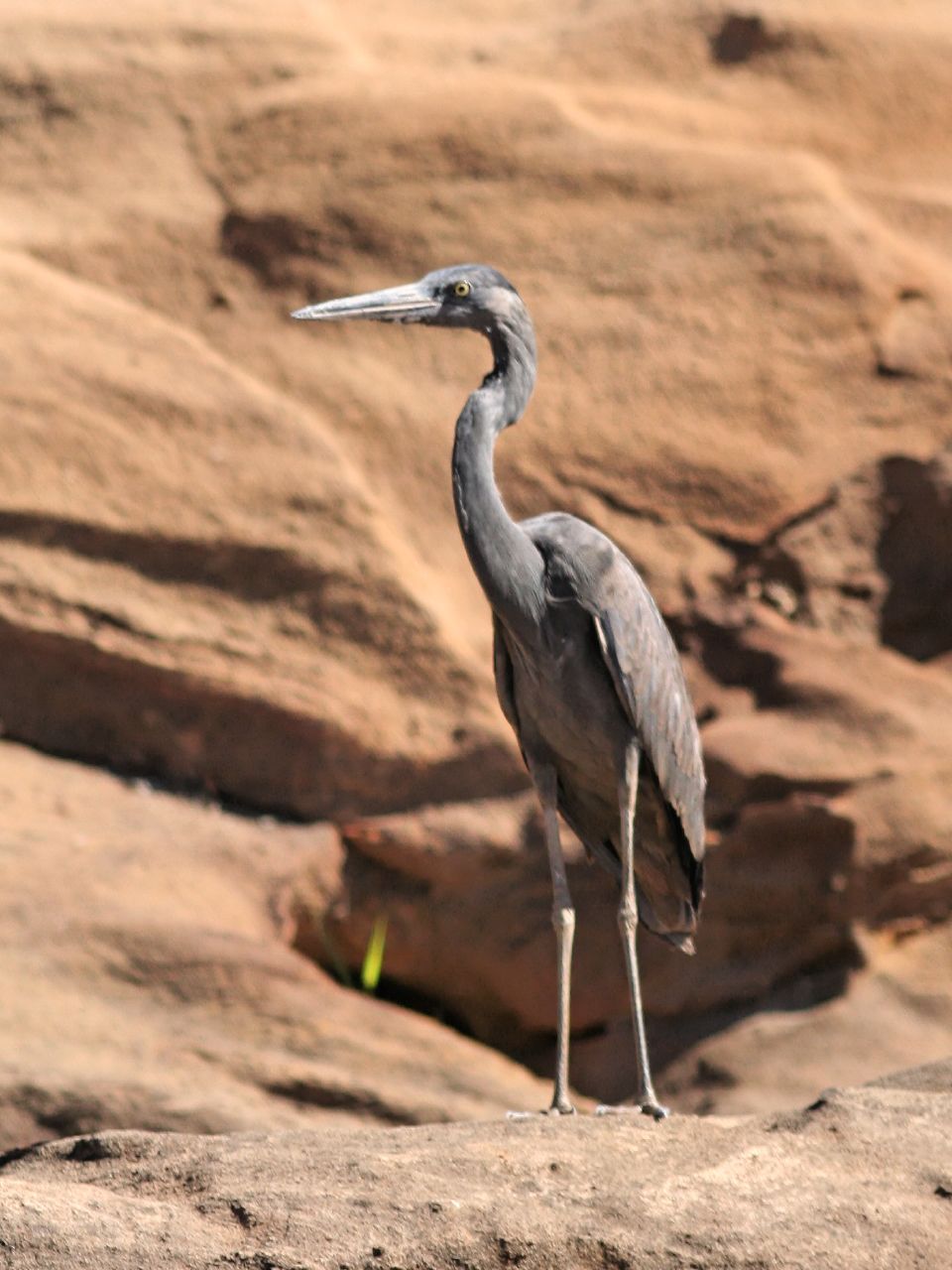
Humblot's Heron

Humblot's Heron

Ardea humbloti

Daniel Vaulot, CC BY-SA 2.0, via Wikimedia Commons

Great Blue Heron

Great Blue Heron

Ardea herodias

Rhododendrites, CC BY-SA 4.0, via Wikimedia Commons

Side by side

Humblot's HeronGreat Blue Heron
Scientific nameArdea humbloti Milne-Edwards & A. Grandidier, 1885Ardea herodias Linnaeus, 1758
English nameHumblot's HeronGreat Blue Heron
GroupBirdsBirds
ClassAves BirdAves Bird
OrderPelecaniformes HeronsPelecaniformes Herons
FamilyArdeidae HeronArdeidae Heron
GenusArdea Great HeronsArdea Great Herons
Named in18851758
Red List categoryEndangeredLeast Concern
EnvironmentNot recordedfreshwater, terrestrial
Countries on record2 countries46 countries
GBIF occurrence records1,638 records13,179,708 records

Rows where the two agree are shown in grey.

Where each is found

Only Humblot's Heron (2)

Only Great Blue Heron (46)

From Catalogue of Life checklists and GBIF occurrence records. A country missing from a list means no record is held, which is not proof of absence.

Checked facts

Humblot's HeronGreat Blue Heron
Appearance
  • Its elongated nape feathers form a crest. English Wikipedia
  • The species has a large pale bill, pale eyes and pale legs. English Wikipedia
  • The species is described as a large, entirely dark heron with a pale bill. ebird.org
  • The great blue heron has slaty flight feathers, red-brown thighs, and a rusty-gray neck with black-and-white streaking on the front. English Wikipedia
  • Adult great blue herons have a nearly white face and black or slate-colored plumes extending from above the eyes toward the back of the head. English Wikipedia
  • Immature great blue herons have duller plumage, a blackish-gray crown, weakly defined flank markings, and no plumes. English Wikipedia
  • The great blue heron's bill is normally dull yellowish but becomes orange briefly at the beginning of the breeding season. English Wikipedia
  • Male great blue herons are slightly larger than females, although the sexes are otherwise difficult to distinguish externally. English Wikipedia
Size
Habitat
  • The species inhabits freshwater, brackish-water and saltwater wetlands. English Wikipedia
  • The species prefers tidal areas but also occupies lakes, rivers, mangroves and estuaries. English Wikipedia
  • The species is most commonly found at low elevations, although records extend to 1,500 m. English Wikipedia
  • The great blue heron inhabits freshwater and saltwater marshes, mangrove swamps, flooded meadows, lake edges, and shorelines. English Wikipedia
  • Great blue herons can occupy heavily developed areas when fish-bearing bodies of water are present. English Wikipedia
  • Great blue herons generally nest in trees or bushes near water, often on islands. English Wikipedia
Diet
  • The species primarily feeds on medium-sized and large fish and crustaceans. English Wikipedia
  • Fish constitute the primary food of the great blue heron. English Wikipedia
  • Great blue herons generally prefer fish measuring approximately 10–20 cm in length. English Wikipedia
  • The great blue heron's diet in Nova Scotia consisted of 98% flounder. English Wikipedia
  • Great blue herons consume leopard frogs, American bullfrogs, toads, and salamanders. English Wikipedia
  • Great blue herons also prey on small turtles, snakes, and lizards. English Wikipedia
  • Great blue herons consume crayfish, shrimp, crabs, grasshoppers, dragonflies, and aquatic insects. English Wikipedia
  • Small mammals eaten by great blue herons include shrews, rats, ground squirrels, and moles. English Wikipedia
  • Great blue herons locate food visually and usually swallow their prey whole. English Wikipedia
Behaviour
  • The species forages on floating vegetation in clear, shallow water and during incoming and outgoing tides. English Wikipedia
  • The species feeds passively by remaining stationary for extended periods, often hunched or with its neck extended over the water. English Wikipedia
  • After capturing prey, the species flies to solid ground to eat it. English Wikipedia
  • The species does not migrate but can disperse over long distances. English Wikipedia
  • The species is generally observed alone. ebird.org
  • Great blue herons usually forage alone while standing in water. English Wikipedia
  • Great blue herons sometimes form loose feeding flocks that can help them locate schools of fish. English Wikipedia
  • Great blue herons typically feed in water less than 50 cm deep or along the water's edge. English Wikipedia
  • Great blue herons feed both during daylight and at night, particularly around dawn and dusk. English Wikipedia
  • The great blue heron commonly hunts by slowly wading through shallow water and spearing fish or frogs with its bill. English Wikipedia
Reproduction
  • Great blue herons generally breed in colonies containing an average of approximately 160 nests. English Wikipedia
  • Great blue heron breeding colonies are generally situated within 4–5 km of suitable feeding areas. English Wikipedia
  • Great blue herons are socially monogamous during an individual breeding season but usually select new mates each year. English Wikipedia
  • Great blue herons construct bulky nests from sticks. English Wikipedia
  • Newly constructed great blue heron nests are usually approximately 50 cm wide. English Wikipedia
  • Female great blue herons lay clutches of three to six pale-blue eggs. English Wikipedia
  • Great blue heron eggs are incubated for approximately 27 days. English Wikipedia
  • Great blue herons generally raise one brood each year. English Wikipedia
  • Young great blue herons generally take their first flight after approximately 55 days in Alberta and 80 days in California. English Wikipedia
Distribution
  • The great blue heron occurs across most of North America, extending north to Alaska and the southern Canadian provinces during summer. English Wikipedia
  • During winter, the great blue heron's range extends through Florida, Mexico, and the Caribbean to northwestern South America. English Wikipedia
Conservation
  • The species is classified as endangered on the IUCN Red List. English Wikipedia
  • The population of the species in Madagascar was estimated at 1,000–3,000 individuals in 2006. English Wikipedia
  • The species faces population decline associated with poaching, habitat destruction and invasive alien species such as water hyacinth. English Wikipedia
  • Poaching of both eggs and adult birds is identified as a likely cause of population decline. English Wikipedia
  • The rate of population decline has not yet been established. English Wikipedia
  • Human disturbance during the early nesting period negatively affects great blue heron reproduction. English Wikipedia
  • Repeated human intrusion into great blue heron nesting areas can cause nests to fail through abandonment of eggs or chicks. English Wikipedia
Similar species
  • The species has been proposed as a darker morph of the grey heron because of similarities in physical characteristics, but that proposal has been refuted. English Wikipedia
  • The great blue heron forms a superspecies with the grey heron and the Cocoi heron. English Wikipedia
  • The grey heron is somewhat smaller than the great blue heron, measuring 90–98 cm. English Wikipedia

In brief

Humblot's Heron

Ardea humbloti inhabits freshwater, brackish-water and saltwater wetlands, mainly in Madagascar, with small populations in the Comoros and Mayotte. It is a large, entirely dark heron distinguished by a pale bill and a crest formed by elongated nape feathers. Full profile

Great Blue Heron

Ardea herodias occurs across most of North America, extending north to Alaska and the southern Canadian provinces during summer, and south through Florida, Mexico, and the Caribbean to northwestern South America during winter. It has slaty flight feathers, red-brown thighs, a rusty-gray streaked neck, and a nearly white adult face with dark plumes extending from above the eyes toward the back of the head. Full profile

Compare something else

Page built on 28 November 2026 from the data on the two species pages, where every source is listed.

Cite this page

ScientificNames.org. (2026). Humblot's Heron vs Great Blue Heron. Retrieved November 28, 2026, from https://scientificnames.org/compare/humblots-heron-vs-great-blue-heron