Comparison
Argya caudata eclipes vs Red-billed Leiothrix
Argya caudata eclipes (Argya caudata eclipes) and Red-billed Leiothrix (Leiothrix lutea) both belong to the family Leiothrichidae (laughingthrush) and part ways below it.
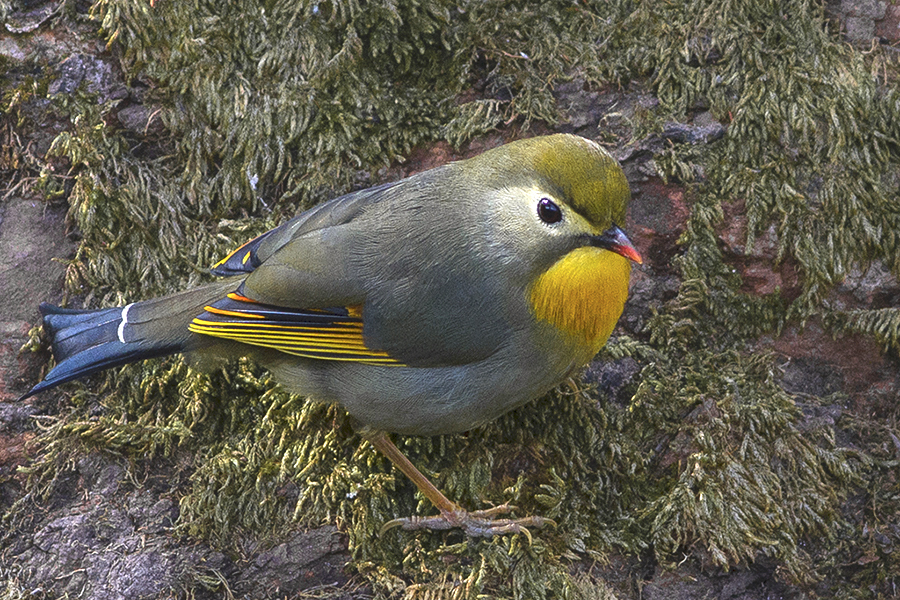

Side by side
| Argya caudata eclipes | Red-billed Leiothrix | |
|---|---|---|
| Scientific name | Argya caudata eclipes (Hume, 1877) | Leiothrix lutea (Scopoli, 1786) |
| English name | Not recorded | Red-billed Leiothrix |
| Rank | subspecies | species |
| Group | Birds | Birds |
| Class | Aves Bird | Aves Bird |
| Order | Passeriformes Passerine | Passeriformes Passerine |
| Family | Leiothrichidae Laughingthrush | Leiothrichidae Laughingthrush |
| Genus | Argya | Leiothrix Leiothrixes |
| Named in | 1877 | 1786 |
| Red List category | Not recorded | Least Concern |
| Countries on record | Not recorded | 24 countries |
| GBIF occurrence records | Not recorded | 82,966 records |
Rows where the two agree are shown in grey.
Where each is found
Only Red-billed Leiothrix (24)
- Belgium
- Bhutan
- Canada
- China
- France
- Germany
- Hong Kong
- India
- Italy
- Japan
- Macao
- Malaysia
- Myanmar
- Nepal
- Pakistan
- Portugal
- Spain
- Sweden
- Taiwan
- Thailand
- The Netherlands
- United Kingdom
- United States
- Vietnam
From Catalogue of Life checklists and GBIF occurrence records. A country missing from a list means no record is held, which is not proof of absence.
Checked facts
| Argya caudata eclipes | Red-billed Leiothrix | |
|---|---|---|
| Appearance | No checked fact yet |
|
| Size | No checked fact yet |
|
| Habitat | No checked fact yet |
|
| Diet | No checked fact yet |
|
| Behaviour | No checked fact yet |
|
| Reproduction | No checked fact yet |
|
| Distribution | No checked fact yet |
|
| Conservation | No checked fact yet |
|
| Uses | No checked fact yet |
|
| Other | No checked fact yet |
|
In brief
Red-billed Leiothrix
The Red-billed Leiothrix is a bird in the genus Leiothrix, alongside the silver-eared mesia. Adults have bright red bills, olive-green backs, yellow throats and orange-shaded breasts, with colourful wing-feather edges. Full profile
Compare something else
Page built on 26 November 2026 from the data on the two species pages, where every source is listed.
Cite this page
ScientificNames.org. (2026). Argya caudata eclipes vs Red-billed Leiothrix. Retrieved November 26, 2026, from https://scientificnames.org/compare/argya-caudata-eclipes-vs-red-billed-leiothrix
“Argya caudata eclipes vs Red-billed Leiothrix.” ScientificNames.org, 2026, scientificnames.org/compare/argya-caudata-eclipes-vs-red-billed-leiothrix. Accessed 26 Nov. 2026.
ScientificNames.org. “Argya caudata eclipes vs Red-billed Leiothrix.” Accessed November 26, 2026. https://scientificnames.org/compare/argya-caudata-eclipes-vs-red-billed-leiothrix.
@misc{scientificnames_argya_caudata_eclipes_vs_red_billed_leiothrix,
  author = {{ScientificNames.org}},
  title = {Argya caudata eclipes vs Red-billed Leiothrix},
  year = {2026},
  url = {https://scientificnames.org/compare/argya-caudata-eclipes-vs-red-billed-leiothrix},
  note = {Accessed 2026-11-26}
}