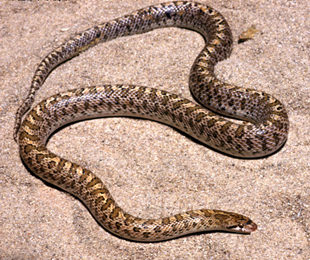
| Appearance | - Arizona elegans has smooth, glossy scales with spotted patterns in shades of tan, brown, and gray. English Wikipedia
- The species has a narrow, pointed head and a pale appearance. English Wikipedia
- The underside is white or cream-colored and lacks markings. English Wikipedia
- Juveniles have darker markings than adults, which become lighter as they grow. animaldiversity.org
- The species has a countersunk lower jaw that helps prevent sand from entering its mouth while burrowing. animaldiversity.org
- Distinguishing features include a prominent eye stripe, lidless eyes with slightly vertical pupils, and a single anal scale. animaldiversity.org
| - The dorsal coloration ranges from brown to gray, with a lighter central stripe bordered by two rows of small dark spots. English Wikipedia
- The underside is lighter brown or pink and has small black dots at the ends of the ventral scales. English Wikipedia
- Its dorsal scales are keeled, and it lacks a loreal scale. English Wikipedia
- Its coloration can range from gray and brown to reddish brown. mdc.mo.gov
- It usually has a tan dorsal stripe bordered by two rows of small brown spots that are often joined by a narrow brown line. mdc.mo.gov
- The top of its head is usually dark, with a dark spot beneath each eye and on both sides of the neck. mdc.mo.gov
- Its belly may be cream-colored, yellow, or pink. mdc.mo.gov
|
|---|
| Size | | No checked fact yet |
|---|
| Habitat | - The species inhabits semi-arid grasslands in the southwestern United States. English Wikipedia
- The species occupies barren sandy deserts, scrub, and rocky washes in addition to semi-arid grasslands. animaldiversity.org
- The species prefers open areas with sandy or loamy soil. animaldiversity.org
- The species occurs from below sea level to approximately 2,220 meters in elevation. animaldiversity.org
- The species uses crevices and rodent burrows as daytime retreats. animaldiversity.org
| - The species occupies wetland and terrestrial habitats east of the Great Plains, from sea level to approximately 1,400 meters elevation. English Wikipedia
- It commonly inhabits urban areas and is encountered more frequently in cities than in the countryside. English Wikipedia
- Its recorded habitats include wetlands, grasslands, dunes, and forests. English Wikipedia
- It prefers moist environments. mdc.mo.gov
- In Missouri, it commonly inhabits moist forests and woodlands, particularly along ravine, creek, and river floodplain edges. mdc.mo.gov
- Missouri populations also occur in prairies and grasslands near wetlands and woodlands. mdc.mo.gov
- In Missouri, it occurs in urban parks, cemeteries, and yards where shelter, moisture, and food are available. mdc.mo.gov
- Nebraska habitat records include woodlands around streams and brushy habitats. herpneb.unl.edu
|
|---|
| Diet | | - Its primary foods include slugs, snails, and earthworms. English Wikipedia
- Earthworms are generally the predominant prey in the southern part of its range, whereas slugs predominate in the north. English Wikipedia
- It can remove snails from their shells using specialized jaws. English Wikipedia
- Its diet includes earthworms, slugs, land snails, and soft-bodied insects. mdc.mo.gov
- One dietary study found that slugs accounted for 75 percent of its diet and earthworms for 25 percent. mdc.mo.gov
|
|---|
| Behaviour | | - Although generally solitary, individuals have occasionally been observed aggregating together. English Wikipedia
- It is secretive and usually hides beneath rocks or logs rather than remaining in open areas. English Wikipedia
- It occasionally burrows. English Wikipedia
- Its principal activity period extends approximately from March through October. English Wikipedia
- In Missouri, it is active from late March to early November. mdc.mo.gov
- In Missouri, individuals are sometimes observed crossing trails and roads during spring and fall. mdc.mo.gov
- Individuals may become nocturnally active during hot weather. mdc.mo.gov
- When threatened, it may coil the front portion of its body and sway it from side to side while attempting to escape. English Wikipedia
- When threatened, it releases a foul-smelling musk from its cloaca. English Wikipedia
- When captured, it may flatten its head and neck and release a musky secretion near the base of its tail. mdc.mo.gov
|
|---|
| Reproduction | | - The species is viviparous and gives birth to live offspring. English Wikipedia
- Individuals generally reach sexual maturity between two and three years of age. English Wikipedia
- Mating usually occurs in spring after individuals emerge from brumation. English Wikipedia
- Females can store sperm seasonally, delaying fertilization and birth to coincide with peak prey availability. English Wikipedia
- Females give birth to between three and 41 young in late summer. English Wikipedia
- In Missouri, mating generally occurs soon after emergence from overwintering retreats, although autumn mating also occurs. mdc.mo.gov
- In Missouri, females give birth between mid-July and September. mdc.mo.gov
|
|---|
| Distribution | - The species is native to the southwestern United States and northern Mexico. English Wikipedia
| - The species' native range includes southern Ontario and Quebec, much of the eastern United States, Mexico, Guatemala, Honduras, and possibly El Salvador. English Wikipedia
|
|---|
| Conservation | | - The species is considered beneficial to human interests because it consumes slugs and snails that can damage cultivated plants. mdc.mo.gov
|
|---|
| Uses | - The species provides an ecological benefit by controlling populations of small rodents, reptiles, and mammals. animaldiversity.org
- The species contributes to soil aeration through its burrowing activity. animaldiversity.org
| - The species helps control populations of the invertebrates it consumes. mdc.mo.gov
|
|---|
| Similar species | No checked fact yet | - The species is closely related to the red-bellied snake. mdc.mo.gov
- The formerly recognized midland brownsnake and Texas brownsnake are no longer considered distinct subspecies of this species. mdc.mo.gov
|
|---|
| Other | | |
|---|