Comparison

Verdin vs Grey Penduline Tit

Verdin (Auriparus flaviceps) and Grey Penduline Tit (Anthoscopus caroli) both belong to the family Remizidae (penduline tit) and part ways below it.
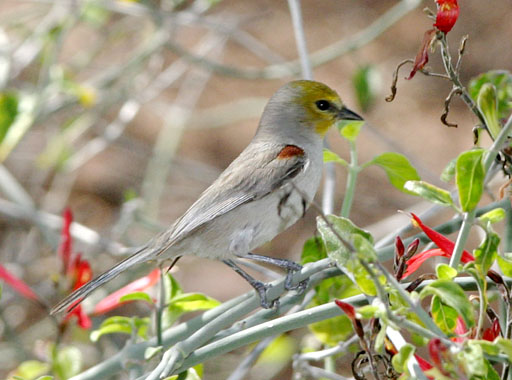
Verdin

Verdin

Auriparus flaviceps

Patrick Coin (Patrick Coin), CC BY-SA 2.5, via Wikimedia Commons

Grey Penduline Tit

Grey Penduline Tit

Anthoscopus caroli

Alan Manson, CC BY-SA 2.0, via Wikimedia Commons

Side by side

VerdinGrey Penduline Tit
Scientific nameAuriparus flaviceps (Sundevall, 1850)Anthoscopus caroli (Sharpe, 1871)
English nameVerdinGrey Penduline Tit
GroupBirdsBirds
ClassAves BirdAves Bird
OrderPasseriformes PasserinePasseriformes Passerine
FamilyRemizidae Penduline TitRemizidae Penduline Tit
GenusAuriparus VerdinAnthoscopus African Penduline-Tits
Named in18501871
Red List categoryLeast ConcernLeast Concern
EnvironmentterrestrialNot recorded
Countries on record2 countries16 countries
GBIF occurrence records993,608 records10,273 records

Rows where the two agree are shown in grey.

Where each is found

Only Verdin (2)

Only Grey Penduline Tit (16)

From Catalogue of Life checklists and GBIF occurrence records. A country missing from a list means no record is held, which is not proof of absence.

Checked facts

VerdinGrey Penduline Tit
Appearance
  • Adult verdins have an overall gray plumage, a bright yellow head, and a rufous shoulder patch. English Wikipedia
  • Juvenile verdins have a light gray body without the yellow head or rufous shoulder patch. English Wikipedia
  • The species has a short, thick-based bill that tapers to a sharp point. English Wikipedia
  • The verdin has an ash-gray upperside, a pale-gray or white underside, dark lores, and a maroon shoulder patch. animaldiversity.org
  • Male verdins are brighter overall than females. animaldiversity.org
No checked fact yet
SizeNo checked fact yet
Habitat
  • The species primarily inhabits desert scrub, particularly desert riparian zones and washes. animaldiversity.org
  • Verdins prefer thorny brush to open desert environments. animaldiversity.org
  • Verdins breed in thorny scrub on hillsides and along arroyos and gulches in Texas, from near sea level to approximately 1,800 m. txtbba.tamu.edu
  • In Arizona, 59% of breeding observations were associated with desert vegetation dominated by legume-family trees such as mesquite and palo verde. txtbba.tamu.edu
  • Verdins nest in shrubs and thorny thickets with few trees. English Wikipedia
No checked fact yet
Diet
  • The verdin's diet consists primarily of insects, supplemented by nectar, fruits, and legume seeds. animaldiversity.org
  • Recorded foods include caterpillars, jumping spiders, aphids, beetle and wasp larvae, and leafhoppers. animaldiversity.org
  • Verdins consume berries, nectar, palm fruits, and legume seedpods. animaldiversity.org
  • Verdins consume both adult insects and insect larvae, as well as hard and soft mast from trees and shrubs. English Wikipedia
  • During fall and winter, verdins feed on fruits, berries, and seeds from legumes. animaldiversity.org
  • Verdins sometimes obtain nectar from hummingbird feeders in suburban environments. animaldiversity.org
No checked fact yet
Behaviour
  • Verdins generally forage within the live foliage of trees and shrubs rather than near the ground. animaldiversity.org
  • When handling food, verdins frequently grasp flowers and prey with one foot. animaldiversity.org
  • Verdins move between branches using short, rapid wingbeats and frequently hop between branches. animaldiversity.org
  • Verdins generally begin their morning activity later than other birds and roost early in the evening. animaldiversity.org
  • Verdins use a repeated gee-gee-gee call as an alarm when detecting predators. English Wikipedia
  • Male verdins are solitary and tolerate other males within approximately 0.5 km of their territories. animaldiversity.org
  • Verdins can behave aggressively toward Bendire's thrashers, cactus wrens, and loggerhead shrikes. animaldiversity.org
  • Verdins build individual roosting nests that provide insulation during cold winter nights. txtbba.tamu.edu
  • Verdins lose an average of 7% of their body mass during winter nights despite roosting in nests. txtbba.tamu.edu
  • Verdins do not show evidence of storing food. animaldiversity.org
No checked fact yet
Reproduction
  • Verdins generally form monogamous breeding pairs during spring but do not remain paired throughout the year. English Wikipedia
  • Verdins breed from early March through August and occasionally into September. txtbba.tamu.edu
  • A typical clutch contains four eggs, with a recorded range of three to six eggs. txtbba.tamu.edu
  • Verdin eggs are blue-green to greenish white and have irregular reddish, brown, or grayish spots. txtbba.tamu.edu
  • Female verdins incubate their eggs for 14 to 18 days. animaldiversity.org
  • Verdin eggs weigh approximately 0.96 g each. animaldiversity.org
  • Verdin nest sites average 1.8 m above the ground and range from 0.8 to 4 m in height. animaldiversity.org
  • Breeding nests are spherical or oval structures made from interwoven thorny twigs and measure approximately 15–25 cm in diameter. txtbba.tamu.edu
  • Both male and female verdins participate in constructing breeding nests. txtbba.tamu.edu
  • Female verdins lay their eggs on consecutive mornings, at a rate of one egg per day. animaldiversity.org
  • Young verdins fledge approximately 17 to 21 days after hatching, depending on insect availability. animaldiversity.org
  • Approximately half of verdin pairs attempt a second brood. txtbba.tamu.edu
  • Male verdins assume full responsibility for the first brood when the female lays a second clutch. animaldiversity.org
No checked fact yet
Distribution
  • The species occurs in southwestern North America from southwestern Colorado into Mexico, including Baja California and the Gulf of Mexico coast south to Tamaulipas. animaldiversity.org
  • Verdins are year-round residents throughout their geographic range. txtbba.tamu.edu
  • In the United States, the highest relative abundances occur in Arizona below the Mogollon Rim and southeastern California. txtbba.tamu.edu
  • Verdins also occur in the extreme southern portions of Nevada and New Mexico. txtbba.tamu.edu
No checked fact yet
Conservation
  • The verdin is classified as a species of Least Concern by the IUCN. English Wikipedia
  • Urbanization, collisions with human structures, and predation are identified as threats to verdin populations. English Wikipedia
  • Verdin populations are negatively affected by habitat loss associated with commercial and residential development. animaldiversity.org
  • Texas Breeding Bird Survey data showed a statistically significant annual population decline of 7.8% between 1966 and 2005. txtbba.tamu.edu
No checked fact yet

In brief

Verdin

Auriparus flaviceps occurs in southwestern North America, from southwestern Colorado into Mexico, and is a year-round resident throughout its geographic range. Adults have gray plumage, a bright yellow head, and a rufous shoulder patch, while juveniles have a light gray body. Full profile

Compare something else

Page built on 26 November 2026 from the data on the two species pages, where every source is listed.

Cite this page

ScientificNames.org. (2026). Verdin vs Grey Penduline Tit. Retrieved November 26, 2026, from https://scientificnames.org/compare/verdin-vs-grey-penduline-tit