Comparison
Mosquito Fern vs Atlantic Azolla
Mosquito Fern (Azolla pinnata) and Atlantic Azolla (Azolla cristata) both belong to the genus Azolla (water fern) and part ways below it. Both are recorded in 3 countries.
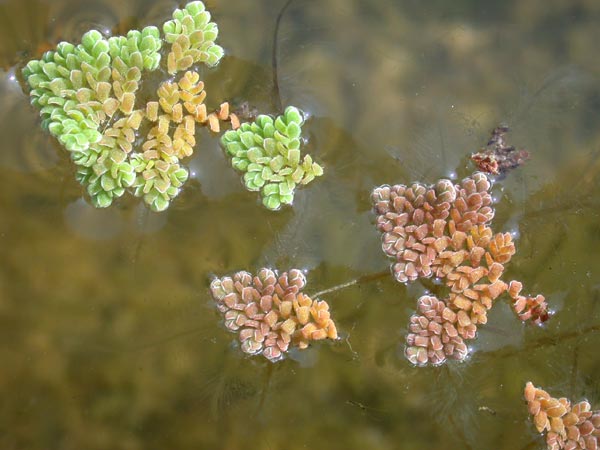

Atlantic Azolla
Azolla cristata
Side by side
| Mosquito Fern | Atlantic Azolla | |
|---|---|---|
| Scientific name | Azolla pinnata R.Br. | Azolla cristata Kaulf. |
| English name | Mosquito Fern | Atlantic Azolla |
| Group | Ferns and allies | Ferns and allies |
| Class | Polypodiopsida Fern | Polypodiopsida Fern |
| Order | Salviniales | Salviniales |
| Family | Salviniaceae Floating-fern Family | Salviniaceae Floating-fern Family |
| Genus | Azolla Water Fern | Azolla Water Fern |
| Red List category | Least Concern | Not recorded |
| Countries on record | 61 countries | 37 countries |
| GBIF occurrence records | 5,056 records | 2,043 records |
Rows where the two agree are shown in grey.
Where each is found
Both recorded in 3 countries
Only Mosquito Fern (58)
- Afghanistan
- Angola
- Australia
- Bangladesh
- Benin
- Bhutan
- Botswana
- Burkina Faso
- Burundi
- Cameroon
- Central African Republic
- Chad
- China
- Democratic Republic of the Congo
- Ethiopia
- Gabon
- Gambia
- Ghana
- Guinea-Bissau
- Hong Kong
- India
- Indonesia
- Ivory Coast
- Japan
- Kenya
- Liberia
- Madagascar
- Malawi
- Malaysia
- Mali
- Myanmar
- Namibia
- Nepal
- New Caledonia
- New Zealand
- Niger
- Nigeria
- Norfolk Island
- Pakistan
- Papua New Guinea
- Philippines
- Republic of the Congo
- Rwanda
- Senegal
- Sierra Leone
- Singapore
- Somalia
- South Korea
- Sri Lanka
- Sudan
- Taiwan
- Tanzania
- Thailand
- Togo
- Uganda
- Vietnam
- Zambia
- Zimbabwe
Only Atlantic Azolla (34)
- Argentina
- Belgium
- Bolivia
- Brazil
- Bulgaria
- Canada
- Chile
- Colombia
- Costa Rica
- Cuba
- Dominican Republic
- Ecuador
- Egypt
- El Salvador
- Eswatini
- France
- French Guiana
- Germany
- Guatemala
- Guyana
- Honduras
- Hungary
- Italy
- Mexico
- Moldova
- Nicaragua
- Panama
- Paraguay
- Peru
- Portugal
- Romania
- Spain
- Uruguay
- Venezuela
From Catalogue of Life checklists and GBIF occurrence records. A country missing from a list means no record is held, which is not proof of absence.
Checked facts
| Mosquito Fern | Atlantic Azolla | |
|---|---|---|
| Appearance |
| No checked fact yet |
| Size |
| No checked fact yet |
| Habitat |
| No checked fact yet |
| Behaviour |
| No checked fact yet |
| Reproduction |
| No checked fact yet |
| Distribution |
| No checked fact yet |
| Conservation |
| No checked fact yet |
| Uses |
| No checked fact yet |
| Other |
| No checked fact yet |
In brief
Mosquito Fern
Azolla pinnata floats on quiet and slow-moving water bodies and is native to much of Africa, Asia, and parts of Australia. Its overlapping leaves have tiny hairs that give the plant a velvety appearance and help it remain afloat after submersion. Full profile
Compare something else
Page built on 29 November 2026 from the data on the two species pages, where every source is listed.
Cite this page
ScientificNames.org. (2026). Mosquito Fern vs Atlantic Azolla. Retrieved November 29, 2026, from https://scientificnames.org/compare/mosquito-fern-vs-atlantic-azolla
“Mosquito Fern vs Atlantic Azolla.” ScientificNames.org, 2026, scientificnames.org/compare/mosquito-fern-vs-atlantic-azolla. Accessed 29 Nov. 2026.
ScientificNames.org. “Mosquito Fern vs Atlantic Azolla.” Accessed November 29, 2026. https://scientificnames.org/compare/mosquito-fern-vs-atlantic-azolla.
@misc{scientificnames_mosquito_fern_vs_atlantic_azolla,
  author = {{ScientificNames.org}},
  title = {Mosquito Fern vs Atlantic Azolla},
  year = {2026},
  url = {https://scientificnames.org/compare/mosquito-fern-vs-atlantic-azolla},
  note = {Accessed 2026-11-29}
}