Comparison
Balcones Cave Amphipod vs Peck's Cave Amphipod
Balcones Cave Amphipod (Stygobromus balconis) and Peck's Cave Amphipod (Stygobromus pecki) both belong to the genus Stygobromus and part ways below it. Both are recorded in 1 country.

Balcones Cave Amphipod
Stygobromus balconis
Photo by Dr. Jean K. Krejca, Zara Environmental LLC - Nissen BD, Devitt TJ, Bendik NF, Gluesenkamp AG, Gibson R (2018) New occurrence records for stygobiontic invertebrates from the Edwards and Trinit, CC BY 4.0, via Wikimedia Commons

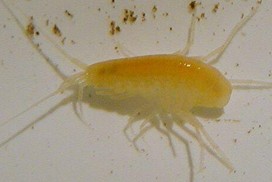
Peck's Cave Amphipod
Stygobromus pecki
Joe Fries, San Marcos National Fish Hatchery, Public domain, via Wikimedia Commons

Side by side
| Balcones Cave Amphipod | Peck's Cave Amphipod | |
|---|---|---|
| Scientific name | Stygobromus balconis (Hubricht, 1943) | Stygobromus pecki (Holsinger, 1967) |
| English name | Balcones Cave Amphipod | Peck's Cave Amphipod |
| Group | Crustaceans | Crustaceans |
| Class | Malacostraca | Malacostraca |
| Order | Amphipoda | Amphipoda |
| Family | Crangonyctidae | Crangonyctidae |
| Genus | Stygobromus | Stygobromus |
| Named in | 1943 | 1967 |
| Red List category | Vulnerable | Endangered |
| Environment | freshwater | freshwater |
| Countries on record | 1 country | 1 country |
| GBIF occurrence records | 29 records | 40 records |
Rows where the two agree are shown in grey.
Where each is found
Both recorded in 1 country
From Catalogue of Life checklists and GBIF occurrence records. A country missing from a list means no record is held, which is not proof of absence.
Checked facts
| Balcones Cave Amphipod | Peck's Cave Amphipod | |
|---|---|---|
| Appearance |
|
|
| Size | No checked fact yet |
|
| Habitat |
|
|
| Diet | No checked fact yet |
|
| Behaviour | No checked fact yet |
|
| Reproduction | No checked fact yet |
|
| Lifespan | No checked fact yet |
|
| Distribution |
|
|
| Conservation | No checked fact yet |
|
| Name origin |
| No checked fact yet |
In brief
Balcones Cave Amphipod
The Balcones cave amphipod is a troglomorphic amphipod species. It inhabits subterranean environments and is endemic to Texas in the United States. Its common name refers to the Balcones Escarpment in central Texas. Full profile
Peck's Cave Amphipod
Peck's cave amphipod is a crustacean in the family Crangonyctidae, order Amphipoda, and class Malacostraca. It inhabits underground spring aquifers in Comal Springs, Hueco Springs, Landa Park, and Panther Canyon in New Braunfels, Texas, United States. It lacks eyes and body pigmentation and has a laterally flattened body with five pairs of legs and two pairs of antennae. Full profile
Compare something else
Page built on 27 November 2026 from the data on the two species pages, where every source is listed.
Cite this page
ScientificNames.org. (2026). Balcones Cave Amphipod vs Peck's Cave Amphipod. Retrieved November 27, 2026, from https://scientificnames.org/compare/balcones-cave-amphipod-vs-pecks-cave-amphipod
“Balcones Cave Amphipod vs Peck's Cave Amphipod.” ScientificNames.org, 2026, scientificnames.org/compare/balcones-cave-amphipod-vs-pecks-cave-amphipod. Accessed 27 Nov. 2026.
ScientificNames.org. “Balcones Cave Amphipod vs Peck's Cave Amphipod.” Accessed November 27, 2026. https://scientificnames.org/compare/balcones-cave-amphipod-vs-pecks-cave-amphipod.
@misc{scientificnames_balcones_cave_amphipod_vs_pecks_cave_amphipod,
  author = {{ScientificNames.org}},
  title = {Balcones Cave Amphipod vs Peck's Cave Amphipod},
  year = {2026},
  url = {https://scientificnames.org/compare/balcones-cave-amphipod-vs-pecks-cave-amphipod},
  note = {Accessed 2026-11-27}
}