Comparison
Kura Barbel vs Common Barbel
Kura Barbel (Barbus cyri) and Common Barbel (Barbus barbus) both belong to the genus Barbus (barbs) and part ways below it.

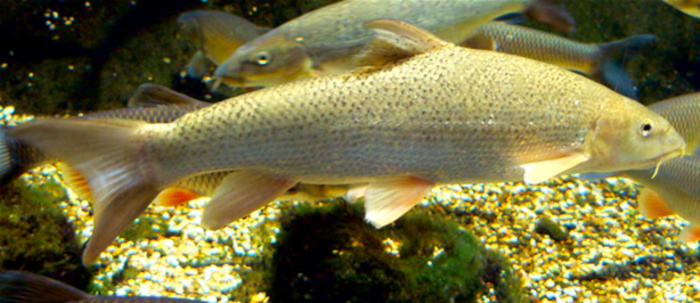
Kura Barbel
Barbus cyri
Kaya C, Bayçelebi E, Turan D (2020) Taxonomic assessment and distribution of fishes in upper Kura and Aras river drainages. Zoosystematics and Evolution 96(2): 325-344. https://doi.org/10.3897/zse.96, CC BY 4.0, via Wikimedia Commons


Side by side
| Kura Barbel | Common Barbel | |
|---|---|---|
| Scientific name | Barbus cyri De Filippi, 1865 | Barbus barbus (Linnaeus, 1758) |
| English name | Kura Barbel | Common Barbel |
| Group | Fishes | Fishes |
| Class | Teleostei Teleost | Teleostei Teleost |
| Order | Cypriniformes | Cypriniformes |
| Family | Cyprinidae Carps | Cyprinidae Carps |
| Genus | Barbus Barbs | Barbus Barbs |
| Named in | 1865 | 1758 |
| Red List category | Not recorded | Least Concern |
| Environment | freshwater | freshwater |
| Countries on record | 5 countries | 29 countries |
| GBIF occurrence records | 500 records | 291,548 records |
Rows where the two agree are shown in grey.
Where each is found
Only Kura Barbel (5)
Only Common Barbel (29)
- Andorra
- Austria
- Belgium
- Bosnia and Herzegovina
- Bulgaria
- Croatia
- Czechia
- France
- Germany
- Greece
- Hungary
- Italy
- Kosovo
- Lithuania
- Luxembourg
- Moldova
- Montenegro
- Poland
- Portugal
- Romania
- Russia
- Serbia
- Slovakia
- Slovenia
- Spain
- Switzerland
- The Netherlands
- Ukraine
- United Kingdom
From Catalogue of Life checklists and GBIF occurrence records. A country missing from a list means no record is held, which is not proof of absence.
Checked facts
| Kura Barbel | Common Barbel | |
|---|---|---|
| Appearance |
|
|
| Size | No checked fact yet |
|
| Habitat |
|
|
| Diet | No checked fact yet |
|
| Behaviour | No checked fact yet |
|
| Reproduction | No checked fact yet |
|
| Distribution |
|
|
| Uses | No checked fact yet |
|
| Name origin |
| No checked fact yet |
| Other | No checked fact yet |
|
In brief
Kura Barbel
The Kura Barbel is a freshwater cyprinid fish. It occurs in the Near East region and is also found in Lake Sevan following its synonymisation with the Gokcha barbel. The specific epithet cyri derives from the Latin word Cyrus, referring to the Kura River in Georgia. Full profile
Common Barbel
Barbus barbus is predominantly a river-dwelling fish that favours fast-flowing rivers with gravel or stone bottoms. Adults typically have dark brown, bronze or grey colouring, a pale underside and reddish or orange-tinged fins. Full profile
Compare something else
Page built on 27 November 2026 from the data on the two species pages, where every source is listed.
Cite this page
ScientificNames.org. (2026). Kura Barbel vs Common Barbel. Retrieved November 27, 2026, from https://scientificnames.org/compare/kura-barbel-vs-common-barbel
“Kura Barbel vs Common Barbel.” ScientificNames.org, 2026, scientificnames.org/compare/kura-barbel-vs-common-barbel. Accessed 27 Nov. 2026.
ScientificNames.org. “Kura Barbel vs Common Barbel.” Accessed November 27, 2026. https://scientificnames.org/compare/kura-barbel-vs-common-barbel.
@misc{scientificnames_kura_barbel_vs_common_barbel,
  author = {{ScientificNames.org}},
  title = {Kura Barbel vs Common Barbel},
  year = {2026},
  url = {https://scientificnames.org/compare/kura-barbel-vs-common-barbel},
  note = {Accessed 2026-11-27}
}