Comparison
Barbus leuciscus vs Common Barbel
Barbus leuciscus (Barbus leuciscus) and Common Barbel (Barbus barbus) both belong to the genus Barbus (barbs) and part ways below it.
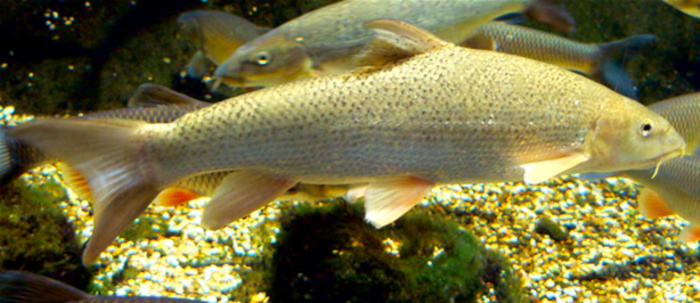

Side by side
| Barbus leuciscus | Common Barbel | |
|---|---|---|
| Scientific name | Barbus leuciscus Cuvier in van Hasselt, 1823 | Barbus barbus (Linnaeus, 1758) |
| English name | Not recorded | Common Barbel |
| Group | Fishes | Fishes |
| Class | Teleostei Teleost | Teleostei Teleost |
| Order | Cypriniformes | Cypriniformes |
| Family | Cyprinidae Carps | Cyprinidae Carps |
| Genus | Barbus Barbs | Barbus Barbs |
| Named in | 1823 | 1758 |
| Red List category | Not recorded | Least Concern |
| Environment | Not recorded | freshwater |
| Countries on record | Not recorded | 29 countries |
| GBIF occurrence records | Not recorded | 291,548 records |
Rows where the two agree are shown in grey.
Where each is found
Only Common Barbel (29)
- Andorra
- Austria
- Belgium
- Bosnia and Herzegovina
- Bulgaria
- Croatia
- Czechia
- France
- Germany
- Greece
- Hungary
- Italy
- Kosovo
- Lithuania
- Luxembourg
- Moldova
- Montenegro
- Poland
- Portugal
- Romania
- Russia
- Serbia
- Slovakia
- Slovenia
- Spain
- Switzerland
- The Netherlands
- Ukraine
- United Kingdom
From Catalogue of Life checklists and GBIF occurrence records. A country missing from a list means no record is held, which is not proof of absence.
Checked facts
| Barbus leuciscus | Common Barbel | |
|---|---|---|
| Appearance | No checked fact yet |
|
| Size | No checked fact yet |
|
| Habitat | No checked fact yet |
|
| Diet | No checked fact yet |
|
| Behaviour | No checked fact yet |
|
| Reproduction | No checked fact yet |
|
| Distribution | No checked fact yet |
|
| Uses | No checked fact yet |
|
| Other | No checked fact yet |
|
In brief
Common Barbel
Barbus barbus is predominantly a river-dwelling fish that favours fast-flowing rivers with gravel or stone bottoms. Adults typically have dark brown, bronze or grey colouring, a pale underside and reddish or orange-tinged fins. Full profile
Compare something else
Page built on 27 November 2026 from the data on the two species pages, where every source is listed.
Cite this page
ScientificNames.org. (2026). Barbus leuciscus vs Common Barbel. Retrieved November 27, 2026, from https://scientificnames.org/compare/barbus-leuciscus-vs-common-barbel
“Barbus leuciscus vs Common Barbel.” ScientificNames.org, 2026, scientificnames.org/compare/barbus-leuciscus-vs-common-barbel. Accessed 27 Nov. 2026.
ScientificNames.org. “Barbus leuciscus vs Common Barbel.” Accessed November 27, 2026. https://scientificnames.org/compare/barbus-leuciscus-vs-common-barbel.
@misc{scientificnames_barbus_leuciscus_vs_common_barbel,
  author = {{ScientificNames.org}},
  title = {Barbus leuciscus vs Common Barbel},
  year = {2026},
  url = {https://scientificnames.org/compare/barbus-leuciscus-vs-common-barbel},
  note = {Accessed 2026-11-27}
}