| Appearance | - Corylus cornuta is a deciduous shrub that typically grows with several trunks. English Wikipedia
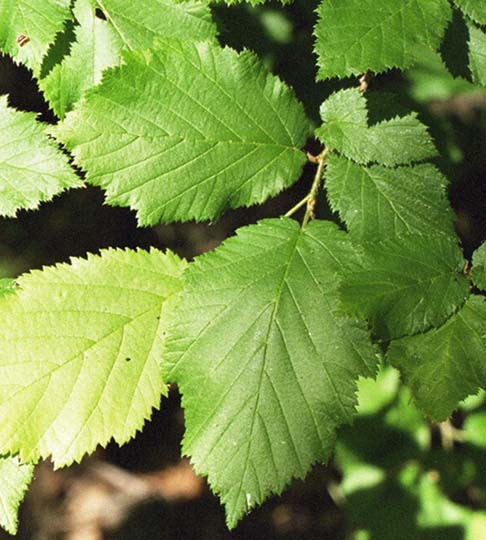
- Its leaves are alternately arranged, rounded oval with pointed tips, and have irregularly double-toothed margins. English Wikipedia
- The undersides of its leaves are soft and hairy. English Wikipedia
- Its male flowers grow in firm catkins arranged in clusters of one to three on twigs from the previous year. English Wikipedia
- The male catkins become elongated and pendulous in spring. English Wikipedia
- The husk bears tiny filaments that can penetrate and irritate contacting skin. English Wikipedia
- Its nuts are spherical, small, and enclosed in hard shells. English Wikipedia
| - Corylus avellana is a deciduous shrub with rounded leaves that have soft hairs on both surfaces and doubly serrated margins. English Wikipedia
- Its flowers are unisexual, wind-pollinated catkins produced before the leaves emerge in early spring. English Wikipedia
- Male catkins are pale yellow and measure 5–12 centimetres long. English Wikipedia
- Female flowers are mostly concealed inside buds, with only bright red styles measuring 1–3 millimetres visible. English Wikipedia
- The fruits are roughly spherical to oval nuts with yellow-brown shells and pale basal scars. English Wikipedia
- Each nut is enclosed for approximately three-quarters of its length by a short leafy husk. English Wikipedia
- The nuts grow in clusters containing one to five fruits. English Wikipedia
- The plant has multiple trunks and twisting shoots that form a thicket. plants.ces.ncsu.edu
- Its bark is smooth and light brown to light gray. plants.ces.ncsu.edu
- Its leaves are simple, alternate, and elliptical, orbicular or ovate in shape. plants.ces.ncsu.edu
- The leaves turn yellow or gold in autumn. plants.ces.ncsu.edu
|
|---|
| Size | | - The shrub typically reaches 3–8 metres in height but can grow up to 15 metres. English Wikipedia
|
|---|
| Habitat | - The species is more common in forests with relatively open canopies than in forests with dense canopies. English Wikipedia
- The species does not tolerate completely open habitats that become hot and dry. English Wikipedia
- The eastern variety occurs at elevations of 100–500 metres across most of its range, reaching 1,000 metres in Alberta. English Wikipedia
- The western variety occurs below 2,100 metres in California and below 800 metres in British Columbia. English Wikipedia
| |
|---|
| Diet | - Deer, moose, and livestock browse the foliage of the eastern variety. English Wikipedia
- Ruffed grouse feed on the species' catkins and young buds. English Wikipedia
- Red squirrels and least chipmunks are important rodents that cache the species' seeds. fs.usda.gov
| |
|---|
| Behaviour | - The species can tolerate some shade but does not thrive in completely open, hot, dry areas. English Wikipedia
- Above-ground growth is killed by fire, but the shrub can resprout from its root crown or rhizomes. English Wikipedia
- Rodents generally disperse the species' nuts no farther than approximately 90 metres. fs.usda.gov
- Squirrels generally distribute the nuts no farther than approximately 90 metres. English Wikipedia
| No checked fact yet |
|---|
| Reproduction | - Single female flowers develop in early spring. English Wikipedia
- The male flowers develop on twigs produced during the previous year. English Wikipedia
- Some nuts buried by squirrels in soil or leaves have an increased chance of germination. English Wikipedia
| - The species produces male and female flowers on the same plant. rhs.org.uk
- Flowering generally occurs between January and March over a period of four to six weeks. rhs.org.uk
- Male and female flowering periods seldom overlap, making self-pollination sporadic. rhs.org.uk
- Pollination occurs through wind. rhs.org.uk
- Wild hazel growing nearby can pollinate most cultivated varieties. rhs.org.uk
- The plants can be propagated by removing rooted suckers and planting them separately. rhs.org.uk
- Layering is a successful propagation method for the species. rhs.org.uk
- Seed propagation requires cold stratification. rhs.org.uk
- The ripe nuts separate from their husks approximately seven to eight months after pollination. English Wikipedia
|
|---|
| Distribution | - The eastern variety occurs from southern Canada south to Georgia. English Wikipedia
- The western variety occurs along the west coast from Alaska to California. English Wikipedia
- The species has two geographically distinct varieties, an eastern variety and a western variety. English Wikipedia
| - The native distribution of Corylus avellana extends across Europe and Western Asia. English Wikipedia
- Its geographical range extends from Ireland and the British Isles to Iberia, Italy, Greece, Turkey and Cyprus. English Wikipedia
- Its northern range reaches central Scandinavia. English Wikipedia
- Its eastern range reaches the central Ural Mountains, the Caucasus and northwestern Iran. English Wikipedia
|
|---|
| Conservation | - The species is threatened in boreal regions by the invasive Siberian peashrub. English Wikipedia
| |
|---|
| Uses | - The Gitxsan, Tsimshian, and Nisga'a peoples have cultivated the species for at least 7,000 years. English Wikipedia
- Native American peoples used the sprouts to make baskets, fish traps, and baby carriers. English Wikipedia
- The nuts were eaten and traded among Indigenous groups. English Wikipedia
- The species was used medicinally as an emetic, deworming agent, astringent, and teething aid. English Wikipedia
- The species is used in restoration plantings to increase biodiversity and improve wildlife food sources. English Wikipedia
- The species is used in restoration plantings to reduce laminated root rot in nearby Douglas-fir and Sitka spruce. English Wikipedia
| - The nuts are edible and are used for human consumption. plants.ces.ncsu.edu
- The wood has traditionally been harvested as coppice and used for wattle-and-daub construction and agricultural fencing. English Wikipedia
- The species has historically been used as a component of hedgerows serving as field boundaries in lowland England. English Wikipedia
- Commercial cultivation of the species for nuts occurs in Europe, Turkey, Iran and the Caucasus. English Wikipedia
|
|---|
| Similar species | - The western variety is considered to have low palatability for ungulates, unlike the eastern variety. English Wikipedia
| No checked fact yet |
|---|
| Name origin | - The common name beaked hazelnut refers to the beak-like tubular extension of the fruit husk. English Wikipedia
| No checked fact yet |
|---|