| Appearance | - Males of the subspecies Remiz macronyx neglectus typically have their heads more extensively covered in black plumage and show fewer traces of chestnut coloration than other subspecies. English Wikipedia
- The subspecies Remiz macronyx nigricans had a dark head and a chestnut-colored body. English Wikipedia
- The Black-headed Penduline-Tit has an entirely dark head, unlike the dark facial mask of the similar caspia form. ebird.org
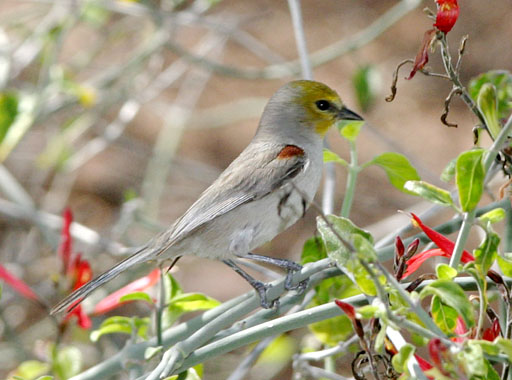
| - Adult verdins have an overall gray plumage, a bright yellow head, and a rufous shoulder patch. English Wikipedia
- Juvenile verdins have a light gray body without the yellow head or rufous shoulder patch. English Wikipedia
- The species has a short, thick-based bill that tapers to a sharp point. English Wikipedia
- The verdin has an ash-gray upperside, a pale-gray or white underside, dark lores, and a maroon shoulder patch. animaldiversity.org
- Male verdins are brighter overall than females. animaldiversity.org
|
|---|
| Size | No checked fact yet | |
|---|
| Habitat | - The species inhabits reed beds along lakes and rivers in Central Asia. English Wikipedia
| - The species primarily inhabits desert scrub, particularly desert riparian zones and washes. animaldiversity.org
- Verdins prefer thorny brush to open desert environments. animaldiversity.org
- Verdins breed in thorny scrub on hillsides and along arroyos and gulches in Texas, from near sea level to approximately 1,800 m. txtbba.tamu.edu
- In Arizona, 59% of breeding observations were associated with desert vegetation dominated by legume-family trees such as mesquite and palo verde. txtbba.tamu.edu
- Verdins nest in shrubs and thorny thickets with few trees. English Wikipedia
|
|---|
| Diet | No checked fact yet | - The verdin's diet consists primarily of insects, supplemented by nectar, fruits, and legume seeds. animaldiversity.org
- Recorded foods include caterpillars, jumping spiders, aphids, beetle and wasp larvae, and leafhoppers. animaldiversity.org
- Verdins consume berries, nectar, palm fruits, and legume seedpods. animaldiversity.org
- Verdins consume both adult insects and insect larvae, as well as hard and soft mast from trees and shrubs. English Wikipedia
- During fall and winter, verdins feed on fruits, berries, and seeds from legumes. animaldiversity.org
- Verdins sometimes obtain nectar from hummingbird feeders in suburban environments. animaldiversity.org
|
|---|
| Behaviour | No checked fact yet | - Verdins generally forage within the live foliage of trees and shrubs rather than near the ground. animaldiversity.org
- When handling food, verdins frequently grasp flowers and prey with one foot. animaldiversity.org
- Verdins move between branches using short, rapid wingbeats and frequently hop between branches. animaldiversity.org
- Verdins generally begin their morning activity later than other birds and roost early in the evening. animaldiversity.org
- Verdins use a repeated gee-gee-gee call as an alarm when detecting predators. English Wikipedia
- Male verdins are solitary and tolerate other males within approximately 0.5 km of their territories. animaldiversity.org
- Verdins can behave aggressively toward Bendire's thrashers, cactus wrens, and loggerhead shrikes. animaldiversity.org
- Verdins build individual roosting nests that provide insulation during cold winter nights. txtbba.tamu.edu
- Verdins lose an average of 7% of their body mass during winter nights despite roosting in nests. txtbba.tamu.edu
- Verdins do not show evidence of storing food. animaldiversity.org
|
|---|
| Reproduction | No checked fact yet | - Verdins generally form monogamous breeding pairs during spring but do not remain paired throughout the year. English Wikipedia
- Verdins breed from early March through August and occasionally into September. txtbba.tamu.edu
- A typical clutch contains four eggs, with a recorded range of three to six eggs. txtbba.tamu.edu
- Verdin eggs are blue-green to greenish white and have irregular reddish, brown, or grayish spots. txtbba.tamu.edu
- Female verdins incubate their eggs for 14 to 18 days. animaldiversity.org
- Verdin eggs weigh approximately 0.96 g each. animaldiversity.org
- Verdin nest sites average 1.8 m above the ground and range from 0.8 to 4 m in height. animaldiversity.org
- Breeding nests are spherical or oval structures made from interwoven thorny twigs and measure approximately 15–25 cm in diameter. txtbba.tamu.edu
- Both male and female verdins participate in constructing breeding nests. txtbba.tamu.edu
- Female verdins lay their eggs on consecutive mornings, at a rate of one egg per day. animaldiversity.org
- Young verdins fledge approximately 17 to 21 days after hatching, depending on insect availability. animaldiversity.org
- Approximately half of verdin pairs attempt a second brood. txtbba.tamu.edu
- Male verdins assume full responsibility for the first brood when the female lays a second clutch. animaldiversity.org
|
|---|
| Distribution | No checked fact yet | - The species occurs in southwestern North America from southwestern Colorado into Mexico, including Baja California and the Gulf of Mexico coast south to Tamaulipas. animaldiversity.org
- Verdins are year-round residents throughout their geographic range. txtbba.tamu.edu
- In the United States, the highest relative abundances occur in Arizona below the Mogollon Rim and southeastern California. txtbba.tamu.edu
- Verdins also occur in the extreme southern portions of Nevada and New Mexico. txtbba.tamu.edu
|
|---|
| Conservation | - The subspecies Remiz macronyx nigricans is generally believed to be extinct. English Wikipedia
- The IUCN treats Remiz macronyx as a synonym of Remiz pendulinus. English Wikipedia
| - The verdin is classified as a species of Least Concern by the IUCN. English Wikipedia
- Urbanization, collisions with human structures, and predation are identified as threats to verdin populations. English Wikipedia
- Verdin populations are negatively affected by habitat loss associated with commercial and residential development. animaldiversity.org
- Texas Breeding Bird Survey data showed a statistically significant annual population decline of 7.8% between 1966 and 2005. txtbba.tamu.edu
|
|---|
| Similar species | - The caspia form of the Eurasian Penduline-Tit can resemble the Black-headed Penduline-Tit. ebird.org
| No checked fact yet |
|---|