Comparison

Black Wallaroo vs Tenkile

Black Wallaroo (Osphranter bernardus) and Tenkile (Dendrolagus scottae) both belong to the subfamily Macropodinae and part ways below it. Both are recorded in 1 country.
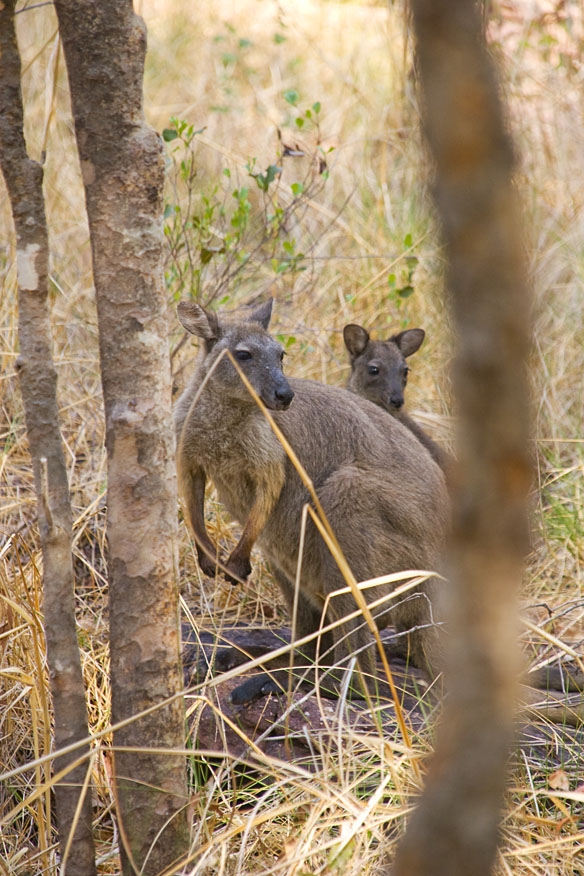
Black Wallaroo

Black Wallaroo

Osphranter bernardus

Michael Wifall, CC BY-SA 2.0, via Wikimedia Commons

Tenkile

Dendrolagus scottae

Side by side

Black WallarooTenkile
Scientific nameOsphranter bernardus (Rothschild, 1904)Dendrolagus scottae Flannery & Seri, 1990
English nameBlack WallarooTenkile
GroupMammalsMammals
ClassMammalia MammalMammalia Mammal
OrderDiprotodontiaDiprotodontia
FamilyMacropodidae KangaroosMacropodidae Kangaroos
GenusOsphranter WallaroosDendrolagus Tree-kangaroo
Named in19041990
Red List categoryNear ThreatenedCritically Endangered
Countries on record1 country2 countries
GBIF occurrence records1,366 records12 records

Rows where the two agree are shown in grey.

Where each is found

Both recorded in 1 country

Only Tenkile (1)

From Catalogue of Life checklists and GBIF occurrence records. A country missing from a list means no record is held, which is not proof of absence.

Checked facts

Black WallarooTenkile
Appearance
SizeNo checked fact yet
Habitat
  • The tenkile inhabits subtropical or tropical dry forests. English Wikipedia
  • The species inhabits mid-montane rainforests dominated by Podocarpus, Libocedrus, Araucaria and Rapanea. English Wikipedia
  • Tenkiles occur at elevations of approximately 900–1,700 metres above sea level. English Wikipedia
  • The species occupies approximately 50 square kilometres of rainforest. animaldiversity.org
  • The rainforest habitat described for the species is located at elevations of 900–1,500 metres. animaldiversity.org
Diet
Behaviour
  • The black wallaroo is extremely shy and flees observers towards nearby hills or sandstone escarpments. English Wikipedia
  • When pursued, individuals demonstrate agility by leaping onto ledges or descending to the ground. English Wikipedia
  • The species seeks shade beneath escarpments or large trees. English Wikipedia
  • The black wallaroo is a nocturnal grazer. English Wikipedia
  • Individuals generally do not gather in groups. English Wikipedia
  • Individuals remain under cover until emerging at night to forage. English Wikipedia
  • Individuals are usually observed alone or in male-female pairs, sometimes accompanied by a larger young individual. English Wikipedia
  • Tenkiles can both hop and walk bipedally. English Wikipedia
  • Tenkiles can raise their arms above their heads. English Wikipedia
  • The species is diurnal and mainly terrestrial, although it climbs to escape predators and danger. animaldiversity.org
  • Tenkiles forage for food both in trees and on the ground. English Wikipedia
  • Wild tenkiles are now more commonly observed individually than in groups. English Wikipedia
  • Female tenkiles may maintain territories covering a few acres, while males maintain larger territories. animaldiversity.org
  • Tenkiles are not known to be hostile toward humans and generally avoid human activity while in trees. English Wikipedia
ReproductionNo checked fact yet
  • Tenkiles are believed to reproduce throughout the year. English Wikipedia
  • Females are believed to produce one offspring approximately every 12 months. animaldiversity.org
  • Female tenkiles carry their offspring in a pouch until the young are approximately 10–12 months old. animaldiversity.org
  • Young tenkiles remain with their mothers for approximately two years before becoming independent. English Wikipedia
  • Female tenkiles nurse their offspring for more than one year. animaldiversity.org
  • The species is gonochoristic, with separate male and female individuals. animaldiversity.org
DistributionNo checked fact yet
  • The tenkile is endemic to the Torricelli Mountains of Papua New Guinea. English Wikipedia
  • The species is restricted to the Torricelli Range, eastern Bewani Range and Menawa Range in Papua New Guinea. English Wikipedia
Conservation
  • The black wallaroo is classified as near threatened. English Wikipedia
  • Its limited geographic distribution is identified as a major reason for its near-threatened classification. English Wikipedia
  • A large proportion of the species' range is protected within Kakadu National Park. English Wikipedia
  • The tenkile is classified as critically endangered by the International Union for Conservation of Nature. English Wikipedia
  • The species has experienced an estimated population decline of 80% over ten years. English Wikipedia
  • The Torricelli Mountains subpopulation is believed to contain fewer than 250 individuals. English Wikipedia
  • The estimated wild population of tenkiles is fewer than 200 individuals. animaldiversity.org
  • Hunting and habitat loss are the principal reported causes of population decline. animaldiversity.org
  • The Tenkile Conservation Alliance was established to protect the species and its habitat. English Wikipedia
Uses
Similar speciesNo checked fact yet

In brief

Black Wallaroo

Osphranter bernardus is distinguished by the predominantly very dark brown to black fur of adult males and its relatively small size. Full profile

Tenkile

Dendrolagus scottae is restricted to the Torricelli Range, eastern Bewani Range and Menawa Range in Papua New Guinea. It has predominantly black fur, chocolate-brown coloration on its limbs and long tail, and whorls of hair on its shoulders. Full profile

Compare something else

Page built on 26 November 2026 from the data on the two species pages, where every source is listed.

Cite this page

ScientificNames.org. (2026). Black Wallaroo vs Tenkile. Retrieved November 26, 2026, from https://scientificnames.org/compare/black-wallaroo-vs-tenkile