Comparison

Black-winged Parrot vs Spix's Macaw

Black-winged Parrot (Hapalopsittaca melanotis) and Spix's Macaw (Cyanopsitta spixii) both belong to the family Psittacidae (macaws) and part ways below it.

Black-winged Parrot

Black-winged Parrot

Hapalopsittaca melanotis

Marc Athanase Parfait Oeillet Des Murs, Public domain, via Wikimedia Commons

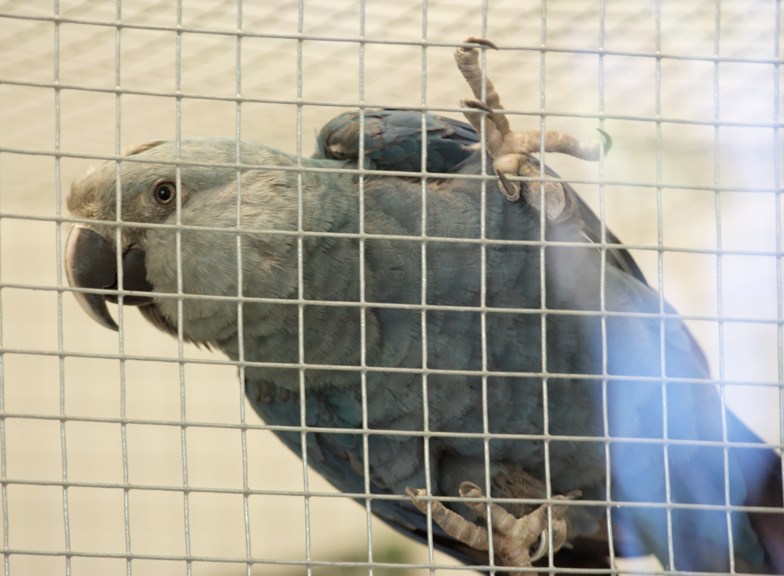
Spix's Macaw

Spix's Macaw

Cyanopsitta spixii

The original uploader was Robert01 at German Wikipedia. (Original text: Robert01), CC BY-SA 2.0 de, via Wikimedia Commons

Side by side

Black-winged ParrotSpix's Macaw
Scientific nameHapalopsittaca melanotis (Lafresnaye, 1847)Cyanopsitta spixii (Wagler, 1832)
English nameBlack-winged ParrotSpix's Macaw
GroupBirdsBirds
ClassAves BirdAves Bird
OrderPsittaciformes ParrotPsittaciformes Parrot
FamilyPsittacidae MacawsPsittacidae Macaws
GenusHapalopsittaca Andean ParrotsCyanopsitta Spix's Macaw
Named in18471832
Red List categoryLeast ConcernExtinct in the Wild
Countries on record2 countries1 country
GBIF occurrence records480 records12 records

Rows where the two agree are shown in grey.

Where each is found

Only Black-winged Parrot (2)

Only Spix's Macaw (1)

From Catalogue of Life checklists and GBIF occurrence records. A country missing from a list means no record is held, which is not proof of absence.

Checked facts

Black-winged ParrotSpix's Macaw
Appearance
  • Adults of both subspecies are predominantly green, with more yellowish coloration on their underparts. English Wikipedia
  • The crown has a blue-gray tinge, the lores are blue, and pinkish feathers surround the eye. English Wikipedia
  • The nominate subspecies has black ear coverts. English Wikipedia
  • The Peruvian subspecies has buff-colored ear coverts. English Wikipedia
  • The nominate subspecies has a wide blue-gray collar. English Wikipedia
  • The Peruvian subspecies has a narrower blue-gray collar than the nominate subspecies. English Wikipedia
  • Both subspecies have predominantly black wings with mostly blue primary feathers. English Wikipedia
  • The tail is green-tipped and blackish blue. English Wikipedia
  • Adults have grey-blue heads, pale blue underparts, and vivid blue upperparts, wings, and tails. English Wikipedia
  • Adult Spix's macaws have grey bare facial skin, dark grey bills, and yellow irises. English Wikipedia
  • Juveniles have pale grey facial skin, brown irises, and a white stripe along the upper center of the bill. English Wikipedia
  • Males and females have almost identical external appearances. English Wikipedia
  • The species has brownish-black legs and feet. English Wikipedia
Size
  • Adults measure approximately 56 cm in total length, including a tail measuring 26–38 cm. English Wikipedia
  • The wing length ranges from 24.7 to 30.0 cm. English Wikipedia
  • Captive males average approximately 318 g, while captive females average approximately 288 g. English Wikipedia
  • The species averages 55 cm in length and 360 g in weight according to Animal Diversity Web. animaldiversity.org
  • The reported wingspan averages 1.2 m. animaldiversity.org
Habitat
  • The species inhabited riparian Caraibeira woodland galleries in the Rio São Francisco drainage basin. English Wikipedia
  • Its natural habitat was within the Caatinga dry forest climate of interior northeastern Brazil. English Wikipedia
  • The species depended on Caraibeira trees for nesting, feeding, and roosting. English Wikipedia
  • Caraibeira woodland galleries extended up to 18 m on either side of seasonal waterways. English Wikipedia
  • The Caraibeira trees grew at regular intervals of approximately 10 meters along watercourse banks. animaldiversity.org
  • The woodland habitat included thorny shrubs, cacti, and tall craibeira trees along watercourses. animaldiversity.org
  • Dead crowns of craibeira trees were used as perches. animaldiversity.org
Diet
  • The species feeds primarily on Caraiba seeds and nuts and those of Euphorbiaceae shrubs. English Wikipedia
  • Wild Spix's macaws commonly consumed seeds and nuts from Pinhão and Favela plants. English Wikipedia
Behaviour
  • The species appears to move nomadically while searching for food. English Wikipedia
  • The species may occupy higher elevations only during certain seasons. English Wikipedia
  • Flocks of up to 50 individuals have been observed moving between forest patches in search of fruit. English Wikipedia
  • The species' movements have not been fully established. English Wikipedia
  • Its flight call consists of one to three short, relatively mellow notes that may be followed by a higher-pitched, more piercing note. English Wikipedia
  • When perched, the species produces a wider variety of short, mellow calls. English Wikipedia
  • The species may produce a faster and longer series of calls when taking off. English Wikipedia
Reproduction
  • The breeding biology of the species has not been documented in the source. English Wikipedia
  • Wild breeding takes place between November and March. English Wikipedia
  • The species nests in hollows of large mature Caraibeira trees and reuses nests annually. English Wikipedia
  • Wild females were believed to lay three eggs per clutch. English Wikipedia
  • Incubation lasts approximately 25–28 days and is performed exclusively by the female. English Wikipedia
  • Chicks fledge at approximately 70 days and become independent between 100 and 130 days. English Wikipedia
  • Captive incubation lasts approximately 26 days. animaldiversity.org
  • Captive-bred chicks fledge at approximately two months and become independent at five months. animaldiversity.org
DistributionNo checked fact yet
Conservation
  • The IUCN declared the species extinct in the wild in 2019. English Wikipedia
  • A total of 52 individual birds were reintroduced into their natural environment in June 2022. English Wikipedia
  • The species is listed on CITES Appendix I. English Wikipedia
  • International trade in the species is prohibited except for legitimate conservation, scientific, or educational purposes. English Wikipedia
  • A captive breeding program is maintained by several conservation organizations under the Brazilian government's aegis. English Wikipedia
  • Deforestation within its restricted range and specialized habitat contributed to the species' rarity in the wild. English Wikipedia
Similar species
  • The Black-winged Parrot formerly shared the genus Pionopsitta with the Pileated Parrot during the early twentieth century. English Wikipedia
  • The red-bellied macaw and blue-headed macaw are identified as the species' nearest relatives. English Wikipedia
Other
  • The species has two recognized subspecies: H. m. melanotis and H. m. peruviana. English Wikipedia
  • The species is also known by the English name Black-eared Parrot. English Wikipedia
  • The species was most recently assessed for the IUCN Red List in 2024. iucnredlist.org

In brief

Black-winged Parrot

The Black-winged Parrot is a bird with two recognized subspecies, H. m. melanotis and H. m. peruviana. The species occurs in Bolivia and Peru. Adults are predominantly green, with predominantly black wings and mostly blue primary feathers. Full profile

Spix's Macaw

The natural habitat was riparian Caraibeira woodland galleries in the Rio São Francisco drainage basin, within the Caatinga dry forest climate of interior northeastern Brazil. Adults have grey-blue heads, pale blue underparts, and vivid blue upperparts, wings, and tails. Full profile

Compare something else

Page built on 29 November 2026 from the data on the two species pages, where every source is listed.

Cite this page

ScientificNames.org. (2026). Black-winged Parrot vs Spix's Macaw. Retrieved November 29, 2026, from https://scientificnames.org/compare/black-winged-parrot-vs-spixs-macaw