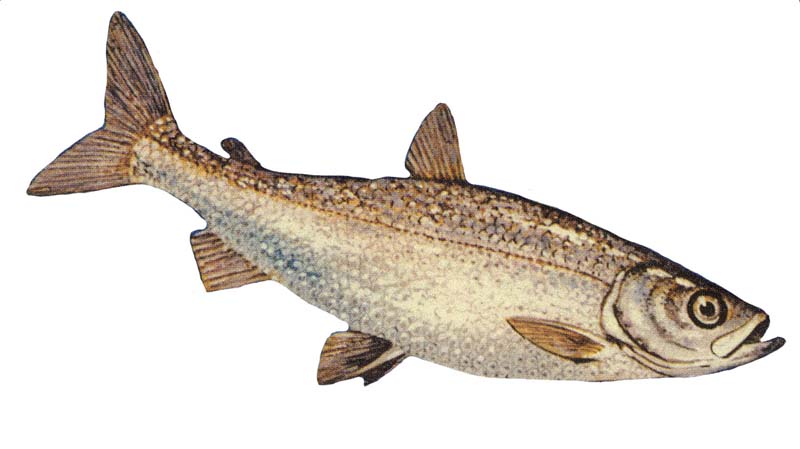
| Appearance | | - The vendace has a slim, streamlined body and an adipose fin located between the dorsal fin and the tail. English Wikipedia
- Its lower jaw is longer than its upper jaw. English Wikipedia
- Its back is bluish green or brown, its flanks are silvery, and its belly is white. English Wikipedia
|
|---|
| Size | No checked fact yet | |
|---|
| Habitat | - The bloater inhabits deep freshwater lakes in both pelagic and benthic regions. animaldiversity.org
- The bloater is most abundant at depths between 40 and 110 metres. animaldiversity.org
- The bloater has occasionally been recorded at depths of 10 metres and 180 metres. animaldiversity.org
- The bloater inhabits underwater slopes at depths between 30 and 198 metres. English Wikipedia
- The bloater tolerates water temperatures between 1.5 and 11.4 degrees Celsius. English Wikipedia
- Bloater larvae are frequently found near the bottom at depths of 90 to 110 metres in water no warmer than 4.7 degrees Celsius. animaldiversity.org
| |
|---|
| Diet | - The bloater primarily feeds on animals living on the lake bottom. English Wikipedia
- The bloater also consumes small drifting animals and zooplankton. English Wikipedia
- Recorded food items of the bloater include Mysis diluviana and Diporeia hoyi. English Wikipedia
- Stomach analyses have identified Mysis relicta and Pontoporeia affinis as important food items. animaldiversity.org
- Copepods, fish eggs, and fingernail clams have also been recorded in bloater stomachs. animaldiversity.org
- The bloater is classified as a carnivore that consumes eggs and non-insect arthropods. animaldiversity.org
| |
|---|
| Behaviour | - The bloater generally stays on or near the lake bottom during daylight. animaldiversity.org
- The bloater moves upward into the water column at night to feed. animaldiversity.org
- Nighttime densities of bloaters in the water column have reached 6.61 fish per cubic metre. animaldiversity.org
- The bloater's nocturnal migration patterns vary with water temperature, light levels, and individual size. animaldiversity.org
| |
|---|
| Reproduction | - Bloater spawning generally occurs in February and March, although reproduction can occur throughout the year. animaldiversity.org
- Bloater spawning occurs over various bottom types at depths between 36 and 90 metres. animaldiversity.org
- Female bloaters produce approximately 3,000 to 12,000 eggs, with larger females producing more eggs. animaldiversity.org
- Bloater eggs have an average diameter of 1.95 millimetres. animaldiversity.org
- The bloater provides no parental care. animaldiversity.org
- Bloater larvae remain in the larval state for approximately 24 days. animaldiversity.org
| - Vendace lay their eggs on pebbly or sandy substrates. English Wikipedia
- Vendace spawning grounds can occur in shallow water or at depths reaching 20 m. English Wikipedia
- Most vendace spawn for the first time during their second year of life. English Wikipedia
- Some vendace may reproduce during their first autumn. English Wikipedia
- Vendace generally reproduce during autumn. English Wikipedia
- Distinct spring-spawning vendace populations occur in several lakes in northern Europe. English Wikipedia
- Mild winters associated with early ice-off dates have negatively affected vendace recruitment in many lakes. pmc.ncbi.nlm.nih.gov
- Earlier lake ice-breaking can increase mortality among vendace larvae by shortening their early larval period. pmc.ncbi.nlm.nih.gov
|
|---|
| Distribution | - The bloater is native to the Great Lakes except Lake Erie and to Lake Nipigon. English Wikipedia
| No checked fact yet |
|---|
| Conservation | - The bloater is classified as Vulnerable to global extinction by the IUCN. English Wikipedia
- Bloater populations have declined in Lakes Superior and Huron. English Wikipedia
- Predation by alewives is identified as the principal cause of bloater population declines, with sea lamprey predation and pollution also contributing. English Wikipedia
- The Lake Ontario bloater reintroduction program involves multiple North American fishery agencies. English Wikipedia
- The Lake Ontario restoration program aims to provide an alternative food source for top predators and improve ecological function. pubs.usgs.gov
| - Vendace populations in the Volga River basin have experienced range regression associated with climate warming and increasing water temperatures. English Wikipedia
- The southernmost remaining Volga basin records of vendace are restricted to the upper pool of the Zhigulevskaya hydroelectric power station near Toliatti. English Wikipedia
- The remaining Volga basin population is considered a rare but stable component of the pelagic community. English Wikipedia
- Vendace is regarded as one of the commercial fish species most vulnerable to modern environmental changes. pmc.ncbi.nlm.nih.gov
- Increasing water temperatures have negatively affected cold-water coregonids, including vendace. pmc.ncbi.nlm.nih.gov
- Warmer summers have occasionally increased adult vendace mortality and reduced population size in southernmost vendace lakes. pmc.ncbi.nlm.nih.gov
|
|---|
| Uses | - Bloater catches are commercially processed primarily by smoking for human consumption. animaldiversity.org
- The bloater is an important food source for larger salmonid fishes. animaldiversity.org
- The bloater was historically considered a suitable panfish but too small for commercial marketing. English Wikipedia
| - Vendace has traditionally been the most important target of freshwater fisheries in parts of Fennoscandia and Russia. English Wikipedia
- Vendace roe is considered a delicacy and has PDO status in the Swedish Bothnian Bay archipelago. English Wikipedia
- Vendace is an important commercial fishery species in some northern and eastern countries. pmc.ncbi.nlm.nih.gov
|
|---|
| Similar species | - The bloater closely resembles the kiyi but can be distinguished by its lighter upper lip and smaller eye. English Wikipedia
- The bloater is closely related to the cisco or lake herring and the shortjaw cisco. English Wikipedia
| - The European vendace is closely related to the Siberian Coregonus sardinella. English Wikipedia
|
|---|
| Name origin | - The common name bloater refers to the swollen appearance caused by expansion of the gas bladder after the fish is brought up from deep water. English Wikipedia
| No checked fact yet |
|---|