Comparison

Blue-headed Macaw vs Grey Parrot

Blue-headed Macaw (Primolius couloni) and Grey Parrot (Psittacus erithacus) both belong to the family Psittacidae (macaws) and part ways below it.
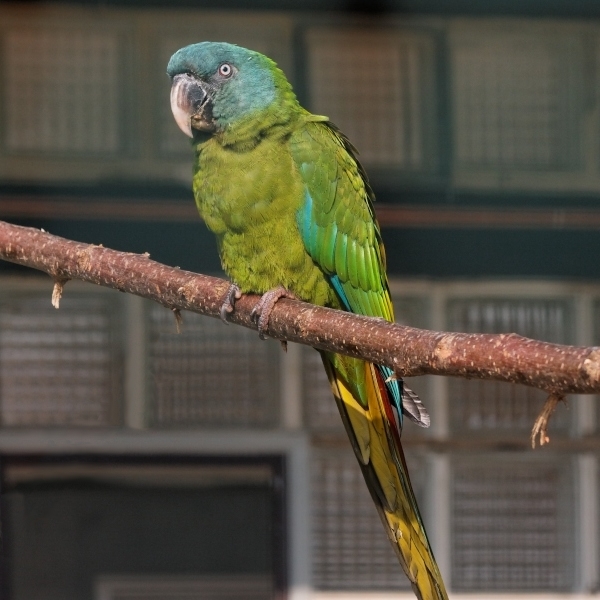
Blue-headed Macaw

Blue-headed Macaw

Primolius couloni

Primolius_couloni_-captive-8a-3c.jpg: *Primolius_couloni_-captive-8a.jpg: Robert01. The original uploader was Robert01 at German Wikipedia. derivative work: Snowmanradio (talk), CC BY-SA 3.0 de, via Wikimedia Commons

Grey Parrot

Grey Parrot

Psittacus erithacus

Florettesokeng, CC BY-SA 4.0, via Wikimedia Commons

Side by side

Blue-headed MacawGrey Parrot
Scientific namePrimolius couloni (P. L. Sclater, 1876)Psittacus erithacus Linnaeus, 1758
English nameBlue-headed MacawGrey Parrot
GroupBirdsBirds
ClassAves BirdAves Bird
OrderPsittaciformes ParrotPsittaciformes Parrot
FamilyPsittacidae MacawsPsittacidae Macaws
GenusPrimolius Primolius MacawsPsittacus Grey Parrot
Named in18761758
Red List categoryVulnerableEndangered
Countries on record3 countries21 countries
GBIF occurrence records5,549 records12,913 records

Rows where the two agree are shown in grey.

Where each is found

Only Blue-headed Macaw (3)

Only Grey Parrot (21)

From Catalogue of Life checklists and GBIF occurrence records. A country missing from a list means no record is held, which is not proof of absence.

Checked facts

Blue-headed MacawGrey Parrot
Appearance
  • The species has predominantly green plumage, with blue coloration on its head, flight feathers, and primary coverts. English Wikipedia
  • The upper tail has a maroon base, a narrow green central section, and a blue tip. English Wikipedia
  • The undertail and underwing are greenish-yellow. English Wikipedia
  • The bill is medium-sized and pale greyish-horn with a black base. English Wikipedia
  • The iris is whitish and surrounded by a narrow maroon eye-ring. English Wikipedia
  • The facial skin and lores are dark greyish. English Wikipedia
  • The legs are dull pinkish. English Wikipedia
  • Juveniles have an entirely black bill, greyer legs, a darker iris, and white facial skin and lores. English Wikipedia
  • The species has a blue head. ecos.fws.gov
  • The species has a distinctive dull blue head and an otherwise green body with blue wings. ebird.org
Size
  • The Blue-headed Macaw has a total body length of approximately 41 cm. English Wikipedia
  • The species belongs to the smaller macaws commonly called mini-macaws. English Wikipedia
Habitat
  • The species occurs in the southwestern Amazon and adjacent eastern Andean foothills. English Wikipedia
  • The species prefers openings in humid forests, including areas along rivers and clearings. English Wikipedia
  • The species has also been observed in Moriche Palm swamps and on the outskirts of towns. English Wikipedia
  • The species occurs from lowland areas to elevations of approximately 1,550 m. English Wikipedia
  • The species inhabits both primary and secondary rainforests. pmc.ncbi.nlm.nih.gov
  • The species commonly occurs in moist lowland forests. animaldiversity.org
  • The species also occurs along forest edges, in clearings, gallery forests, mangroves, wooded savannahs, cultivated areas, and gardens. animaldiversity.org
  • Individuals have been recorded at elevations reaching 2,200 m in the eastern parts of their range. animaldiversity.org
  • The species uses natural forest clearings with marshy or muddy soil. pmc.ncbi.nlm.nih.gov
  • Individuals commonly roost in trees above water and may favour river islands. animaldiversity.org
DietNo checked fact yet
Behaviour
  • The species is known to visit clay-licks. English Wikipedia
  • The species is typically observed in groups of two to four individuals in the wild. English Wikipedia
  • Wild groups of up to approximately 60 individuals have occasionally been recorded. English Wikipedia
  • Its call is higher-pitched and softer than that of most other macaws. English Wikipedia
  • The species is highly social and forms large groups. animaldiversity.org
  • Wild individuals are shy and rarely allow humans to approach them. animaldiversity.org
  • Individuals gather in large, noisy flocks during morning and evening roosting periods. animaldiversity.org
  • During daytime, individuals divide into smaller flocks and travel long distances to forage. animaldiversity.org
  • The species is a partial ground feeder. English Wikipedia
  • Groups visiting forest clearings typically perch in surrounding trees and vocalize before landing to feed, drink, and interact. pmc.ncbi.nlm.nih.gov
  • An average of 40 individuals visited the studied forest clearing each day. pmc.ncbi.nlm.nih.gov
  • Visits to forest clearings become shorter when predators or humans disturb the birds. pmc.ncbi.nlm.nih.gov
  • Wild individuals can imitate sounds heard in their environment. English Wikipedia
Reproduction
Distribution
  • The Blue-headed Macaw occurs in eastern Peru, northwestern Bolivia, and far western Brazil. English Wikipedia
  • The species is native to equatorial Africa. English Wikipedia
  • Its native range includes Angola, Cameroon, the Congo, Gabon, Ivory Coast, Ghana, Kenya, and Uganda. English Wikipedia
  • The species occurs across the forest belt of central and West Africa, including Príncipe. animaldiversity.org
Conservation
  • The number of known locations for the species is unknown. datazone.birdlife.org
  • The species is classified as Vulnerable in the eBird species profile. ebird.org
  • A 2006 BirdLife International review estimated the population at 1,000–2,500 individuals and described it as decreasing. English Wikipedia
  • The species was uplisted to Endangered in the 2007 IUCN Red List. English Wikipedia
  • A 2007 assessment suggested that the population estimate might instead be 9,200–46,000 mature individuals. English Wikipedia
  • Habitat loss is considered a potential threat, at least in some parts of the species' range. English Wikipedia
  • The species occurs in the Tambopata-Candamo and Manu protected areas. English Wikipedia
  • Capture for the wild bird trade is identified as a potentially serious threat. English Wikipedia
  • The species is classified as Endangered on the IUCN Red List. English Wikipedia
  • Capture for the pet trade and habitat loss are major threats to the species. pmc.ncbi.nlm.nih.gov
  • Grey parrot populations declined by an estimated 50–79% in recent decades. pmc.ncbi.nlm.nih.gov
  • The species received the highest level of CITES protection in October 2016 through Appendix I listing. English Wikipedia
  • Protecting forest clearings from disturbance and capture is recommended as a conservation measure. pmc.ncbi.nlm.nih.gov
UsesNo checked fact yet
  • The species is commonly kept as a companion parrot because of its ability to mimic human speech. English Wikipedia
Name origin
  • The specific epithet couloni commemorates Swiss naturalist Paul Louis Coulon, who lived from 1804 to 1894. English Wikipedia
No checked fact yet

In brief

Blue-headed Macaw

Primolius couloni occurs in eastern Peru, northwestern Bolivia, and far western Brazil. It is distinguished by its blue head and predominantly green plumage with blue wings. Full profile

Grey Parrot

Psittacus erithacus inhabits primary and secondary rainforests and commonly occurs in moist lowland forests. Full profile

Compare something else

Page built on 26 November 2026 from the data on the two species pages, where every source is listed.

Cite this page

ScientificNames.org. (2026). Blue-headed Macaw vs Grey Parrot. Retrieved November 26, 2026, from https://scientificnames.org/compare/blue-headed-macaw-vs-grey-parrot