Comparison
Boldo vs Australian Mulberry
Boldo (Peumus boldus) and Australian Mulberry (Hedycarya angustifolia) both belong to the family Monimiaceae (monimia family) and part ways below it.
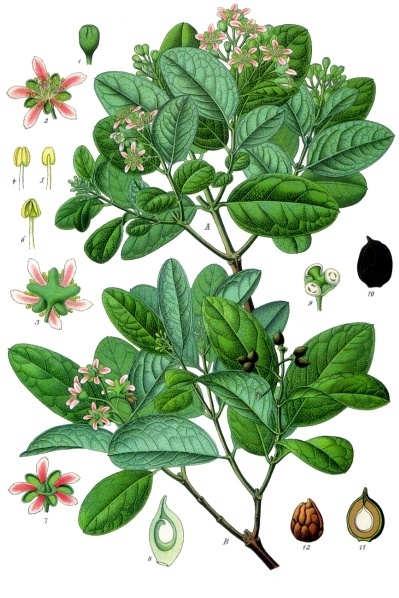
Boldo
Peumus boldus
Franz Eugen Köhler, Köhler's Medizinal-Pflanzen, Public domain, via Wikimedia Commons


Side by side
| Boldo | Australian Mulberry | |
|---|---|---|
| Scientific name | Peumus boldus Molina | Hedycarya angustifolia A.Cunn. |
| English name | Boldo | Australian Mulberry |
| Group | Flowering plants | Flowering plants |
| Class | Magnoliopsida | Magnoliopsida |
| Order | Laurales | Laurales |
| Family | Monimiaceae Monimia Family | Monimiaceae Monimia Family |
| Genus | Peumus | Hedycarya |
| Red List category | Least Concern | Not recorded |
| Countries on record | 4 countries | 2 countries |
| GBIF occurrence records | 2,683 records | 6,663 records |
Rows where the two agree are shown in grey.
Where each is found
Only Boldo (4)
Only Australian Mulberry (2)
From Catalogue of Life checklists and GBIF occurrence records. A country missing from a list means no record is held, which is not proof of absence.
Checked facts
| Boldo | Australian Mulberry | |
|---|---|---|
| Appearance |
|
|
| Size | No checked fact yet |
|
| Habitat |
|
|
| Behaviour |
| No checked fact yet |
| Reproduction | No checked fact yet |
|
| Distribution |
|
|
| Conservation | No checked fact yet |
|
| Uses |
|
|
| Other |
| No checked fact yet |
In brief
Boldo
Boldo is an aromatic evergreen shrub or small tree. Boldo is endemic to central Chile between 33° and 40° south latitude. Boldo is the only species in the genus Peumus. Full profile
Australian Mulberry
Australian mulberry is a shrub or small tree that typically reaches 2–10 metres in height. It grows in and near rainforest margins and frequently occurs in moist mountain gullies, with a range extending from south-east Queensland through eastern New South Wales and eastern and southern Victoria to King Island in Tasmania. Its spherical fruits grow in tight clusters and turn yellow or orange. Full profile
Compare something else
Page built on 29 November 2026 from the data on the two species pages, where every source is listed.
Cite this page
ScientificNames.org. (2026). Boldo vs Australian Mulberry. Retrieved November 29, 2026, from https://scientificnames.org/compare/boldo-vs-australian-mulberry
“Boldo vs Australian Mulberry.” ScientificNames.org, 2026, scientificnames.org/compare/boldo-vs-australian-mulberry. Accessed 29 Nov. 2026.
ScientificNames.org. “Boldo vs Australian Mulberry.” Accessed November 29, 2026. https://scientificnames.org/compare/boldo-vs-australian-mulberry.
@misc{scientificnames_boldo_vs_australian_mulberry,
  author = {{ScientificNames.org}},
  title = {Boldo vs Australian Mulberry},
  year = {2026},
  url = {https://scientificnames.org/compare/boldo-vs-australian-mulberry},
  note = {Accessed 2026-11-29}
}