Comparison
Boldo vs Large-leaved Wilkiea
Boldo (Peumus boldus) and Large-leaved Wilkiea (Wilkiea macrophylla) both belong to the family Monimiaceae (monimia family) and part ways below it.
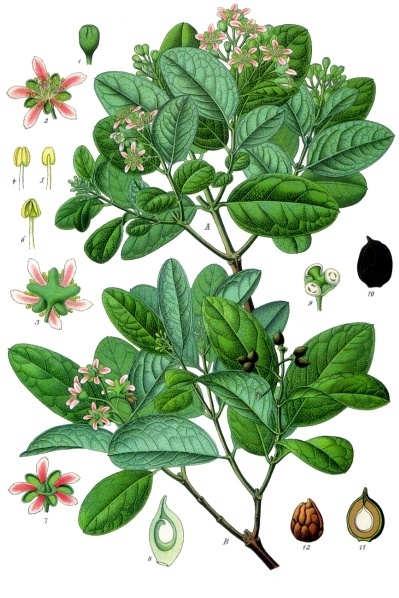
Boldo
Peumus boldus
Franz Eugen Köhler, Köhler's Medizinal-Pflanzen, Public domain, via Wikimedia Commons


Side by side
| Boldo | Large-leaved Wilkiea | |
|---|---|---|
| Scientific name | Peumus boldus Molina | Wilkiea macrophylla (Tul.) A.DC. |
| English name | Boldo | Large-leaved Wilkiea |
| Group | Flowering plants | Flowering plants |
| Class | Magnoliopsida | Magnoliopsida |
| Order | Laurales | Laurales |
| Family | Monimiaceae Monimia Family | Monimiaceae Monimia Family |
| Genus | Peumus | Wilkiea |
| Red List category | Least Concern | Least Concern |
| Countries on record | 4 countries | 1 country |
| GBIF occurrence records | 2,683 records | 1,247 records |
Rows where the two agree are shown in grey.
Where each is found
Only Boldo (4)
Only Large-leaved Wilkiea (1)
From Catalogue of Life checklists and GBIF occurrence records. A country missing from a list means no record is held, which is not proof of absence.
Checked facts
| Boldo | Large-leaved Wilkiea | |
|---|---|---|
| Appearance |
|
|
| Size | No checked fact yet |
|
| Habitat |
|
|
| Behaviour |
|
|
| Reproduction | No checked fact yet |
|
| Distribution |
|
|
| Uses |
| No checked fact yet |
| Name origin | No checked fact yet |
|
| Other |
|
|
In brief
Boldo
Boldo is an aromatic evergreen shrub or small tree. Boldo is endemic to central Chile between 33° and 40° south latitude. Boldo is the only species in the genus Peumus. Full profile
Large-leaved Wilkiea
Wilkiea macrophylla grows in subtropical rainforest at elevations between 510 and 610 metres, from central Queensland to the Richmond River in north-eastern New South Wales. It is a completely hairless shrub or small tree with stiff, prominently toothed leaves and glossy purplish to olive-black fruit. Full profile
Compare something else
Page built on 28 November 2026 from the data on the two species pages, where every source is listed.
Cite this page
ScientificNames.org. (2026). Boldo vs Large-leaved Wilkiea. Retrieved November 28, 2026, from https://scientificnames.org/compare/boldo-vs-large-leaved-wilkiea
“Boldo vs Large-leaved Wilkiea.” ScientificNames.org, 2026, scientificnames.org/compare/boldo-vs-large-leaved-wilkiea. Accessed 28 Nov. 2026.
ScientificNames.org. “Boldo vs Large-leaved Wilkiea.” Accessed November 28, 2026. https://scientificnames.org/compare/boldo-vs-large-leaved-wilkiea.
@misc{scientificnames_boldo_vs_large_leaved_wilkiea,
  author = {{ScientificNames.org}},
  title = {Boldo vs Large-leaved Wilkiea},
  year = {2026},
  url = {https://scientificnames.org/compare/boldo-vs-large-leaved-wilkiea},
  note = {Accessed 2026-11-28}
}