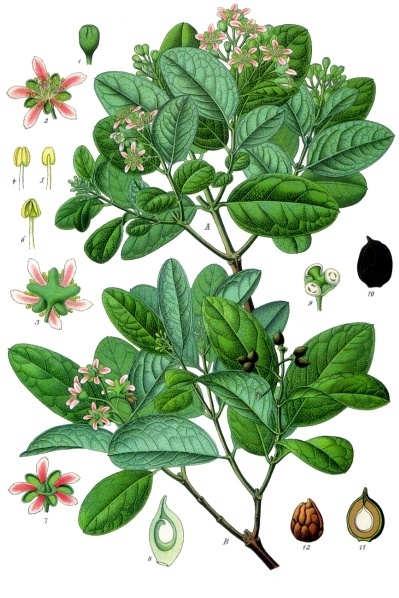
| Appearance | - Peumus boldus is an aromatic evergreen shrub or small tree with greenish fruits. utep.edu
- The leaves have a strong, woody, slightly bitter flavor and a camphor-like aroma. English Wikipedia
- Its fruits are small, green drupes approximately 2 centimeters in diameter. English Wikipedia
| - Its leaves are dark green and arranged oppositely on the stems. English Wikipedia
- Its leaves are mostly leathery or smooth, with paler undersides. English Wikipedia
- Its leaf blades are broadly oval to egg-shaped and have partly serrated or toothed margins. English Wikipedia
- Its flower clusters are branched racemes. English Wikipedia
- Male flowers have perianths approximately 10 mm in diameter, while female flowers have perianths approximately 6 mm in diameter. English Wikipedia
|
|---|
| Size | No checked fact yet | |
|---|
| Habitat | - Boldo is a characteristic component of the sclerophyllous forests of central Chile. English Wikipedia
| |
|---|
| Behaviour | | - The species is primarily pollinated by wind. English Wikipedia
- Its seeds are dispersed by fruit-eating animals, including birds. English Wikipedia
- Recorded bird species that disperse its seeds include blackbirds, kererū, kōkako, tūī, song thrushes and weka. English Wikipedia
- Introduced deer and goats consume the leaves of the species. English Wikipedia
- Possums preferentially consume its buds and flowers. English Wikipedia
- Rats consume the fruits of the species. English Wikipedia
- The species provides a host for the endemic insects Lasiorhynchus barbicornis and Calliprason sinclairi. English Wikipedia
|
|---|
| Reproduction | No checked fact yet | |
|---|
| Distribution | - Boldo is endemic to central Chile between 33° and 40° south latitude. English Wikipedia
- Boldo has been introduced to Europe and North Africa, where it is uncommon outside botanical gardens. English Wikipedia
| |
|---|
| Conservation | No checked fact yet | - The species was classified as Not Threatened under the New Zealand Threat Classification System in 2023. English Wikipedia
- The IUCN assessed the species as Least Concern in 2024. English Wikipedia
- Its population trend was assessed as unknown in the 2024 IUCN evaluation. English Wikipedia
|
|---|
| Uses | - Boldo leaves are used as a culinary herb, particularly in Latin American cooking. English Wikipedia
- Boldo leaves are used as a substitute for bay leaves in cooking. English Wikipedia
- Boldo leaves are prepared as herbal tea, particularly in Chile and Argentina. English Wikipedia
- Boldo leaves are combined with yerba mate and other teas in Brazil, Argentina, Chile, Uruguay, and Paraguay. English Wikipedia
- Boldo leaves are used to season fish, mushrooms, vegetables, and savory sauces. English Wikipedia
- Boldo leaves are sometimes used to wrap fish and meat during frying. English Wikipedia
- Dried boldo fruits are used to prepare spicy condiments. English Wikipedia
- Boldo leaves and sometimes its bark are used in herbal preparations. utep.edu
- Boldo leaf tea is traditionally taken for liver and gallbladder problems, including gallbladder stones. utep.edu
- Boldo leaf preparations are used to stimulate bile flow in the gallbladder. utep.edu
- Boldo is officially listed in the Brazilian pharmacopoeia as a phytotherapeutic plant used as a cholagogue and choleretic for mild dyspepsia. English Wikipedia
| - Māori traditionally used its timber to make musical instruments and digging sticks. English Wikipedia
- Māori used the leaves in vapour baths for medicinal purposes. English Wikipedia
- Its wood is soft and not particularly durable. English Wikipedia
- Its fruits were not traditionally eaten by Māori. English Wikipedia
- The species has been classified as poisonous in a New Zealand poisonous plants reference. English Wikipedia
- A dose of 14 grams of leaves per kilogram of body weight was lethal to sheep. English Wikipedia
|
|---|
| Name origin | No checked fact yet | - The specific epithet arborea means tree-like and derives from the Latin word arbor. English Wikipedia
- The English common name pigeonwood refers to kererū that feed on the plant's fruit. English Wikipedia
|
|---|
| Other | - Boldo is the only species in the genus Peumus. English Wikipedia
- Boldo leaves contain the alkaloid boldine. English Wikipedia
- Boldo leaves contain between 2% and 4% volatile oil. English Wikipedia
- Ascaridole, 1,8-cineole, and p-cymene are reported as major constituents of boldo volatile oil. English Wikipedia
- Boldo essential oil contains the toxic compound ascaridiol. utep.edu
- Eighteen alkaloids have been detected in boldo bark, leaves, wood, and roots. science.gov
- Boldine was identified as the dominant alkaloid in boldo bark. science.gov
- Laurolitsine was the dominant alkaloid identified in boldo wood and roots. science.gov
- The alkaloid composition of boldo leaves varies considerably among individually identified trees. science.gov
| - The species was first scientifically described in 1776 by Georg and Johann Reinhold Forster. English Wikipedia
- The species is also known by the Māori common name porokaiwhiri. English Wikipedia
|
|---|