Comparison
Indiscriminate Cuckoo Bumble Bee vs Red-tailed Bumblebee
Indiscriminate Cuckoo Bumble Bee (Bombus insularis) and Red-tailed Bumblebee (Bombus lapidarius) both belong to the genus Bombus (bumblebee) and part ways below it. Both are recorded in 1 country.
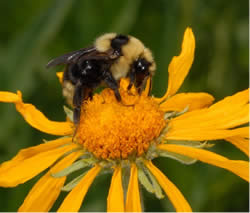


Side by side
| Indiscriminate Cuckoo Bumble Bee | Red-tailed Bumblebee | |
|---|---|---|
| Scientific name | Bombus insularis (Smith, 1861) | Bombus lapidarius (Linnaeus, 1758) |
| English name | Indiscriminate Cuckoo Bumble Bee | Red-tailed Bumblebee |
| Group | Insects | Insects |
| Class | Insecta Insect | Insecta Insect |
| Order | Hymenoptera Ants | Hymenoptera Ants |
| Family | Apidae Euglossine | Apidae Euglossine |
| Genus | Bombus Bumblebee | Bombus Bumblebee |
| Named in | 1861 | 1758 |
| Red List category | Least Concern | Not recorded |
| Countries on record | 3 countries | 46 countries |
| GBIF occurrence records | 12,417 records | 386,060 records |
Rows where the two agree are shown in grey.
Where each is found
Both recorded in 1 country
Only Indiscriminate Cuckoo Bumble Bee (2)
Only Red-tailed Bumblebee (45)
- Aland Islands
- Albania
- Andorra
- Austria
- Belarus
- Belgium
- Bosnia and Herzegovina
- Bulgaria
- Croatia
- Czechia
- Denmark
- Estonia
- Finland
- France
- Germany
- Greece
- Guernsey
- Hungary
- Ireland
- Isle of Man
- Italy
- Jersey
- Kosovo
- Latvia
- Liechtenstein
- Lithuania
- Luxembourg
- Moldova
- Montenegro
- Morocco
- North Macedonia
- Norway
- Poland
- Portugal
- Romania
- Russia
- Serbia
- Slovakia
- Slovenia
- Spain
- Sweden
- Switzerland
- The Netherlands
- Ukraine
- United Kingdom
From Catalogue of Life checklists and GBIF occurrence records. A country missing from a list means no record is held, which is not proof of absence.
Checked facts
| Indiscriminate Cuckoo Bumble Bee | Red-tailed Bumblebee | |
|---|---|---|
| Appearance |
|
|
| Size |
|
|
| Habitat |
|
|
| Diet | No checked fact yet |
|
| Behaviour |
|
|
| Reproduction |
|
|
| Distribution | No checked fact yet |
|
| Conservation |
|
|
| Uses | No checked fact yet |
|
| Other |
|
|
In brief
Indiscriminate Cuckoo Bumble Bee
The Indiscriminate cuckoo bumble bee is a bumblebee species that relies on non-Psithyrus bumblebee workers to rear its offspring. It inhabits tundra and taiga environments, western mountain ranges, and some maritime regions. It is associated with more documented bumblebee host species than any other Psithyrus species. Full profile
Red-tailed Bumblebee
The species occurs throughout Europe, including Britain and Ireland, and typically inhabits temperate regions. It has a predominantly black body with red markings around the abdomen. Full profile
Compare something else
Page built on 29 November 2026 from the data on the two species pages, where every source is listed.
Cite this page
ScientificNames.org. (2026). Indiscriminate Cuckoo Bumble Bee vs Red-tailed Bumblebee. Retrieved November 29, 2026, from https://scientificnames.org/compare/indiscriminate-cuckoo-bumble-bee-vs-red-tailed-bumblebee
“Indiscriminate Cuckoo Bumble Bee vs Red-tailed Bumblebee.” ScientificNames.org, 2026, scientificnames.org/compare/indiscriminate-cuckoo-bumble-bee-vs-red-tailed-bumblebee. Accessed 29 Nov. 2026.
ScientificNames.org. “Indiscriminate Cuckoo Bumble Bee vs Red-tailed Bumblebee.” Accessed November 29, 2026. https://scientificnames.org/compare/indiscriminate-cuckoo-bumble-bee-vs-red-tailed-bumblebee.
@misc{scientificnames_indiscriminate_cuckoo_bumble_bee_vs_red_tailed_bumblebee,
  author = {{ScientificNames.org}},
  title = {Indiscriminate Cuckoo Bumble Bee vs Red-tailed Bumblebee},
  year = {2026},
  url = {https://scientificnames.org/compare/indiscriminate-cuckoo-bumble-bee-vs-red-tailed-bumblebee},
  note = {Accessed 2026-11-29}
}