Comparison

Brabocetus gigaseorum vs Dall's Porpoise

Brabocetus gigaseorum (Brabocetus gigaseorum) and Dall's Porpoise (Phocoenoides dalli) both belong to the family Phocoenidae (porpoise) and part ways below it.
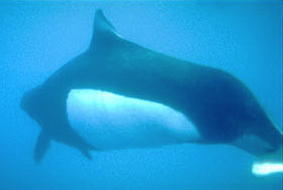
Dall's Porpoise

Dall's Porpoise

Phocoenoides dalli

Unknown author, Public domain, via Wikimedia Commons

Side by side

Brabocetus gigaseorumDall's Porpoise
Scientific nameBrabocetus gigaseorum Colpaert, Bosselaers & Lambert, 2015Phocoenoides dalli (True, 1885)
English nameNot recordedDall's Porpoise
GroupMammalsMammals
ClassMammalia MammalMammalia Mammal
OrderCetacea CetaceanCetacea Cetacean
FamilyPhocoenidae PorpoisePhocoenidae Porpoise
GenusBrabocetusPhocoenoides Dall's Porpoises
Named in20151885
Red List categoryNot recordedLeast Concern
EnvironmentNot recordedmarine
Countries on recordNot recorded4 countries
GBIF occurrence recordsNot recorded8,925 records

Rows where the two agree are shown in grey.

Where each is found

Only Dall's Porpoise (4)

From Catalogue of Life checklists and GBIF occurrence records. A country missing from a list means no record is held, which is not proof of absence.

Checked facts

Brabocetus gigaseorumDall's Porpoise
AppearanceNo checked fact yet
  • The species has a small head without a distinct beak. adfg.alaska.gov
  • Its flippers are small, pointed, and positioned near the head. adfg.alaska.gov
  • The species has a small mouth with a slight underbite. adfg.alaska.gov
  • Its teeth are small and spade-shaped rather than cone-shaped. nps.gov
  • It has rigid protruding growths between its teeth that are thought to help it grasp slippery prey. nps.gov
  • The western Pacific truei color morph has a white belly marking that extends farther forward than the marking of the dalli morph. English Wikipedia
SizeNo checked fact yet
HabitatNo checked fact yet
  • The species generally inhabits cold waters with temperatures below 18 °C. English Wikipedia
  • Although primarily offshore, the species also inhabits deeper coastal waters, submarine canyons, and fjords. English Wikipedia
  • The species can inhabit sounds and inland passages as well as offshore and onshore waters. adfg.alaska.gov
  • The species prefers deep water and uses underwater canyons and deep channels to approach coastlines. adfg.alaska.gov
  • Some populations remain near shore throughout the year in Japan, the Kamchatka Peninsula, Puget Sound, British Columbia, the Aleutians, and Alaska's inside waters. nps.gov
DietNo checked fact yet
  • The species commonly consumes mesopelagic fish, including myctophids, and gonatid squid. English Wikipedia
  • Its diet can include krill and shrimp, although crustaceans are not considered an important food source. English Wikipedia
  • Depending on the region, the species feeds on capelin, lantern fish, herring, and squid. adfg.alaska.gov
  • The species commonly consumes herring, anchovies, squid, and crustaceans. nps.gov
  • The species commonly feeds on animals living at depths greater than 590 feet. nps.gov
  • The species has been observed feeding on salmon alongside resident killer whales. nps.gov
BehaviourNo checked fact yet
  • The species generally forages at night. adfg.alaska.gov
  • The species can dive to depths of up to 94 metres. English Wikipedia
  • Individuals typically form groups of two to ten, although aggregations numbering hundreds have been recorded. English Wikipedia
  • The species generally travels in groups of approximately 10 to 20 individuals. adfg.alaska.gov
  • Rapid swimming near the surface produces a characteristic spray known as a rooster tail. English Wikipedia
  • The species frequently approaches boats to ride their bow waves. English Wikipedia
  • The species can swim at speeds exceeding 30 knots. adfg.alaska.gov
  • The species has been observed swimming alongside harbour porpoises and grey whales. adfg.alaska.gov
ReproductionNo checked fact yet
  • The species has a polygynous mating system in which males compete for females. English Wikipedia
  • Gestation lasts approximately 11 to 12 months. English Wikipedia
  • Females generally give birth once every three years. English Wikipedia
  • Females give birth to a single calf, usually in mid-summer. adfg.alaska.gov
  • Female sexual maturity occurs between three and six years of age. adfg.alaska.gov
  • Male sexual maturity occurs at approximately five to eight years of age. adfg.alaska.gov
  • Lactation lasts approximately two to four months. adfg.alaska.gov
  • Calves and their mothers remain separate from the main porpoise herds for a period after birth. adfg.alaska.gov
DistributionNo checked fact yet
  • The species occurs throughout the North Pacific, ranging from California to the Bering Sea and Sea of Okhotsk in the east and the Sea of Japan in the west. English Wikipedia
ConservationNo checked fact yet
  • The species is classified as Least Concern on the IUCN Red List. English Wikipedia
  • The species is listed in Appendix II of the Convention on the Conservation of Migratory Species of Wild Animals. English Wikipedia
  • The species is protected in the United States under the Marine Mammal Protection Act. English Wikipedia
  • The species is vulnerable to accidental capture in fishing operations. English Wikipedia
  • Commercial driftnet fisheries killed thousands of individuals before a United Nations moratorium was introduced in the 1990s. English Wikipedia
UsesNo checked fact yet
  • The species' meat has been used as food in Japanese fisheries. nps.gov
  • The species' blubber has been used as a source of oil. nps.gov
  • The species' bones have been ground into fertilizer. nps.gov
  • The species contributes to marine ecotourism in some regions. adfg.alaska.gov

In brief

Dall's Porpoise

Phocoenoides dalli occurs throughout the North Pacific, ranging from California to the Bering Sea and Sea of Okhotsk in the east and the Sea of Japan in the west. Full profile

Compare something else

Page built on 29 November 2026 from the data on the two species pages, where every source is listed.

Cite this page

ScientificNames.org. (2026). Brabocetus gigaseorum vs Dall's Porpoise. Retrieved November 29, 2026, from https://scientificnames.org/compare/brabocetus-gigaseorum-vs-dalls-porpoise