Comparison

Bradford Pear vs Pear

Bradford Pear (Pyrus calleryana) and Pear (Pyrus communis) both belong to the genus Pyrus (pear) and part ways below it. Both are recorded in 8 countries.

Bradford Pear

Bradford Pear

Pyrus calleryana

Bruce Marlin, CC BY 3.0, via Wikimedia Commons

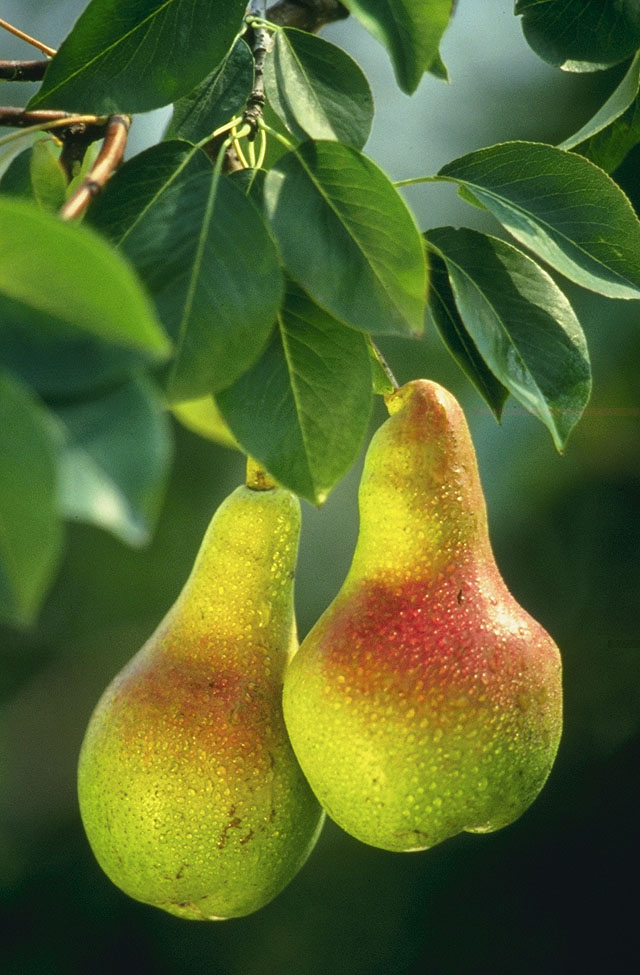
Pear

Pear

Pyrus communis

Keith Weller, Public domain, via Wikimedia Commons

Side by side

Bradford PearPear
Scientific namePyrus calleryana Decne.Pyrus communis L.
English nameBradford PearPear
GroupFlowering plantsFlowering plants
ClassMagnoliopsidaMagnoliopsida
OrderRosalesRosales
FamilyRosaceae Rose FamilyRosaceae Rose Family
GenusPyrus PearPyrus Pear
Red List categoryNot recordedLeast Concern
Countries on record13 countries92 countries
GBIF occurrence records174,242 records98,745 records

Rows where the two agree are shown in grey.

Where each is found

Both recorded in 8 countries

Only Bradford Pear (5)

Only Pear (84)

From Catalogue of Life checklists and GBIF occurrence records. A country missing from a list means no record is held, which is not proof of absence.

Checked facts

Bradford PearPear
Appearance
  • Pyrus calleryana is a deciduous tree with a conical to rounded crown. English Wikipedia
  • Its leaves are oval, glossy dark green on the upper surface, and pale underneath. English Wikipedia
  • Its leaves are alternately arranged and have long petioles. English Wikipedia
  • Its flowers are white, have five petals, and measure approximately 2 to 2.5 cm across. English Wikipedia
  • Its flowers are produced abundantly in early spring before the leaves have fully expanded. English Wikipedia
  • Its fruits are small, hard, and almost woody before being softened by frost. English Wikipedia
  • Its autumn foliage can turn yellow, orange, red, pink, purple, or bronze. English Wikipedia
  • Its bark is grayish brown and becomes deeply fissured or scaly as the tree matures. extension.psu.edu
  • Naturalized individuals commonly develop stout, sturdy spines. extension.psu.edu
  • Naturalized trees often have sharp, thorny spur shoots that can remain present on older trees. aces.edu
No checked fact yet
Size
  • The species typically grows to a height of 5 to 8 metres. English Wikipedia
  • Open-grown individuals can reach heights of 30 to 60 feet. aces.edu
No checked fact yet
Habitat
  • The species tolerates partial shade but prefers full sunlight. extension.psu.edu
  • It commonly occurs along roadsides, in old fields, hedgerows, and forest edges. extension.psu.edu
  • It tolerates sites with soil conditions ranging from dry to wet. aces.edu
  • It can invade disturbed areas, open fields, unimproved pastures, rights of way, and forest edges. aces.edu
  • Naturalized populations can establish in habitats ranging from wetlands to forests. English Wikipedia
Behaviour
  • The species grows rapidly and can form dense thickets that compete with native plants for resources. aces.edu
  • The species can spread vegetatively by producing shoots from its shallow root system. extension.psu.edu
  • Birds disperse its seeds through their droppings after eating the fruit. aces.edu
  • Its flowers attract flies, which are reported as its primary pollinators. English Wikipedia
  • Its flowers produce an unpleasant, strong, rancid odor. extension.psu.edu
  • Common pear fruits allowed to ripen on the tree often fall before they can be harvested. English Wikipedia
Reproduction
  • Flowering can begin when trees are approximately three years old. aces.edu
  • The species is self-incompatible and requires pollination from genetically different plants for successful fruit production. aces.edu
  • Different cultivars growing within insect-pollination distance can produce fertile seeds. English Wikipedia
  • Seeds from cultivated varieties do not necessarily produce offspring resembling their parent cultivars. aces.edu
  • Its fruits contain between two and six maroon seeds. aces.edu
  • The fruits mature between June and February and persist in clusters. aces.edu
  • The cultivated common pear is thought to have originated from the wild subspecies pyraster and caucasica. English Wikipedia
  • The wild subspecies pyraster and caucasica are interfertile with domesticated pears. English Wikipedia
  • Historical evidence indicates that wild pears were collected before they were introduced into cultivation. English Wikipedia
  • Reliable historical information about pear cultivation first appears in the writings of Greek and Roman authors. English Wikipedia
  • Theophrastus, Cato the Elder, and Pliny the Elder documented pear cultivation and grafting. English Wikipedia
Distribution
  • The species is native to mainland China, Japan, the Korean Peninsula, and Taiwan. English Wikipedia
  • It has been introduced to the United States, Canada, Iraq, and the Western Himalayas region of India. English Wikipedia
  • In the United States, established wild populations have been reported in 152 counties across 25 states. English Wikipedia
  • Wild populations have been recorded as far north as Madison, Wisconsin. English Wikipedia
  • Pyrus communis is native to central and eastern Europe and western Asia. English Wikipedia
Conservation
  • The species is regarded as invasive in many parts of eastern and midwestern North America. English Wikipedia
  • Its invasive populations can outcompete native plants and trees. English Wikipedia
  • In young, low-density populations, the species has been found to have no significant effect on surrounding species richness or diversity. English Wikipedia
  • The species is intolerant of extreme cold, which currently limits its northward spread. English Wikipedia
No checked fact yet
Uses
  • The species has been used as rootstock for grafting cultivated pear varieties, including Comice, Bosc, and Seckel. English Wikipedia
  • The species was introduced to the United States for agricultural experimentation before being widely adopted as an ornamental tree. English Wikipedia
  • The species has been widely planted as a street and ornamental tree since the 1960s. extension.psu.edu
  • Pyrus communis is the source species for most orchard pear cultivars grown in Europe, North America, and Australia. English Wikipedia
  • The common pear is one of the most important fruit crops in temperate regions. English Wikipedia
  • Common pears are harvested at maturity before becoming fully ripe to achieve the best and most consistent quality. English Wikipedia
  • Mature but unripe pears can be stored and transported successfully when kept cold. English Wikipedia
  • Some common pear varieties require cold exposure to ripen. English Wikipedia
  • Fermented pear juice is used to produce a beverage called perry. English Wikipedia
  • Pears can be eaten fresh or cooked as desserts. English Wikipedia
  • Pears can be served in pies. English Wikipedia
  • Pears are sometimes served alongside meat. English Wikipedia
  • Perry can be distilled to produce pear brandy. English Wikipedia
OtherNo checked fact yet
  • The Bartlett cultivar, also known as Williams, represents approximately 75% of United States pear production. English Wikipedia

In brief

Bradford Pear

Pyrus calleryana is native to mainland China, Japan, the Korean Peninsula, and Taiwan, and has been introduced to the United States, Canada, Iraq, and the Western Himalayas region of India. Full profile

Pear

Pyrus communis is native to central and eastern Europe and western Asia. It is the source species for most orchard pear cultivars grown in Europe, North America, and Australia. Full profile

Compare something else

Page built on 27 November 2026 from the data on the two species pages, where every source is listed.

Cite this page

ScientificNames.org. (2026). Bradford Pear vs Pear. Retrieved November 27, 2026, from https://scientificnames.org/compare/bradford-pear-vs-pear