Comparison

Burchell's Courser vs Jerdon's Courser

Burchell's Courser (Cursorius rufus) and Jerdon's Courser (Rhinoptilus bitorquatus) both belong to the family Glareolidae (coursers) and part ways below it.

Burchell's Courser

Burchell's Courser

Cursorius rufus

Chantelle Bosch, CC BY-SA 4.0, via Wikimedia Commons

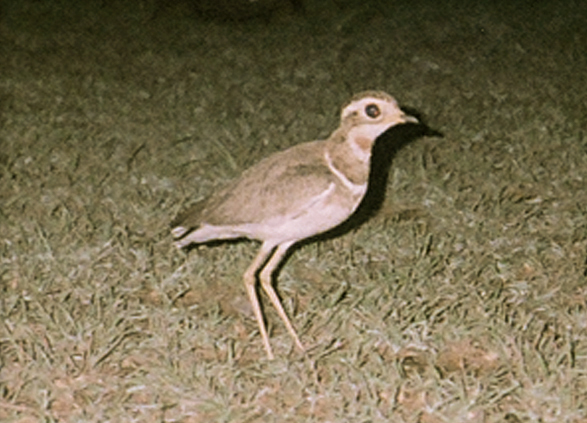
Jerdon's Courser

Jerdon's Courser

Rhinoptilus bitorquatus

PJeganathan, CC BY-SA 3.0, via Wikimedia Commons

Side by side

Burchell's CourserJerdon's Courser
Scientific nameCursorius rufus Gould, 1837Rhinoptilus bitorquatus (Blyth, 1848)
English nameBurchell's CourserJerdon's Courser
GroupBirdsBirds
ClassAves BirdAves Bird
OrderCharadriiformes AuksCharadriiformes Auks
FamilyGlareolidae CoursersGlareolidae Coursers
GenusCursorius CoursersRhinoptilus Short-billed Coursers
Named in18371848
Red List categoryLeast ConcernCritically Endangered
Countries on record4 countries1 country
GBIF occurrence records2,594 records31 records

Rows where the two agree are shown in grey.

Where each is found

Only Burchell's Courser (4)

Only Jerdon's Courser (1)

From Catalogue of Life checklists and GBIF occurrence records. A country missing from a list means no record is held, which is not proof of absence.

Checked facts

Burchell's CourserJerdon's Courser
Appearance
Size
Habitat
  • The species inhabits dry, open country, particularly semi-desert environments. English Wikipedia
  • It occupies deserts and semi-deserts with gravel substrates rather than exclusively sandy terrain. English Wikipedia
  • It also inhabits open grasslands with short grass. English Wikipedia
  • It uses habitats with sparse, burnt or overgrazed vegetation. English Wikipedia
  • The species inhabits sparse scrub forest containing patches of bare ground. English Wikipedia
  • The species is associated with scrubland in which tall bushes occur at densities of 300 to 700 per hectare. English Wikipedia
  • The species is known to inhabit open, dry thorny scrubland. ebird.org
Diet
  • The species feeds predominantly on insects. English Wikipedia
  • It frequently consumes beetles belonging to the Coleoptera group, particularly curculionid beetles. English Wikipedia
  • It prefers harvester termites when available, and these can account for more than half its diet. English Wikipedia
  • It almost never consumes seeds as a food source. English Wikipedia
Behaviour
  • The species is diurnal and terrestrial. English Wikipedia
  • It generally runs rather than flies and usually takes flight only after significant disturbance. English Wikipedia
  • It uses its long bill to forage on the ground and dig up insects. English Wikipedia
  • It runs to catch its prey. English Wikipedia
  • Adults perform displacement brooding to distract potential predators from nesting sites. English Wikipedia
  • The species is mostly quiet while on the ground but produces loud calls during flight. English Wikipedia
  • Its identified vocalizations include a throaty launch call, grunts during flight and contact calls. English Wikipedia
  • The species may run away from its nest while giving an alarm call when threatened by a predator. English Wikipedia
  • It is generally solitary, although it can occur in small flocks. English Wikipedia
Reproduction
  • The only known egg of the species is preserved at the Zoology Museum of the University of Aberdeen. English Wikipedia
  • The known egg was collected in 1917 by Ernest Gilbert Meaton, a veterinarian working at Kolar Gold Fields. English Wikipedia
Distribution
  • Its distribution range occasionally overlaps with that of Temminck's courser. English Wikipedia
  • The species is principally known from southern Andhra Pradesh. English Wikipedia
  • The species is currently known from Sri Lankamalleswara Wildlife Sanctuary and Sri Penusila Narasimha Wildlife Sanctuary. English Wikipedia
Conservation
  • The species is classified as Least Concern. English Wikipedia
  • Its population is declining. English Wikipedia
  • Potential threats include habitat loss on agricultural land, intensive irrigation, pesticide overuse and other human disturbances. English Wikipedia
  • The species is classified as Critically Endangered. birdlife.org
  • The species remains critically endangered because of habitat loss. English Wikipedia
  • Estimates of the species' population range from 50 to 249 individuals. English Wikipedia
  • The species has an extremely restricted known geographical range. English Wikipedia
  • Agricultural expansion has contributed to the decline of the species' preferred scrub habitat. English Wikipedia
  • Extensive quarrying threatens the species' habitat. English Wikipedia
  • Livestock pressure and firewood extraction increased following human population growth in the region. English Wikipedia
  • The Telugu Ganga water-supply project threatened the species' only known location in December 2005. English Wikipedia
  • The species' habitat has been surveyed using camera traps and fine-sand strips to estimate population density from footprints. English Wikipedia

In brief

Burchell's Courser

Cursorius rufus inhabits dry, open country, including deserts, semi-deserts and open grasslands with short grass. It is distinguished by its pale rufous plumage and blue-grey hind crown. Full profile

Jerdon's Courser

Jerdon's Courser (Rhinoptilus bitorquatus) is a bird in the family Glareolidae, order Charadriiformes and class Aves. The species is principally known from southern Andhra Pradesh and currently occurs in Sri Lankamalleswara Wildlife Sanctuary and Sri Penusila Narasimha Wildlife Sanctuary. It has two brown breast-bands, a broad buff supercilium and an orange-chestnut throat patch. Full profile

Compare something else

Page built on 27 November 2026 from the data on the two species pages, where every source is listed.

Cite this page

ScientificNames.org. (2026). Burchell's Courser vs Jerdon's Courser. Retrieved November 27, 2026, from https://scientificnames.org/compare/burchells-courser-vs-jerdons-courser