Comparison
Caatinga Parakeet vs Spix's Macaw
Caatinga Parakeet (Eupsittula cactorum) and Spix's Macaw (Cyanopsitta spixii) both belong to the family Psittacidae (macaws) and part ways below it. Both are recorded in 1 country.
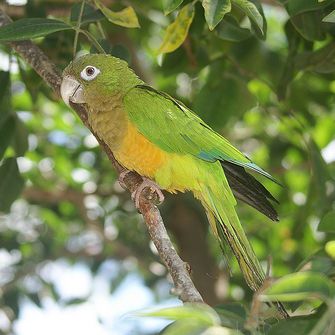
Caatinga Parakeet
Eupsittula cactorum
Aratinga_cactorum_-Brazil-8.jpg: Phillipe derivative work: Snowmanradio (talk), CC BY-SA 3.0, via Wikimedia Commons

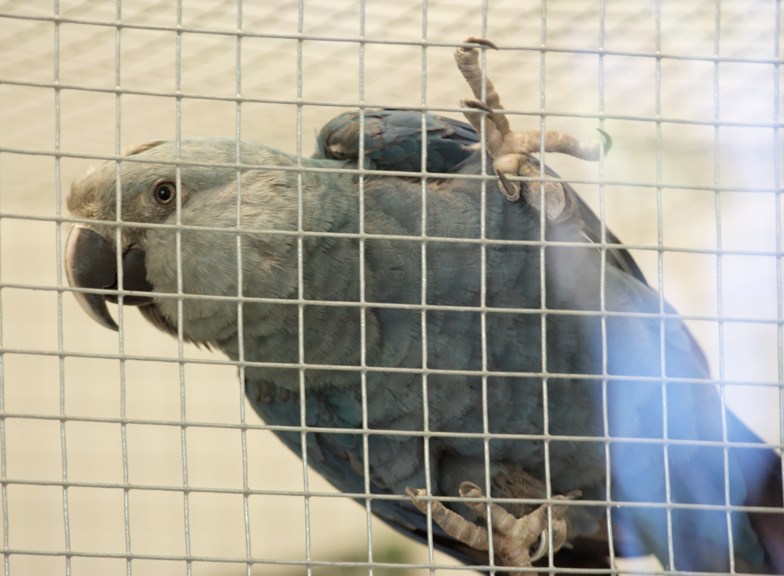
Spix's Macaw
Cyanopsitta spixii
The original uploader was Robert01 at German Wikipedia. (Original text: Robert01), CC BY-SA 2.0 de, via Wikimedia Commons

Side by side
| Caatinga Parakeet | Spix's Macaw | |
|---|---|---|
| Scientific name | Eupsittula cactorum (Kuhl, 1820) | Cyanopsitta spixii (Wagler, 1832) |
| English name | Caatinga Parakeet | Spix's Macaw |
| Group | Birds | Birds |
| Class | Aves Bird | Aves Bird |
| Order | Psittaciformes Parrot | Psittaciformes Parrot |
| Family | Psittacidae Macaws | Psittacidae Macaws |
| Genus | Eupsittula Eupsittula Parakeets | Cyanopsitta Spix's Macaw |
| Named in | 1820 | 1832 |
| Red List category | Least Concern | Extinct in the Wild |
| Countries on record | 1 country | 1 country |
| GBIF occurrence records | 15,242 records | 12 records |
Rows where the two agree are shown in grey.
Where each is found
Both recorded in 1 country
From Catalogue of Life checklists and GBIF occurrence records. A country missing from a list means no record is held, which is not proof of absence.
Checked facts
| Caatinga Parakeet | Spix's Macaw | |
|---|---|---|
| Appearance |
|
|
| Size |
|
|
| Habitat |
|
|
| Diet |
|
|
| Behaviour |
|
|
| Reproduction |
|
|
| Distribution |
| No checked fact yet |
| Conservation |
|
|
| Similar species |
|
|
| Other | No checked fact yet |
|
In brief
Caatinga Parakeet
The species is endemic to eastern Brazil and the Caatinga region. Adults of the nominate subspecies have pale brown forecrowns and underparts, green upperparts, and yellow-orange bellies and vent areas. Full profile
Spix's Macaw
The natural habitat was riparian Caraibeira woodland galleries in the Rio São Francisco drainage basin, within the Caatinga dry forest climate of interior northeastern Brazil. Adults have grey-blue heads, pale blue underparts, and vivid blue upperparts, wings, and tails. Full profile
Compare something else
Page built on 28 November 2026 from the data on the two species pages, where every source is listed.
Cite this page
ScientificNames.org. (2026). Caatinga Parakeet vs Spix's Macaw. Retrieved November 28, 2026, from https://scientificnames.org/compare/caatinga-parakeet-vs-spixs-macaw
“Caatinga Parakeet vs Spix's Macaw.” ScientificNames.org, 2026, scientificnames.org/compare/caatinga-parakeet-vs-spixs-macaw. Accessed 28 Nov. 2026.
ScientificNames.org. “Caatinga Parakeet vs Spix's Macaw.” Accessed November 28, 2026. https://scientificnames.org/compare/caatinga-parakeet-vs-spixs-macaw.
@misc{scientificnames_caatinga_parakeet_vs_spixs_macaw,
  author = {{ScientificNames.org}},
  title = {Caatinga Parakeet vs Spix's Macaw},
  year = {2026},
  url = {https://scientificnames.org/compare/caatinga-parakeet-vs-spixs-macaw},
  note = {Accessed 2026-11-28}
}