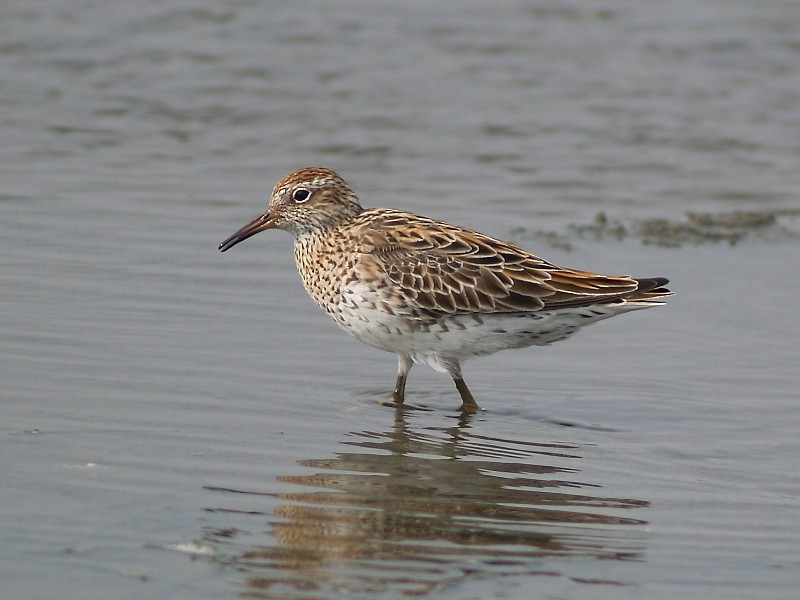
| Appearance | - The Sharp-tailed Sandpiper has a pot belly, flat back and elongated rear profile. English Wikipedia
- Its upper body is mottled chestnut-brown, with dark-centred feathers and a chestnut-coloured crown. English Wikipedia
- The species has a brown stripe running through each eye. English Wikipedia
- Its bill is straight and dark grey to black, while its legs are olive to yellow. English Wikipedia
- Its underparts are white or pale, with mottling across the breast and sides of the belly. English Wikipedia
- Its plumage is more vivid during the breeding season and duller during winter. English Wikipedia
| - The species has a distinctive spatulate bill. English Wikipedia
- Breeding adults have red-brown heads, necks and breasts with dark brown streaks. English Wikipedia
- Breeding adults have blackish upperparts edged with buff and pale rufous coloration. English Wikipedia
- Non-breeding adults have pale brownish-grey upperparts with whitish fringes on their wing-coverts. English Wikipedia
- The species has white underparts and black legs. English Wikipedia
|
|---|
| Size | No checked fact yet | |
|---|
| Habitat | - Its Siberian breeding habitat consists mainly of tundra with peat hummocks and lichen. English Wikipedia
- During migration, it favours muddy margins of shallow freshwater or brackish wetlands with low vegetation. English Wikipedia
- Its migration habitats include swamps, lakes, lagoons and coastal pools. English Wikipedia
- In Alaska, it uses coastal moist graminoid meadows and riverine mudbanks exposed by tides. English Wikipedia
- In Australia, it mainly occupies wetlands and prefers inland freshwater wetlands with grassy edges. English Wikipedia
- After ephemeral terrestrial wetlands dry out in Australia, the species tends to use coastal mudflats, salt marshes and brackish lagoons. English Wikipedia
- Additional Australian habitats include sewage farms, flooded fields, mangroves, rocky shores and beaches. English Wikipedia
| - The species breeds on sea coasts and adjacent hinterland along the Chukchi Peninsula and southward along the isthmus of the Kamchatka Peninsula. English Wikipedia
- Its nesting habitat includes coastal tundra areas with grass near freshwater pools. English Wikipedia
|
|---|
| Diet | | |
|---|
| Behaviour | - The species is strongly migratory, with its breeding and wintering ranges separated between Siberia and Australasia. English Wikipedia
- Adults generally leave Siberia in July, while juveniles depart in August. English Wikipedia
- Most of the population winters in Australasia. English Wikipedia
- Most post-breeding adults migrate south in flocks containing fewer than 1,000 birds. English Wikipedia
- Some juveniles and adults migrate east across the Bering Strait into Alaska. English Wikipedia
- Migrating birds in Alaska remain from mid-August until late October to accumulate fat reserves. English Wikipedia
- The species forages along wetland edges, intertidal mudflats, sand and bare wet mud. English Wikipedia
- It sometimes forages in short-grass paddocks well away from water after rainfall. English Wikipedia
- It generally feeds by picking up food visually, although it sometimes probes the substrate. English Wikipedia
- At low tide, it forages on intertidal mudflats and moves inland to freshwater wetlands at high tide. English Wikipedia
| - While walking forward with its head lowered, the species moves its bill from side to side to feed. English Wikipedia
- Its contact calls include a quiet preep and a shrill wheer. English Wikipedia
- Its display song consists of an intermittent buzzing and descending trill. English Wikipedia
- Males perform brief hovers, circling and rapid dives during display flights while singing. English Wikipedia
|
|---|
| Reproduction | | - The species nests during June and July. English Wikipedia
- In 2013, conservationists hatched twenty spoon-billed sandpiper chicks in Chukotka. English Wikipedia
- The first two spoon-billed sandpipers were born in a United Kingdom captive-breeding facility in 2019. English Wikipedia
|
|---|
| Distribution | - The species breeds exclusively in eastern Siberia, from the Taymyr Peninsula to Chaunskaya Bay in Chukotka. English Wikipedia
- The majority of the population winters in Australasia. English Wikipedia
| - The species breeds along the coasts of the Bering Sea. English Wikipedia
- Its migration route follows the Pacific coast through Japan, Korea and China. English Wikipedia
- Its wintering distribution includes India, Bangladesh, Sri Lanka, Burma, Thailand, Vietnam, the Philippines, Peninsular Malaysia and Singapore. English Wikipedia
- Southeast Asia contains the species' wintering grounds. English Wikipedia
|
|---|
| Conservation | - The species was classified as globally vulnerable by the IUCN in 2021. English Wikipedia
- Its estimated population comprises 60,000 to 120,000 mature individuals. English Wikipedia
- Its global population trend is decreasing. English Wikipedia
- Habitat loss caused by land reclamation for aquaculture and degradation from human activities threatens the species at migratory staging areas. English Wikipedia
- In Australia, wetland clearing, inundation, drainage and infilling reduce the availability of feeding and roosting sites. English Wikipedia
- Other threats include riparian vegetation loss, invasive species, water pollution and human-induced changes to hydrological regimes. English Wikipedia
- The species faces mortality risks from hunting, vehicle collisions, aircraft strikes and predation by foxes and cats. English Wikipedia
- The species was listed as vulnerable in New South Wales under the Biodiversity Conservation Act 2016 following a final determination. environment.nsw.gov.au
| - The species is classified as Critically Endangered. English Wikipedia
- Its mature global population is estimated at fewer than 2,500 individuals, probably fewer than 1,000. English Wikipedia
- Its breeding population was estimated at 350–500 individuals in 2000. English Wikipedia
- Its global population was estimated at 240–456 mature individuals in 2016. English Wikipedia
- The species was reclassified as Critically Endangered in 2008. English Wikipedia
- Habitat loss on breeding grounds and the destruction of tidal flats along migration and wintering routes are major threats to the species. English Wikipedia
- Land reclamation has destroyed up to 65% of key habitat in China, South Korea and North Korea. English Wikipedia
- Hunting by traditional bird trappers in Burma was identified as a primary cause of the species' decline in a 2010 study. English Wikipedia
- Thirteen spoon-billed sandpipers arrived at a Wildfowl and Wetlands Trust reserve in Slimbridge, United Kingdom, in November 2011 for a breeding programme. English Wikipedia
- Artificial incubation and captive rearing were expected to increase chick survival rates from below 25% to above 75%. English Wikipedia
|
|---|
| Similar species | - The Broad-billed Sandpiper is identified as the Sharp-tailed Sandpiper's closest relative within the genus Calidris. English Wikipedia
- The Pectoral Sandpiper is the species most similar in appearance to the Sharp-tailed Sandpiper. English Wikipedia
- The Sharp-tailed Sandpiper differs from the Pectoral Sandpiper by lacking a strongly demarcated breast band and having chevron-shaped flank markings. English Wikipedia
- The Sharp-tailed Sandpiper resembles the Long-toed Stint but is substantially larger. English Wikipedia
| - Within the genus Calidris, the spoon-billed sandpiper is most closely related to the red-necked stint. English Wikipedia
|
|---|