Comparison
Capparis rigida vs Caper
Capparis rigida (Capparis rigida) and Caper (Capparis spinosa) both belong to the genus Capparis (caper) and part ways below it.
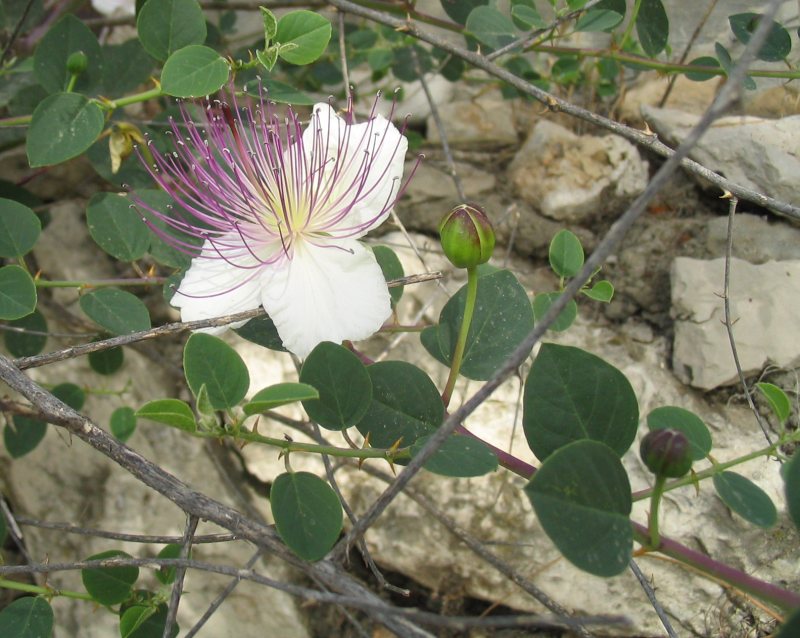

Side by side
| Capparis rigida | Caper | |
|---|---|---|
| Scientific name | Capparis rigida M.Jacobs | Capparis spinosa L. |
| English name | Not recorded | Caper |
| Group | Flowering plants | Flowering plants |
| Class | Magnoliopsida | Magnoliopsida |
| Order | Capparales | Capparales |
| Family | Capparaceae Caper Family | Capparaceae Caper Family |
| Genus | Capparis Caper | Capparis Caper |
| Red List category | Not recorded | Least Concern |
| Countries on record | 1 country | 86 countries |
| GBIF occurrence records | 5 records | 22,992 records |
Rows where the two agree are shown in grey.
Where each is found
Only Capparis rigida (1)
Only Caper (86)
- Afghanistan
- Albania
- Algeria
- American Samoa
- Armenia
- Australia
- Azerbaijan
- Bahrain
- Chad
- China
- Cook Islands
- Croatia
- Cyprus
- Djibouti
- Egypt
- Ethiopia
- Fiji
- France
- French Polynesia
- Georgia
- Germany
- Gibraltar
- Greece
- Guam
- India
- Indonesia
- Iran
- Iraq
- Israel
- Italy
- Jordan
- Kazakhstan
- Kenya
- Kuwait
- Kyrgyzstan
- Lebanon
- Libya
- Madagascar
- Malta
- Micronesia
- Mongolia
- Montenegro
- Morocco
- Nauru
- Nepal
- New Caledonia
- Niue
- North Macedonia
- Northern Mariana Islands
- Oman
- Pakistan
- Palau
- Palestinian Territory
- Papua New Guinea
- Philippines
- Pitcairn
- Portugal
- Qatar
- Russia
- Samoa
- Sao Tome and Principe
- Saudi Arabia
- Seychelles
- Slovenia
- Solomon Islands
- Somalia
- Spain
- Sri Lanka
- Sudan
- Switzerland
- Syria
- Tajikistan
- Tanzania
- Tonga
- Tunisia
- Turkey
- Turkmenistan
- Ukraine
- United Arab Emirates
- United States
- United States Minor Outlying Islands
- Uzbekistan
- Vanuatu
- Vatican
- Wallis and Futuna
- Yemen
From Catalogue of Life checklists and GBIF occurrence records. A country missing from a list means no record is held, which is not proof of absence.
Checked facts
| Capparis rigida | Caper | |
|---|---|---|
| Appearance | No checked fact yet |
|
| Habitat | No checked fact yet |
|
| Diet | No checked fact yet |
|
| Behaviour | No checked fact yet |
|
| Reproduction | No checked fact yet |
|
| Distribution | No checked fact yet |
|
| Uses | No checked fact yet |
|
In brief
Caper
Capparis spinosa occurs across the Mediterranean Basin, Arabian Peninsula, and parts of Western and Central Asia. It produces edible flower buds and oblong, multi-seeded fruits. Full profile
Compare something else
Page built on 26 November 2026 from the data on the two species pages, where every source is listed.
Cite this page
ScientificNames.org. (2026). Capparis rigida vs Caper. Retrieved November 26, 2026, from https://scientificnames.org/compare/capparis-rigida-vs-caper
“Capparis rigida vs Caper.” ScientificNames.org, 2026, scientificnames.org/compare/capparis-rigida-vs-caper. Accessed 26 Nov. 2026.
ScientificNames.org. “Capparis rigida vs Caper.” Accessed November 26, 2026. https://scientificnames.org/compare/capparis-rigida-vs-caper.
@misc{scientificnames_capparis_rigida_vs_caper,
  author = {{ScientificNames.org}},
  title = {Capparis rigida vs Caper},
  year = {2026},
  url = {https://scientificnames.org/compare/capparis-rigida-vs-caper},
  note = {Accessed 2026-11-26}
}