Comparison
Capped Langur vs Gee's Golden Langur
Capped Langur (Trachypithecus pileatus) and Gee's Golden Langur (Trachypithecus geei) both belong to the genus Trachypithecus (lutungs) and part ways below it. Both are recorded in 2 countries.

Capped Langur
Trachypithecus pileatus
Faisal Akram from Dhaka, Bangladesh, CC BY-SA 2.0, via Wikimedia Commons

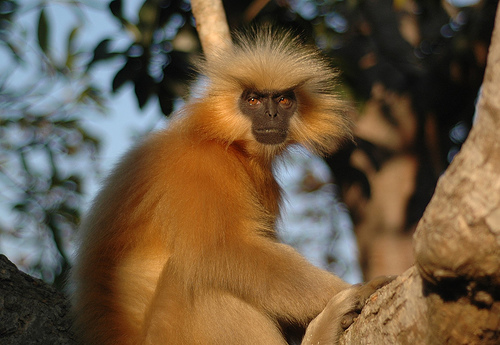
Gee's Golden Langur
Trachypithecus geei
The original uploader was Amartyabag at English Wikipedia., CC BY-SA 2.5, via Wikimedia Commons

Side by side
| Capped Langur | Gee's Golden Langur | |
|---|---|---|
| Scientific name | Trachypithecus pileatus (Blyth, 1843) | Trachypithecus geei Khajuria, 1956 |
| English name | Capped Langur | Gee's Golden Langur |
| Group | Mammals | Mammals |
| Class | Mammalia Mammal | Mammalia Mammal |
| Order | Primates Primate | Primates Primate |
| Family | Cercopithecidae Old World Monkey | Cercopithecidae Old World Monkey |
| Genus | Trachypithecus Lutungs | Trachypithecus Lutungs |
| Named in | 1843 | 1956 |
| Red List category | Vulnerable | Endangered |
| Countries on record | 5 countries | 2 countries |
| GBIF occurrence records | 573 records | 225 records |
Rows where the two agree are shown in grey.
Where each is found
Both recorded in 2 countries
Only Capped Langur (3)
From Catalogue of Life checklists and GBIF occurrence records. A country missing from a list means no record is held, which is not proof of absence.
Checked facts
| Capped Langur | Gee's Golden Langur | |
|---|---|---|
| Appearance | No checked fact yet |
|
| Size | No checked fact yet |
|
| Habitat |
|
|
| Diet |
|
|
| Behaviour |
|
|
| Reproduction | No checked fact yet |
|
| Distribution |
|
|
| Conservation |
|
|
In brief
Capped Langur
The Capped Langur is an obligate folivorous colobine. The species occurs in Bhutan, Bangladesh, northeastern India, western Myanmar and a small part of Tibet. The species has a specialized foregut fermentation system adapted to a predominantly leaf-based diet. Full profile
Gee's Golden Langur
Trachypithecus geei occurs in western Assam, India, and the neighboring foothills of Bhutan's Black Mountains. It has a black face, a large whorl of hair on its crown and a coat that changes seasonally from white or cream in summer to dark golden or chestnut in winter. Full profile
Compare something else
Page built on 29 November 2026 from the data on the two species pages, where every source is listed.
Cite this page
ScientificNames.org. (2026). Capped Langur vs Gee's Golden Langur. Retrieved November 29, 2026, from https://scientificnames.org/compare/capped-langur-vs-gees-golden-langur
“Capped Langur vs Gee's Golden Langur.” ScientificNames.org, 2026, scientificnames.org/compare/capped-langur-vs-gees-golden-langur. Accessed 29 Nov. 2026.
ScientificNames.org. “Capped Langur vs Gee's Golden Langur.” Accessed November 29, 2026. https://scientificnames.org/compare/capped-langur-vs-gees-golden-langur.
@misc{scientificnames_capped_langur_vs_gees_golden_langur,
  author = {{ScientificNames.org}},
  title = {Capped Langur vs Gee's Golden Langur},
  year = {2026},
  url = {https://scientificnames.org/compare/capped-langur-vs-gees-golden-langur},
  note = {Accessed 2026-11-29}
}