Comparison
Carcharodon hubbelli vs Longfin Mako Shark
Carcharodon hubbelli (Carcharodon hubbelli) and Longfin Mako Shark (Isurus paucus) both belong to the family Lamnidae (porbeagles) and part ways below it.

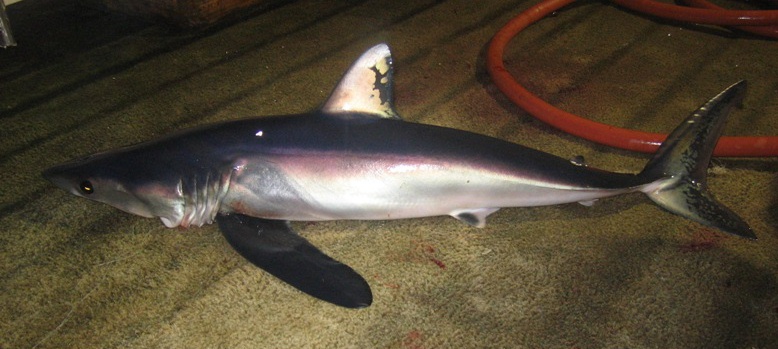


Side by side
| Carcharodon hubbelli | Longfin Mako Shark | |
|---|---|---|
| Scientific name | Carcharodon hubbelli Ehret, MacFadden, Jones, DeVries, Foster & Salas-Gismondi, 2012 | Isurus paucus Guitart, 1966 |
| English name | Not recorded | Longfin Mako Shark |
| Group | Fishes | Fishes |
| Class | Elasmobranchii | Elasmobranchii |
| Order | Lamniformes | Lamniformes |
| Family | Lamnidae Porbeagles | Lamnidae Porbeagles |
| Genus | Carcharodon Great White Shark | Isurus Mako Shark |
| Named in | 2012 | 1966 |
| Red List category | Not recorded | Endangered |
| Environment | Not recorded | marine |
| Countries on record | Not recorded | 17 countries |
| GBIF occurrence records | Not recorded | 198 records |
Rows where the two agree are shown in grey.
Where each is found
Only Longfin Mako Shark (17)
- Australia
- Brazil
- Canada
- Chile
- Colombia
- Faroe Islands
- India
- Indonesia
- Japan
- New Caledonia
- Portugal
- Reunion
- South Africa
- Sri Lanka
- Taiwan
- United Kingdom
- United States
From Catalogue of Life checklists and GBIF occurrence records. A country missing from a list means no record is held, which is not proof of absence.
Checked facts
| Carcharodon hubbelli | Longfin Mako Shark | |
|---|---|---|
| Appearance |
|
|
| Size |
|
|
| Habitat |
|
|
| Diet |
|
|
| Behaviour |
|
|
| Reproduction | No checked fact yet |
|
| Distribution |
| No checked fact yet |
| Conservation | No checked fact yet |
|
| Uses | No checked fact yet |
|
| Similar species | No checked fact yet |
|
| Other |
|
|
In brief
Carcharodon hubbelli
Carcharodon hubbelli is a fish in the family Lamnidae, order Lamniformes, and class Elasmobranchii, considered a transitional species between Carcharodon hastalis and the modern great white shark. Fossil specimens have been recovered from the Pacific Ocean region, with discoveries in Peru, Chile, California, and New Zealand. The species had triangular teeth with weak, incompletely developed serrations and reached an estimated length of approximately 4.9–5.1 metres. Full profile
Compare something else
Page built on 28 November 2026 from the data on the two species pages, where every source is listed.
Cite this page
ScientificNames.org. (2026). Carcharodon hubbelli vs Longfin Mako Shark. Retrieved November 28, 2026, from https://scientificnames.org/compare/carcharodon-hubbelli-vs-longfin-mako-shark
“Carcharodon hubbelli vs Longfin Mako Shark.” ScientificNames.org, 2026, scientificnames.org/compare/carcharodon-hubbelli-vs-longfin-mako-shark. Accessed 28 Nov. 2026.
ScientificNames.org. “Carcharodon hubbelli vs Longfin Mako Shark.” Accessed November 28, 2026. https://scientificnames.org/compare/carcharodon-hubbelli-vs-longfin-mako-shark.
@misc{scientificnames_carcharodon_hubbelli_vs_longfin_mako_shark,
  author = {{ScientificNames.org}},
  title = {Carcharodon hubbelli vs Longfin Mako Shark},
  year = {2026},
  url = {https://scientificnames.org/compare/carcharodon-hubbelli-vs-longfin-mako-shark},
  note = {Accessed 2026-11-28}
}