Comparison

Carpathian Barbel vs Common Barbel

Carpathian Barbel (Barbus carpathicus) and Common Barbel (Barbus barbus) both belong to the genus Barbus (barbs) and part ways below it. Both are recorded in 5 countries.

Carpathian Barbel

Barbus carpathicus
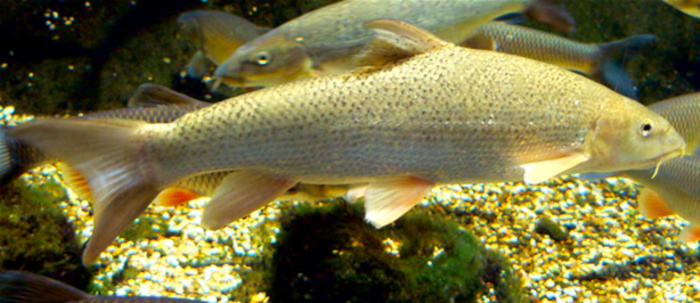
Common Barbel

Common Barbel

Barbus barbus

Neil Phillips from uk, CC BY 2.0, via Wikimedia Commons

Side by side

Carpathian BarbelCommon Barbel
Scientific nameBarbus carpathicus Kotlík, Tsigenopoulos, Ráb & Berrebi, 2002Barbus barbus (Linnaeus, 1758)
English nameCarpathian BarbelCommon Barbel
GroupFishesFishes
ClassTeleostei TeleostTeleostei Teleost
OrderCypriniformesCypriniformes
FamilyCyprinidae CarpsCyprinidae Carps
GenusBarbus BarbsBarbus Barbs
Named in20021758
Red List categoryLeast ConcernLeast Concern
Environmentfreshwaterfreshwater
Countries on record5 countries29 countries
GBIF occurrence records512 records291,548 records

Rows where the two agree are shown in grey.

Where each is found

Both recorded in 5 countries

Only Common Barbel (24)

From Catalogue of Life checklists and GBIF occurrence records. A country missing from a list means no record is held, which is not proof of absence.

Checked facts

Carpathian BarbelCommon Barbel
Appearance
  • The species has a poorly developed last unbranched dorsal-fin ray without serrations along its rear edge. English Wikipedia
  • The dorsal-fin ray has segments along its length. English Wikipedia
  • The lower lip is thick and has a central lobe. English Wikipedia
  • The species has between 8 and 11 scale rows between the lateral line and the dorsal-fin origin. English Wikipedia
  • The species has between 8 and 11 scale rows between the lateral line and the pelvic-fin origin. English Wikipedia
  • The top of the head is unmarked. English Wikipedia
  • The cheeks and operculum have very few small spots or none. English Wikipedia
  • The pelvic and pectoral fins are unspotted and have little or no pigment in their rays. English Wikipedia
  • The pelvic and pectoral fin rays lack dark barring. English Wikipedia
  • The body is largely unmarked, with indistinct dots and blotches. English Wikipedia
  • The caudal fin is either unspotted or has small spots. English Wikipedia
  • Juvenile common barbel are generally grey and mottled in appearance. English Wikipedia
  • Adult common barbel are typically dark brown, bronze or grey with a pale underside. English Wikipedia
  • The adult fish has distinctly reddish or orange-tinged fins. English Wikipedia
  • The common barbel has an asymmetrical tail with a rounded, slightly shorter lower lobe and a pointed upper lobe. English Wikipedia
  • The common barbel has a slender body, flattened underside and sloping forehead. English Wikipedia
Size
  • The Carpathian barbel belongs to a group of montane barbels described as small to medium-sized. pmc.ncbi.nlm.nih.gov
Habitat
  • The species inhabits montane streams in the northern part of the Carpathian range. pmc.ncbi.nlm.nih.gov
  • The species is restricted to montane and submontane streams and rivers. pmc.ncbi.nlm.nih.gov
  • The species inhabits premontane and montane streams and small rivers with gravel bottoms. English Wikipedia
  • The species occurs in waters with swift to moderate currents. English Wikipedia
  • During summer, the species is most common in shallow rapids and riffles. English Wikipedia
  • During winter, the species moves to deeper locations. English Wikipedia
DietNo checked fact yet
  • Diatoms covering rocks are an important food source for young common barbel. English Wikipedia
  • Larvae of non-biting midges in the family Chironomidae are particularly important foods for young common barbel. English Wikipedia
Behaviour
  • Common barbel are active fish that can travel considerable distances over short periods. English Wikipedia
  • Individual common barbel can move between 16 and 68 kilometres in a year. English Wikipedia
  • The mean daily movement of common barbel ranges from 26 to 139 metres. English Wikipedia
  • Adult common barbel commonly feed at night. English Wikipedia
  • Adult common barbel may also feed during daylight in deeper water or near bankside cover and underwater obstructions. English Wikipedia
  • Common barbel frequently form large shoals in some rivers. English Wikipedia
ReproductionNo checked fact yet
  • Male common barbel generally reach sexual maturity at three to four years of age. English Wikipedia
  • Female common barbel generally reach sexual maturity at five to eight years of age. English Wikipedia
  • Common barbel generally spawn between May and late June in most rivers. English Wikipedia
  • Male common barbel gather in shallow water to pursue mates during spawning. English Wikipedia
  • Common barbel typically migrate upstream to spawning grounds between March and May. English Wikipedia
  • Female common barbel produce between 8,000 and 12,000 eggs per kilogram of body weight. English Wikipedia
  • Common barbel deposit their fertilised eggs in shallow excavations in riverbed gravel. English Wikipedia
  • Common barbel bury their eggs beneath gravel, forming pit and tailspill structures resembling redds. English Wikipedia
  • High concentrations of fine sediment can adversely affect common barbel eggs and larvae. English Wikipedia
  • Common barbel can spawn multiple times in captivity. English Wikipedia
Distribution
  • The species occurs in the northern and central parts of the Carpathian Mountains. pmc.ncbi.nlm.nih.gov
  • The common barbel is native to northern and eastern Europe, extending from the Pyrenees and Alps to Lithuania, Russia and the northern Black Sea basin. English Wikipedia
  • The common barbel has become established as an introduced species in Scotland, Morocco and Italy. English Wikipedia
  • In England, native common barbel populations occur in east-flowing rivers between the Thames and Great Ouse. English Wikipedia
Conservation
  • The species has relatively low overall genetic variation. pmc.ncbi.nlm.nih.gov
  • Some local populations of the species are large. pmc.ncbi.nlm.nih.gov
  • The species' distribution and population demography are sensitive to environmental change. pmc.ncbi.nlm.nih.gov
  • The species experienced demographic breakdowns and expansions during the Holocene. pmc.ncbi.nlm.nih.gov
  • Genetic similarities have been identified between populations in adjacent rivers belonging to the Vistula and Dniester basins. pmc.ncbi.nlm.nih.gov
No checked fact yet
UsesNo checked fact yet
  • The common barbel is a popular sport fish throughout its geographical range. English Wikipedia
  • Common barbel have historically been targeted by anglers for their strength and stamina. English Wikipedia
Similar species
  • The Balkan barbel (Barbus balcanicus) is the closest congener of the Carpathian barbel. pmc.ncbi.nlm.nih.gov
  • The Carpathian barbel shares biological similarities with the Balkan barbel and Peteny's barbel. pmc.ncbi.nlm.nih.gov
  • The Carpathian barbel, Balkan barbel, and Peteny's barbel were historically confused as one species. pmc.ncbi.nlm.nih.gov
  • Morphological characteristics provide limited help in distinguishing the Carpathian barbel from the Danube barbel and Romanian barbel in the field. English Wikipedia
  • The species is mainly differentiated from the Danube barbel and Romanian barbel through mitochondrial DNA. English Wikipedia
No checked fact yet
Other
  • The species was formally described in 2007 by Petr Kotlík, Constantinos S. Tsigenopoulos, Petr Ráb, and Patrick Berrebi. English Wikipedia

In brief

Carpathian Barbel

The Carpathian Barbel (Barbus carpathicus Kotlík, Tsigenopoulos, Ráb & Berrebi, 2002) is a fish in the family Cyprinidae, order Cypriniformes, and class Teleostei. It inhabits montane and submontane streams and rivers in the Carpathian Mountains. It has a thick lower lip with a central lobe and a poorly developed dorsal-fin ray without serrations along its rear edge. Full profile

Common Barbel

Barbus barbus is predominantly a river-dwelling fish that favours fast-flowing rivers with gravel or stone bottoms. Adults typically have dark brown, bronze or grey colouring, a pale underside and reddish or orange-tinged fins. Full profile

Compare something else

Page built on 29 November 2026 from the data on the two species pages, where every source is listed.

Cite this page

ScientificNames.org. (2026). Carpathian Barbel vs Common Barbel. Retrieved November 29, 2026, from https://scientificnames.org/compare/carpathian-barbel-vs-common-barbel