Comparison

Hermit Thrush vs Black-headed Nightingale-thrush

Hermit Thrush (Catharus guttatus) and Black-headed Nightingale-thrush (Catharus mexicanus) both belong to the genus Catharus (american thrushes) and part ways below it. Both are recorded in 4 countries.

Hermit Thrush

Hermit Thrush

Catharus guttatus

Rhododendrites, CC BY-SA 4.0, via Wikimedia Commons

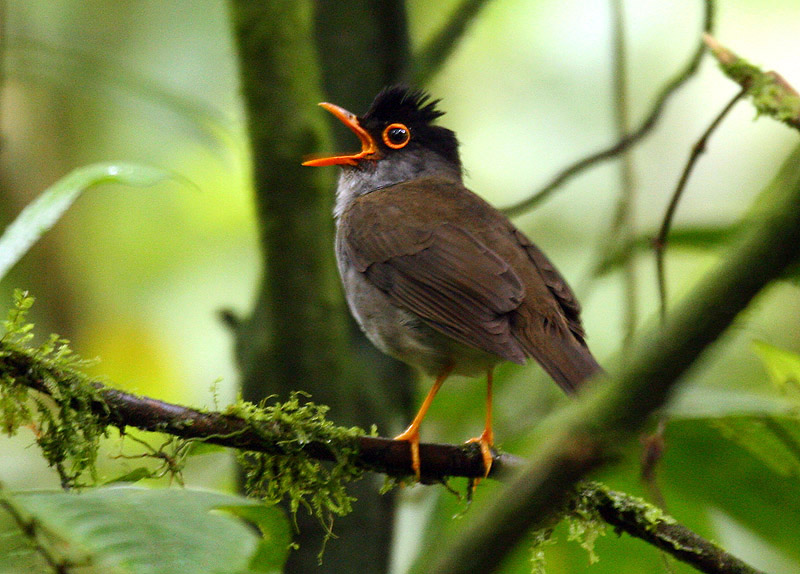
Black-headed Nightingale-thrush

Black-headed Nightingale-thrush

Catharus mexicanus

Michael Woodruff, CC BY-SA 2.0, via Wikimedia Commons

Side by side

Hermit ThrushBlack-headed Nightingale-thrush
Scientific nameCatharus guttatus (Pallas, 1811)Catharus mexicanus (Bonaparte, 1856)
English nameHermit ThrushBlack-headed Nightingale-thrush
GroupBirdsBirds
ClassAves BirdAves Bird
OrderPasseriformes PasserinePasseriformes Passerine
FamilyTurdidae ThrushTurdidae Thrush
GenusCatharus American ThrushesCatharus American Thrushes
Named in18111856
Red List categoryLeast ConcernLeast Concern
Environmentterrestrialterrestrial
Countries on record12 countries7 countries
GBIF occurrence records3,245,162 records19,671 records

Rows where the two agree are shown in grey.

Where each is found

Both recorded in 4 countries

Only Hermit Thrush (8)

Only Black-headed Nightingale-thrush (3)

From Catalogue of Life checklists and GBIF occurrence records. A country missing from a list means no record is held, which is not proof of absence.

Checked facts

Hermit ThrushBlack-headed Nightingale-thrush
Appearance
  • Adult Hermit Thrushes have predominantly brown upperparts, reddish tails, white underparts marked with dark breast spots, grey or brownish flanks, pink legs, and white eye rings. English Wikipedia
  • Eastern populations have more olive-brown upperparts, whereas western populations have more grey-brown upperparts. English Wikipedia
  • The species has a characteristic white-dark-white pattern on the underside of its wings. English Wikipedia
  • Adult males of the nominate subspecies have a black crown, dark gray face, bright orange eye-ring, and olive-brown upperparts. English Wikipedia
  • Adult males have a white throat with faint dark streaks, pale grayish brown breast and flanks, and a white belly and vent. English Wikipedia
  • Adult females have a browner head and breast than adult males. English Wikipedia
  • All subspecies have bright orange bills, legs, and feet. English Wikipedia
  • The species has a plain breast. ebird.org
  • The C. m. cantator subspecies has a grayer face and throat and an olive wash on its breast compared with the nominate subspecies. English Wikipedia
  • The C. m. yaegeri subspecies has a pronounced reddish wash on its back. English Wikipedia
  • The C. m. carrikeri subspecies has dark reddish upperparts and the darkest gray underparts among the subspecies. English Wikipedia
Size
Habitat
  • The species primarily inhabits lowland and montane evergreen forests in tropical and subtropical zones. English Wikipedia
  • The species also occurs in pine-oak forests in Guatemala and Honduras. English Wikipedia
  • The species inhabits evergreen forests in foothills and highlands. ebird.org
  • One reported elevational range for the species is 600–1,800 m. English Wikipedia
  • In Guatemala and Honduras, the reported elevational range is 750–1,800 m. English Wikipedia
  • In Costa Rica, the species occurs at elevations of 300–1,000 m on the Caribbean slope. English Wikipedia
  • In Costa Rica, the species occurs at elevations of 700–1,300 m on the Pacific slope. English Wikipedia
Diet
  • The Hermit Thrush primarily consumes insects and berries. English Wikipedia
  • The species shifts from a diet consisting mainly of arthropods to a winter diet supplemented substantially with fruits. usgs.gov
Behaviour
  • The species searches for food on forest floors and among trees and shrubs. English Wikipedia
  • Hermit Thrushes frequently sing from elevated, open locations. English Wikipedia
  • Its song consists of an introductory note followed by several descending musical phrases in a minor key, repeated at different pitches. English Wikipedia
  • The species forages in the forest understory and on the ground by turning over leaf litter. English Wikipedia
  • The species is usually elusive and is heard more frequently than it is seen. ebird.org
  • The species is mostly resident throughout the year. English Wikipedia
  • Individuals in the northernmost part of the range show evidence of moving south during winter. English Wikipedia
  • Elevational movements have been recorded in Veracruz. English Wikipedia
  • The species sings mainly at dawn, dusk, and during the afternoon. English Wikipedia
  • The species produces a rapid, thin, flute-like song with slightly tinny and fuzzy phrases. English Wikipedia
  • The species gives harsh, complaining, upward-slurred calls. English Wikipedia
  • The species produces a dry rattle or trill when agitated. English Wikipedia
  • The species behaves aggressively toward ruddy-capped nightingale-thrushes. English Wikipedia
Reproduction
  • The breeding season includes April and May in Mexico. English Wikipedia
  • The breeding season extends from March through July in Costa Rica. English Wikipedia
  • The species constructs a large cup-shaped nest from mosses, bark strips, and rootlets, lined with finer plant material. English Wikipedia
  • The nest is typically placed in an understory plant fork approximately 1–3 m above the ground. English Wikipedia
  • The species often places its nest near a stream. English Wikipedia
  • The clutch contains two or three eggs. English Wikipedia
  • The eggs range from pinkish white to bluish white and have reddish-brown speckles. English Wikipedia
Distribution
  • The breeding range includes Canada, southern Alaska, and the northeastern and western United States. English Wikipedia
  • Most individuals migrate to wintering grounds in the southern United States and Central America. English Wikipedia
  • Some individuals remain during winter in northern coastal US states and southern Ontario. English Wikipedia
  • The Hermit Thrush occurs as a very rare vagrant in western Europe and northeast Asia. English Wikipedia
  • The species occurs in Costa Rica, Guatemala, Honduras, Mexico, Nicaragua, and Panama. English Wikipedia
  • The species has been recorded as a vagrant in Texas. English Wikipedia
  • An individual of the nominate subspecies spent much of 2004 in Hidalgo County, Texas. English Wikipedia
ConservationNo checked fact yet
  • The species is classified as Least Concern by the IUCN. English Wikipedia
  • The species has a large geographic range, although its population size is unknown and believed to be decreasing. English Wikipedia
  • No immediate threats have been identified for the species. English Wikipedia
  • The species is considered common in Oaxaca and locally fairly common in Panama. English Wikipedia
  • The species is rare and local in Guatemala but common in Honduras. English Wikipedia
  • The species is common on Costa Rica's Caribbean slope and uncommon on its Pacific slope. English Wikipedia
Similar species
  • The Hermit Thrush is more closely related to the Mexican russet nightingale-thrush than to other North American migratory Catharus species. English Wikipedia
  • During winter in North America, the Hermit Thrush is normally the only spotted thrush species present. English Wikipedia
No checked fact yet
Other
  • Analysis of the species' song indicates that its notes are related through harmonic simple integer pitch ratios. English Wikipedia
No checked fact yet

In brief

Hermit Thrush

Catharus guttatus breeds in Canada, southern Alaska, and the northeastern and western United States, and most individuals migrate to the southern United States and Central America for winter. It is distinguished by its reddish tail, spotted breast, white eye rings, and characteristic white-dark-white pattern on the underside of its wings. Full profile

Black-headed Nightingale-thrush

Catharus mexicanus occurs in Costa Rica, Guatemala, Honduras, Mexico, Nicaragua, and Panama, primarily inhabiting lowland and montane evergreen forests. It has bright orange bills, legs, and feet, and measures 15–16.5 cm in length. Full profile

Compare something else

Page built on 27 November 2026 from the data on the two species pages, where every source is listed.

Cite this page

ScientificNames.org. (2026). Hermit Thrush vs Black-headed Nightingale-thrush. Retrieved November 27, 2026, from https://scientificnames.org/compare/hermit-thrush-vs-black-headed-nightingale-thrush